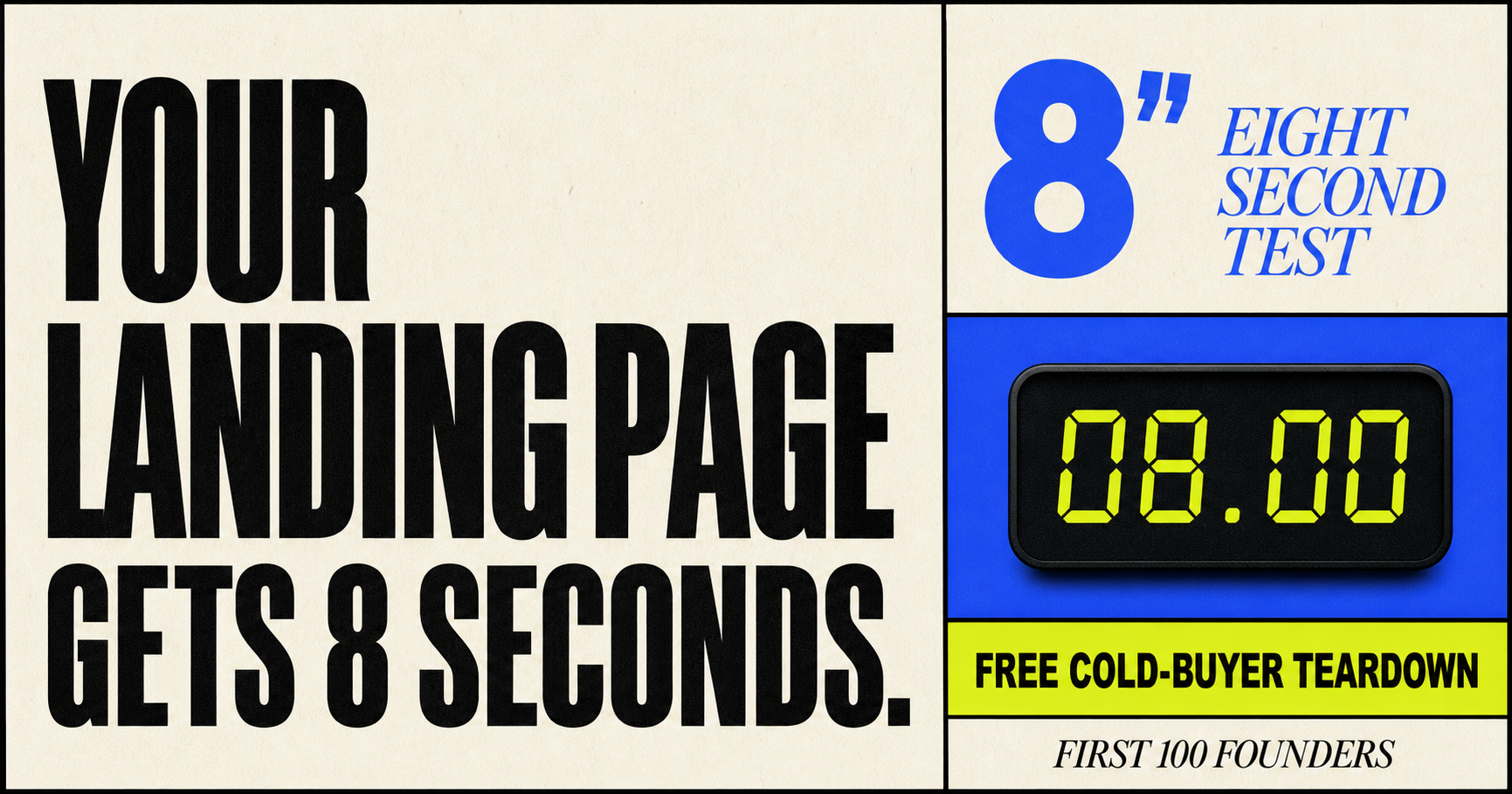
Your landing page gets eight seconds
Founders are unusually bad cold visitors. They know the product history, the edge cases, the roadmap, and why every sentence ended up on the page. A new visitor has none of that context. They arrive with a question, a half-formed comparison set, and very little patience.
A useful first-impression audit asks whether the page does three jobs quickly: explain the message, reveal the next action, and earn enough trust for that action to feel reasonable.
1. Message: can a stranger name the offer?
Read only the headline and subhead. Hide the logo and navigation if you can. Then ask: could this copy plausibly belong to five unrelated products?
If the answer is yes, the message is probably atmospheric rather than informative. Strong first-screen copy usually makes at least two of these three things concrete:
- the category or mechanism;
- the audience or situation;
- the outcome or job being done.
This does not require a long headline. It requires useful nouns and verbs. “Move faster with confidence” sounds pleasant, but it forces the visitor to supply the missing meaning. “Review landing-page clarity before you buy traffic” gives the visitor something they can actually classify.
Quick message check
After eight seconds, close the page and write one sentence describing the product. If that sentence is difficult to produce—or wildly different from what the company sells—the page has a comprehension problem before it has a persuasion problem.
2. Action: is the next step obvious and proportionate?
A visible button is not automatically a clear call to action. The visitor needs to understand what happens after the click and why that step makes sense now.
Look for one primary action in the first screen. Secondary links can exist, but they should not make the visitor solve a menu of equally loud choices. Button copy such as “Get started” becomes clearer when nearby text explains whether the result is a demo, an account, a report, a download, or a purchase.
The size of the ask should also match the trust already earned. A cold visitor may happily run a free diagnostic but resist booking a sales call before seeing the product. Lowering commitment can be more effective than making the button brighter.
Quick action check
Cover every button label and try to predict the intended next step from the surrounding copy. Then uncover the labels. If the intended action changes or remains vague, the page is leaning on interface convention instead of communicating intent.
3. Trust: is there a reason to believe the promise?
Trust is not a strip of grayscale logos at the bottom of the page. It is evidence placed near the claim it supports.
Useful evidence includes:
- a specific outcome with enough context to interpret it;
- a product screenshot or example that proves the mechanism exists;
- a customer quotation that describes a before-and-after;
- a clear explanation of limits, privacy, pricing, or risk;
- an observable way to try the product before making a larger commitment.
Generic superlatives do not create the same effect. “Powerful,” “seamless,” and “best-in-class” are claims without a verification path. Specificity gives the visitor something to inspect.
Quick trust check
Circle every major promise, then draw a line to the closest supporting evidence. Claims with no line are candidates for proof, qualification, or removal.
What this audit cannot tell you
A copy scan is a first-pass signal, not a conversion forecast. It cannot tell you whether the traffic is qualified, whether the offer is wanted, or why a real customer hesitates. Interviews, usability tests, funnel data, and experiments answer those questions.
What a fast audit can do is identify avoidable friction before you spend more attention or money sending people to the page.
Run a neutral first pass
Eight Second Test reads a public landing-page URL for message clarity, CTA clarity, and visible trust signals. It returns a score and three findings. There is no signup, email, card, or login.
Run the free eight-second check
Use the result as a prompt for a sharper review—not as a substitute for listening to customers.