

CONTENTS
Editorial Note XI
Preface 1
1 The Dark Age 7
2 The Opposition Between East and West 21
3 Knowledge and Action 33
4 Sacred and Profane Science 42
5 Individualism 55
6 The Social Chaos 69
7 A Material Civilization 81
8 Western Encroachment 97
9 Some Conclusions 107
Index 119
Author Background
René Guénon was born in 1886. He was raised in a Roman Catholic family while his father was an architect. He was a remarkable student and as a relatively young man was deeply interested in esoteric and occult matters of the spirit and mind. For a short time , he studied mathematics and philosophy in Paris. He also sojourned in various mystical and occult circles, including freemasonry, in the freak climate of early 20th-century France. Unimpressed with the intellectual environment in these circles, and having a will toward assembling, from the Traditional sources and doctrines, a "stable edifice" in a decrepit modernity, he kept moving. He wrote for some journals.
He was initiated into Sufism at the age of 24, and, after leaving the army in 1917 due to his persistent health issues, he took a gig teaching college-level philosophy in Algeria. It was here, as the story goes, that he was initiated into Eastern Taoism with a direct line to a Vietnamese monk known as the Master Of Sentences - very interesting considering that from my perspective, he did become a profound "master of sentences" himself.
Eventually he decided to write fulltime and moved back to France .

Back in his home country rapidly degenerating post-rev France, and throughout the 1920's, he wrote a number of books which brought him to the attention of the intellectual and religious classes on an international level. Some praised his writing as instant "classic" status, and others, particularly from the Catholic quarter, criticized and rejected his ideas. The Crisis of the Modern World was published in 1927.
Prompted and encouraged by others, he even established a Masonic Lodge based on exclusively Traditionalist ideals, wishing to jettison the syncretic hubris which plagued the lodges he traversed in his more youthful explorations. Apparently the lodge exists to this day.

Guénon eventually moved to and settled in Cairo. He married and had four children. The family lived in a villa near the base of the pyramids. He spent his days engaging with friends, praying and working. He passed in 1951 after uttering his last word, "Allah" .
His influence is really incalculable as he is credited with being the intellectual and spiritual light under which other great Traditionalist writers like Frithjof Schuon , Ananda Coomaraswamy and even Julius Evola continued to develop and carry the torch. Even Steven Bannon's (yes, THAT one) political sensibilities are steeped in some of these writings. You could say that the resurgence of Traditional values and the "rightist" pushback during the last decade in American Politics can be traced right back to Guénon - something he himself would surely scoff at and disavow.
Nonetheless...
The Crisis of the Modern World
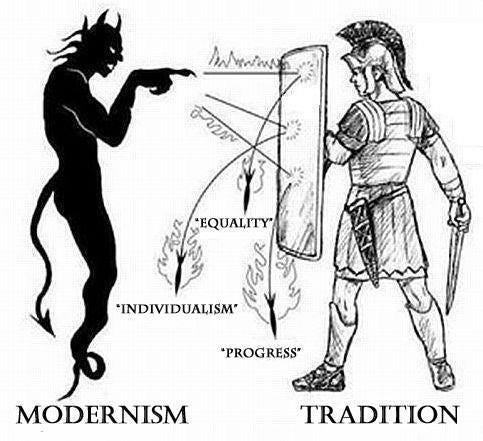
A foundational text in what became known as the Traditionalist school , Guénon’s Crisis lays bare every aspect of the false and satanically inverted “cosmology” of modernity.
In just over a hundred pages , he succeeds in slaughtering a majority of the philosophical and metaphysical errors that lay at the root of the modern malaise . Think humanism is good ? Think again. Renaissance as regression - check. From the mental masturbations of so-called evolution and it’s bastard child progress to the anti-cultural black hole of individualism and crass materialism, which both idolize quantity over quality, reading and UNDERSTANDING Guénon is the ultimate cold shower for our long season in hell.
On humanism:
A word that rose to honor at the time of the Renaissance, and that summarized in advance the whole program of modern civilization is ‘humanism’. Men were indeed concerned to reduce everything to purely human proportions, to eliminate every principle of a higher order, and, one might say, symbolically to turn away from the heavens under pretext of conquering the earth; the Greeks, whose example they claimed to follow, had never gone as far in this direction, even at the time of their greatest intellectual decadence, and with them utilitarian considerations had at least never claimed the first place, as they were very soon to do with the moderns. Humanism was the first form of what has subsequently become contemporary secularism; and, owing to its desire to reduce everything to the measure of man as an end in himself, modern civilization has sunk stage by stage until it has reached the level of the lowest elements in man and aims at little more than satisfying the needs inherent in the material side of his nature, an aim that is in any case quite illusory since it constantly creates more artificial needs than it can satisfy.
Elsewhere he points out the curiously apparent corollary between Darwin's evolution of species and the traditional Great Chain of Being:

What else does the Master Of Sentences have to say ?
On the current year:
The Hindu doctrine teaches that a human cycle, to which it gives the name Manvantara, is divided into four periods marking so many stages during which the primordial spirituality becomes gradually more and more obscured; these are the same periods that the ancient traditions of the West called the Golden, Silver, Bronze, and Iron Ages. We are now in the fourth age, the Kali-Yuga or ‘dark age’, and have been so already, it is said, for more than six thousand years, that is to say since a time far earlier than any known to ‘classical’ history. Since that time, the truths which were formerly within reach of all have become more and more hidden and inaccessible; those who possess them grow fewer and fewer, and although the treasure of ‘nonhuman’ (that is, supra-human) wisdom that was prior to all the ages can never be lost, it nevertheless becomes enveloped in more and more impenetrable veils, which hide it from men’s sight and make it extremely difficult to discover. This is why we find everywhere, under various symbols, the same theme of something that has been lost— at least to all appearances and as far as the outer world is concerned— and that those who aspire to true knowledge must rediscover; but it is also said that what is thus hidden will become visible again at the end of the cycle, which, because of the continuity binding all things together, will coincide with the beginning of a new cycle.
It will doubtless be asked why cyclic development must proceed in this manner, in a downward direction, from higher to lower, a course that will at once be perceived to be a complete antithesis to the idea of progress as the moderns understand it. The reason is that the development of any manifestation necessarily implies a gradually increasing distance from the principle from which it proceeds; starting from the highest point, it tends necessarily downward, and, as with heavy bodies, the speed of its motion increases continuously until finally it reaches a point at which it is stopped. This fall could be described as a progressive materialization, for the expression of the principle is pure spirituality; we say the expression and not the principle itself, for the latter, being beyond all oppositions, cannot be described by any term appearing to suggest an opposite. Moreover, words such as ‘spirit’ and ‘matter’, which we borrow here from Western terminology for the sake of convenience, have for us little more than a symbolical value; in any case, they can be made to fit the question in hand only on condition that we exclude the special interpretations given them by modern philosophy, whose ‘spiritualism’ and ‘materialism’ are, in our eyes, only two complementary forms that imply each other and are both negligible for anyone who wishes to go beyond these contingent points of view. However, since it is not of pure metaphysics that we propose to treat here, if all due precautions are taken to avoid ambiguity, and if the essential principles are never lost from sight, we may accept the use of terms that, although inadequate, nevertheless serve to make things more easily understandable, so long, of course, as this can be done without distorting what is to be understood.
If you, reader , are one of the lucky few who have had the experiential confirmation of an ultimate spiritual reality, but perhaps lack, as is all too common today, the language to articulate or defend the experience, even if only from your own internal demons, then this book is for you. What you read here will fortify your 'intellection' and confirm what you already know. It will silence those demons.
If you are not of that particular group , yet have an honest disposition and some grit , this book WILL change the way you view the world. And as the man who introduced me to this writer so long ago said:
“If you don’t get it , the problem is in YOU.”
Indeed…
Read the book for free: The Crisis Of The Modern World - Rene Guenon