

What is real-world technological disruption?
Anyone alive in the 21st century is witnessing digital disruption first-hand. We have seen successive waves of digital innovation, with a new fundamental disruption occurring roughly every ~5-10 years:
- Personal computing and the Web in the 90's
- The broadband revolution in the early 00's
- Smartphones in the late 00's
- The social media boom of the 2010's
- Videoconferencing and virtual work in response to 2020's pandemic
- AI now in the mid-2020's
All of these were mass technological shifts that affected how billions of human beings lived, worked, played and (in democratic nations at least) voted.
However, these are almost exclusively advancements made in the digital world rather than the *physical *one. A time traveler from the 50 years ago (the year 1976) would see that many of the physical realities of our daily existence have remained essentially the same... how we feed, clothe and house ourselves, the power we used to turn the lights on, the fuel we use for transportation, and the forms and structures of our medical care. In contrast our time traveler from 1976 would have lived in a world for the previous 50 years had seen:
- The birth of Fission (nuclear) energy
- The commercialization of the automobile and the jetplane
- The invention and mass commercialization of plastics
- Private-sector innovations in the transistor, the laser & etc
- The Green Revolution and the industrialization of food production
- Medical miracles like the polio vaccine
These advancements, in the real world of atoms not bits, constituted truly "disruptive" changes to human society in that they affected how billions of human beings lived. Arguably, while technological progress has continued on a predictable, plodding pace -- medical progress trundles along, Moore's law continues to shakily hold up -- nothing as disruptive as any of these advancements has come to pass in the 21st century. When we think of "innovation" in 2026, we still largely refer to software products coming out of Silicon Valley, more than things you can physically hold, feel, or that sustain life.
In fact, it's arguable that many of these incredible advancements for humanity have been slowly walked back in the decades since our 1976 time traveler arrived. Nuclear energy has been stymied by decades of NIMBYism and environmental paranoia in developed nations, and its deployment in the Global South has been halted by aggressive anti-proliferation regimes. Vaccines of all types have faced pushback from a similar scientific ignorance, and the naive pastoralism of "let's all just eat non-GMO organic foods" ignores the fact that these methods will never be able to serve a global population in the billions.
So, what happened? ... Or to paraphrase Peter Thiel:
Where's my flying car?
"We were promised flying cars, we got 120 characters." -- Peter Thiel
While it must be stated that flying cars are massively impractical as real solutions for urban transportation for many reasons, the sentiment clearly expresses the idea that while digital technologies have advanced rapidly in our lifetime, physical technologies seem to have stubbornly lagged behind our expectations of what a "21st century" future looks like.
What's behind this? I believe that you have to start at the source of all true innovation, and that's Science. While there are some exceptions, I'm a firm believer in the so-called "linear model" of progress. Scientific innovation leads to applied research, which then allows for commercial development. All of the 20th century advancements described above followed more or less something like this model.
For this to work, the "top of the funnel" -- early-stage scientific research -- needs to be very free to pursue the kinds of ideas that could very well lead to "dead ends", but could also translate into huge advancements. So, is this happening?
Who exactly are scientists and what do they do?
When we think about "scientists", i.e. the kinds of people who work in actual labs with actual scientific instruments to test novel ideas and hypotheses, who are we talking about?
In this framing, we're predominantly talking about three distinct job titles that make up Academic Science: Professors, postdoctoral researchers, and graduate students at top-tier (R1) universities. It is to these workers that Western society has largely outsourced the task of Discovery Science, with the implicit (if not explicit) expectation that the $billions spent on them each year will produce economically useful innovation for their respective nations.
As an aside: Lots of other people call themselves "scientists", either legitimately or illegitimately. If you'll forgive the hot take, most "data scientists" are glorified analysts who have spent the past 10 years aiding and enabling the enshittification of Silicon Valley tech products. And while it's true that there are many (titled) Scientists in the Biotech and Semiconductor R&D pipeline, most of what they're working on is IP that was licensed from some academic lab 10 years ago. This is still difficult knowledge work, but it's generally not "novel" because Wall Street can't tolerate the kind of risk that comes from early-stage research.
So we're back to the Academic Scientist who, despite being ostensibly free to pursue any "blue sky" idea they please, doesn't seem any closer to giving us free clean energy or a cure for cancer than they were at the dawn of the 21st century. To quote the vernacular, still no "flying car."
How it Should Work
So what gives? I would argue a "healthy" approach to research innovation looks something like this funnel/pyramid model:
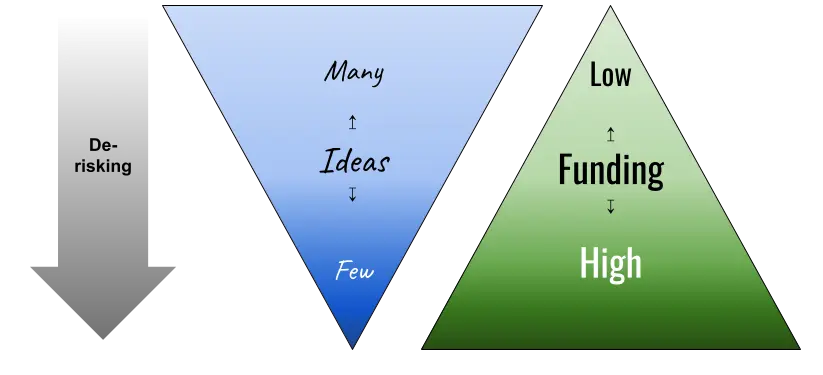
The "idea funnel" starts wide at the top. This is where "blue-sky" innovation happens. All ideas are good ideas, and even crazy ideas need to be at least considered, discussed, remixed, & etc. At this stage, a proper funding apparatus would obviously not give every crackpot $1 million and their own lab to play with -- but there should be some way to make small grants to explore and/or vet unconventional ideas.
Conversely, at the bottom of the funnel, ideas have been reasonably tested, vetted and de-risked. Papers have been published, and the basic scientific facts have been established. At this stage, more funding will naturally become "concentrated" on these proven approaches. This isn't necessarily a bug, but a feature -- assuming the other parts of the ecosystem are intact.
How it Actually Works
Unfortunately there's a large blockage at the "top of the funnel", and to understand what it is we need to understand the incentives of the actors in the system -- the professors, graduate students, and postdocs. All three of these actors, and particularly the grad students and postdocs, are strongly incentivized to ask a fundamental question for each and every endeavor to which they devote their time and attention. This question is:
"Can I get a high-impact publication from this work?"
If the answer is "no", it probably isn't going to happen.
Graduate students make "poverty" wages, by design. Like college athletes, STEM graduate students are a sort of "Frankenstein's monster" vocational merger of the pedagogical and the practical. They are the ones expected to do the labor for which the rest of the university system financially benefits, while receiving a pittance in return because they're technically "students" receiving an education, not "workers" doing a job.
A Grad student's only way out of this situation (short of dropping out) is to publish, at least their own thesis, but hopefully high-impact publication(s) to help the next stages of their career. While many grad students can (and I certainly did) "fuck around" for a few years trying many different things before settling down on a distinct research theme, this is increasingly uncommon and difficult as external pressures in the system mount.
Postdocs perhaps are in the worst situation; they're making lower-middle-class salaries, but are expected to produce multiple high-impact papers to impress a faculty hiring panel in the span of a year or two. They have no time to "fuck around." Finally, professors (if tenured) have a job for life so can in principle afford marginally more risk; however, in practice, any concern about the career needs of their students and postdocs as well as the parallel demands of a competitive funding environment means that "publish or perish" subsumes them like everyone else.
So, guess what this environment does for high-risk ideas?

That's right, lops the top right off. Now, there is a maximum risk that workers in the system are willing to tolerate, and that's "can I publish from this?" Guess what you can't publish: negative results, i.e. "I tried this and it didn't work." Good luck getting that into Nature!
But if you're doing real innovation, most of what you try shouldn't work. This is the standard venture capitalist model, where it's expected that 99%+ of companies fail, but the few that succeed have 100X+ returns that make up for everything else. You'd think this would be the case in science, but it's not. Projects failing mean grad students don't graduate, postdocs don't publish and professors don't get grants. Everything is stacked against this outcome, and as a result, all projects are carefully vetted for "publishability."
What's the solution?
Yeah... I'm not sure, but I have some ideas.
Bell Labs' success in the mid-20th century is frequently discussed. The dominant narrative among many historians of science is that Bell Labs succeeded because of the unvarnished freedom granted to researchers, but this is only partially true. While it's true that Bell Labs researchers had wide latitude on what they could pursue, everything tied back to some kind of commercial application.
Scientists at Bell Labs weren't proposing to build giant particle accelerators the size of cities or complex space telescopes, because they knew that these endeavors, while laudatory for our fundamental understanding of the universe, had little chance of become economically useful technologies for humanity. Instead, what they worked on were technologies that were more or less "garage" scale, or things that could presumably be mass-produced and sold some day. The transistor from Bell Labs, the laser from Hughes Research Lab, and the computer mouse from Xerox PARC are all examples of this line of thinking: Blue sky ideas but laboratory-scale physical science with at least the prospect of commercial viability.
And I think this is precisely what's missing. We need the "garage" inventor/scientist to make a comeback, but perhaps more importantly, we need some kind of transitional phase of the innovation lifecycle between garage research and the full academic lab treatment. In other words, something to fill in the top of the innovation funnel in a way that the current Academic Science cannot.
This is what I'll discuss in a future essay.
**Cover Image Credit **-- Recapping ‘The Jetsons’: Episode 03 – The Space Car