

I first encountered bitcoin approximately two years ago. Prior to that, my understanding of economics was limited to introductory courses I had taken at university. Much like my fellow peers, I found myself lost in the complexity of the mathematical models, leading me to accept the notion that if the math added up, the logic must naturally follow. However, my perspective underwent a significant shift towards the end of 2020 when a friend introduced me to bitcoin by recommending Lex Friedman's podcast with Safedean Amous and, like so many others before me, I fell deep down the rabbit hole. Since that moment, I have immersed myself in countless hours of content, including news articles, books, and podcasts, delving into every facet of bitcoin, from its digital security and mining to wealth management tools and Austrian monetary theory.
The challenge, however, lies in distilling this wealth of information into a format that resonates with individuals who, much like myself in 2020, are not yet deeply engrossed in the subject matter. If you've ever encountered a similar struggle of summarizing and organizing complex thoughts, then this is for you.
This paper presents a clear and strategic approach to reaching individuals who are less informed about bitcoin, often referred to as "Normies." This approach is encapsulated in what we call the "Orange Pill" methodology. For the purposes of this paper, a "Normie" is defined as someone who exhibits the following characteristics:
- They are unfamiliar with the concept of 'fiat money' and lack an understanding of how government-issued currency is created, beyond the term 'money printing.'
- Their knowledge of monetary history is limited, if existent at all.
- While they may have heard of bitcoin, their knowledge typically doesn't extend beyond recognizing it as digital currency. They may have encountered common criticisms, such as concerns about money laundering and the environmental impact of mining.
We will also assume that you, the reader, possess the following characteristics:
- You have recently become interested in bitcoin, likely within the past few years.
- You have extensively consumed a wide range of content related to bitcoin and Austrian economics, including books and podcasts.
- You have dabbled in the art of 'orange pilling,' but you may find it challenging to effectively convey your point when discussing bitcoin with others, often resorting to rambling and non-sequential arguments rather than delivering precise and compelling explanations.
From these considerations, we arrive at a practical blueprint. Here is my guidance for a young enthusiast seeking to promote the understanding of the inevitable. I recommend following these steps:
Diagnose the Problem:
- Learn what inflation actually is and where it comes from whilst outlining why central banks are illequipped to dealing with the issue. Identify the Properties of the Solution:
- Clearly define why these issues are solved by fixing the money. Noting the charactistics of sounds money that would create financial equality
Link these Properties to bitcoin: Form a strong connection between the identified properties and how bitcoin embodies them. Use concrete examples and relatable explanations to illustrate how bitcoin addresses the problems you've diagnosed.
From my perspective, initiating an "orange pill" moment hinges on people developing a profound aversion to inflation. They should gain an understanding of its origins, who it favours, who it hinders, and who it empowers. If ordinary individuals took the time to contemplate the implications of inflation, it might well lead to widespread unrest. Are we to believe that the money we've earned through our hard work or by offering goods and services to others is gradually losing its value while sitting in our bank accounts, all because unelected officials can create more of it at their discretion? How can such a system be considered equitable?
Theoretically, the initial step in administering the orange pill appears straightforward, but in practice, it's undeniably challenging. The key is to bring people into alignment regarding the concept of inflation. Anyone who earns an income, pays taxes, or possesses any form of financial independence is currently experiencing the pinch of rising prices. We are all too familiar with the sensation of squinting at price tags in the grocery store or at the fuel pump. As bitcoin proponents, we comprehend that characterizing the past two years as simply 'prices going up' is an incomplete and factually inaccurate perspective. Those of us in the bitcoin community recognise that it's the value of our currency that is deliberately diminishing, a situation outrageously engineered to unfold.
We Should Despise Inflation:
My initial question to people usually takes the form of, "Don't you detest inflation? Doesn't it infuriate you to pay over $8 for a carton of eggs or $2 per litre for fuel? Doesn't this bother you?" Unless they happen to be Larry Fink, I would assume their answer is no. However, if people remain indifferent or consider it an inevitable facet of life, I follow up with the following argument, often framed in terms of morality. The depth to which you delve into this topic can vary, but the central theme should revolve around addressing the question of who is most adversely affected during inflationary periods. The unequivocal answer is that lower and working-class individuals bear the brunt of it. In the words of the late George Carlin, "It's a big club, and you ain't in it." We're not merely referring to recent years, but rather to every inflationary bubble dating back to the 1920s, 1940s, 1970s, 2000s, and beyond. In each instance, the wealth gap between the top 1% and the bottom 90% has expanded.
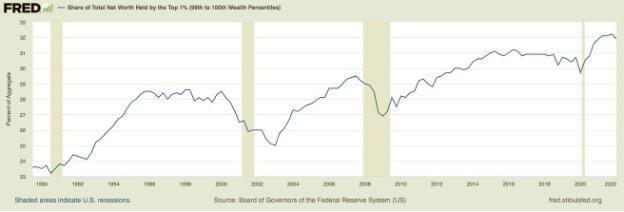 The increase in wealth from the top 1%. Notice how the increase is always after a recession
Those fortunate enough to have purchased homes with regular incomes from the 1970s to even the mid-2000s are now sitting on what seems like multi-generational wealth, which is at the detriment of the next generation. This is where the concepts of hard and soft assets become relevant.
In simple terms, capital tends to flow towards assets that are the most challenging to create, such as houses, fine art, and jewellery. The price of an asset above its utility value is what’s called the monetary premium as people are looking at it as a store of value. Real estate has been an ever growing source of wealth over the past 50 years meaning that it’s monetary value has grown substantially over that time. To help your friends grasp this concept, you might ask them why a low-cost watch loses value while a Rolex appreciates over time.
The undeniable truth is that inflation primarily benefits individuals who possess hard assets like real estate, jewelry, and stocks, often at the expense of those who do not. The wealth gap widens due to a self-reinforcing inflation cycle: If you already own hard assets, their value increases and you become even wealthier; if you don't, you find yourself further priced out of the market as inflation raises asset prices through credit bubbles. People need to recognise this phenomenon.
What makes inflation particularly insidious is that it doesn't affect everyone uniformly or randomly. The crucial point to emphasize is that inflation disproportionately advantages individuals with existing wealth while placing an added burden on those with lower incomes. This perpetuates the wealth gap.
Years it takes to save for a house, arrow points to when President Nixon closed the gold exchange window in 1971

Cause and Effect
So, we've identified inflation as the problem, but now let's delve into why it's happening. Starting with a straightforward question like, "What do you think has caused inflation over the past two years?" may lead the conversation in different directions. However, it's likely that you'll encounter two main types of answers:
a) Supply chain disruptions due to factors like wars or the pandemic.
b) Price gouging by corporations.
The first type of answer relates to a supply shock.
While such shocks are relatively common in our globalised economy, they don't fully explain the consistent month-on-month price increases we've witnessed over the past 24 months. Supply shocks essentially result from a temporary mismatch between supply and demand. When supply chains are severely affected, as they were during the war and pandemic, especially in critical areas like grain, oil, and natural gas, the interconnected global economy feels the strain.
Short-term price inflation due to unforeseen natural events is inevitable and is akin to speed bumps on the road of economic progress. What's important to note is that the free market is best suited to address these issues. As Saifedean Amous explains in "The bitcoin Standard," an increase in the price of a particular good incentivizes producers to increase production, thereby lowering prices back to equilibrium. The key point to emphasize here is that the war in Ukraine, for example, isn't the primary reason why the three-bedroom home your parents bought for $150,000 in 1980 is now comfortably valued at over $1.5 million.
The discussion regarding option B is relatively straightforward. During my time as an accountant, I experienced a disruption one morning when the workers' union gathered outside our building, demanding better pay. While not an unfair or novel protest topic, I went downstairs to listen to the local union representative. He claimed, "The inflation we've felt over the past year is caused by greedy companies and corporate fat cats price-gouging regular Australians." Additionally, I've come across claims in newspaper articles and the general news suggesting that the increase in corporate profits has contributed to 30-40% of the inflation over the last year.
In my view, responding to this argument requires little more than a moment's reflection. Were these corporations equally greedy in 2019? Why didn't we see double-digit inflation and widespread price-gouging four years ago? If corporations exist primarily to maximize profits, why is this happening now? These questions essentially answer themselves and strongly suggest that inflation is not primarily caused by big businesses but is rather leveraged by them. While it's true that major corporations may use inflation as an excuse to raise prices to the detriment of everyone else, this argument misses the point. Essentially, it concedes that the source of inflation lies further upstream.
From this point, we're on our way. Remember, we're not delving too deeply just yet. Based on my personal experiences, I've found myself stuck by trying to condense everything I've learned over two years into such a short amount of time. The result is like a high-powered four-wheel drive spinning its tires in the mud – too much power, not enough traction. We'll omit discussions about the extensive monetary history of central banks, the emergence of the petrodollar after Bretton Woods, the distinctions between bank lending inflation and fiscal inflation, as well as the impending debt spiral and the looming credit crisis for another occasion. For now, we're simply posing a few straightforward questions to set this sizable locomotive in motion. Eventually, inertia will take care of the rest.
Once we've established that we agree with the normie that inflation is immoral, we should take a step further and emphasize that it stems from our flawed monetary system. In our current system, money is essentially credit, and credit is money. This situation arises from how our money is created or "mined." To put it simply, instead of new tokens or monetary units being generated by a natural process, like the laws of chemistry, our money is brought into existence through debt issuance from banks and centrally planned money creation.
Each individual orange piler can delve into this topic in as much detail as needed, but in simpler terms, credit expansion increases the overall money supply, thereby diluting the value of each individual unit. This phenomenon is what we call monetary inflation and explains the consistent year-over-year price increases we've grown accustomed to seeing.
Returning to the earlier discussion about the morality of the orange pill, it's crucial to point out that excessive government spending and credit creation only worsen the problem they claim to solve. There's a circular logic at play here, similar to wealth creation. The federal government and central banks create inflation through poor monetary policies and fiscal deficit spending, which, in turn, fuels inflation. Inflation disproportionately affects lower-income individuals. Governments then respond with more spending, causing further inflation. Even from the perspective of Keynesian economics, this spending won't have a 1:1 impact on aggregate demand, thus increasing inflation. Therefore, it's like a snake eating its own tail: more spending drives up inflation, leaving poorer people further behind, which necessitates more spending. This is how governments tend to expand.
Another point I'd like the reader to explore with their normie is to challenge the necessity of inflation. In my university studies, I was taught that the target inflation rate is set at 2-3%, considered a 'Goldilocks' scenario. However, a glaring question arises: why? Why does an economy require a consistent 2% inflation rate? Why not 4% or 5%? The Reserve Bank of Australia (RBA) sets the inflation target between 2-3% with the goal of "achieving price stability, full employment, and prosperity for the Australian people." This answer strikes me as absurd, and I prefer to break down the response into three subparts. Firstly, if stability means staying the same, wouldn't a better target rate be 0%? After all, that's the only way prices would genuinely remain stable, right? Imagine how much simpler and less stressful daily life would be if you could guarantee that prices for supermarket goods, insurance, or overseas travel would remain constant year after year. Furthermore, you wouldn't need to become an investment expert just to preserve the money you've already earned, because no bank would offer a savings rate higher than inflation. If it's my money, why can't I retain its value?
Secondly, the answer to the aforementioned question is that without inflation, our economy would implode. This is not an exaggeration. Since our economy is based on credit to fund a large majority of transactions, central bankers have no choice but to be married to inflation. To illustrate a fundamental debt concept, consider this: I borrow $100 from you today and agree to repay you in a year's time. Since I repay you in nominal terms, like all debt contracts, with a 10% inflation rate, the $100 I borrowed from you a year ago is effectively worth $90 when I make the payment. As you can see, this situation benefits the borrower at the expense of the lender and forms a crucial part of why debt is so attractive in our modern economy.
Now, let's switch gears and introduce 10% deflation. That same $100 we borrowed today would be worth $110 when we repay it. This poses a problem for the borrower, who would incur an additional cost to service the debt. If we extrapolate this logic to the $33 trillion of publicly funded debt that the US government owes, we can understand why central economies are averse to deflation. It would be catastrophic. From this scenario, we can conclude that deflation is considered detrimental only in the context of credit-based economies, where it could have disastrous consequences. In contrast, in a society that not credit based, having items naturally become cheaper over time aligns with over 50,000 years of human development. This should be viewed as a blessing and aligns with the process of modernizing economies.
I'm not sure if the Chairman of the Federal Reserve has the easiest or hardest job in the world. Instead of debating this, I would liken their role to attempting to fit a square peg into a round hole. Runaway debt leads to credit bubbles, asset bubbles, and inflation, as we've discussed, and these issues have severe and harmful consequences, particularly for the lower and middle class. So, you'd think Jerome Powell has been equipped with the best tools imaginable to tackle these challenges, right? Wrong. He primarily relies on two tools: a) Creating money out of thin air or removing it to directly impact the money supply (Quantitative Easing or Tightening), and b) Adjusting borrowing costs to indirectly influence the money supply through interest rate changes. Both of these tools lack the precision required for the task at hand and are assessed only on a monthly basis (quarterly in Australia). He is unable to intervene effectively when runaway inflation is caused by government deficit spending and his policies cannot be voted on in the House or Senate.
This is the same for all central banks
To further emphasize this point, consider how distant these policymakers are from the indicators they use. The heads of central banks confidently claim that they closely monitor lagging indicators like unemployment, business loan delinquencies, and consumer spending to determine if their recent rate adjustments are effective. Let's put this in simpler terms for our target audience: Did enough people lose their jobs? Did enough businesses go bankrupt? Did enough families spend so much on their mortgages this month that they can't afford anything else to justify the Chairman's decision? How is this not seen as morally questionable? Each lever they pull has the potential (and often does) to devastate someone's life, particularly impacting those with very little, who spend a larger portion of their income each year and are more vulnerable to job losses.
Identifying the characteristics of the solution The distinction between pessimism and optimism lies in the presence of a solution. It can be challenging not to feel somewhat disheartened when we chart the trajectories of economic trends and contemplate their implications for future generations. However, it's crucial to connect the issues we've identified with the number one solution: bitcoin. To facilitate understanding, I propose breaking down this next step into two parts. To make the explanation easier i suggest breaking this next step into two parts, and since we know that credit is sub optimal money, we need to introduce a hypothetical supermoney. To possess a currency immune to inflation, it mustn't be subject to control by governments or centralised entities. Instead, it should be governed by a decentralised network, with the currency's rules openly available to all. The aspect of control is paramount here; no single individual can be entrusted with dictating how the money operates. Our supermoney should thus exhibit characteristics akin to a commodity-based currency. While we could delve into an extensive history of money, for the purposes of this paper, we'll briefly traverse this history, highlighting key points. As technology advanced, so did trade. In an earlier era, if I had something you desired, we would only trade if you possessed something I wanted in return. This method works within small groups, but it inherently contains friction. This friction is eased by money, which carries an attached value. Various forms of money have emerged throughout history, but the ones that tend to prevail in any society exhibit these characteristics: divisibility, portability, durability, fungibility, verifiability, scarcity, and utility. To underscore these characteristics, we should discuss their suitability. Although we've briefly touched on each of them throughout our explanations, to effectively convey the idea of an "orange pill," we must emphasize that for a currency to succeed, it must exhibit suitability across time, space, and scale.
Salability across time Our supermoney needs to be a good store of value. If we think about a car or computer, they lose value over time as we use them and they become old and obsolete. The depreciation of money is quite different, a dollar minted in the year 2000 hasn’t changed in its qualities as it’s still ubiquitous however we need more of them to buy the same object. This means that every individual unit of a dollar is depreciating and is seen to have a low sailibility across time. For a currency to be salable in this regard it must have a low stock to flow ratio. The only way to guarantee a low stock to flow ratio is if the money physically cannot be issued or controlled by any given group of people. Gold rose to prominance over the 15th to 18th centuries as commodity money as it beat out all other types of precious metals due to its inherent properties and low stock to flow ratio. It didn’t matter how good the mining technology got the increase in gold around the world was consistently between 2-3% for over 150 years. Therefore, for our supercurrency to be salable across time it needs to durable, fungable and scarce.
- Salability Across Space* Salability across space refers to a currency's capacity to be effortlessly transported and accepted across vast distances. For money to be salable across space, it must be highly liquid, capable of changing hands with minimal friction. This means that it should facilitate the instantaneous transfer of wealth across borders to fulfill one side of a transaction. In my view, this is precisely what led to the decline of gold as a currency. As the world became increasingly globalized and trade accelerated, gold couldn't keep pace with paper money. Consequently, our proposed super currency must have the ability to swiftly traverse seas and borders.
It would also be advantageous if this new supercurrency could address foreign exchange (FX) issues. Currently, if I want a product from overseas, I have to send money abroad to acquire it. Even in our current system, this poses challenges. For instance, suppose the item I desire is in Germany while I reside in Australia. In such a scenario, I must convert my Australian Dollars (AUD) into Euros (EUR), likely through an intermediate step involving USD. Notably, I was taken aback by the cost when I last engaged in such a transaction. While I knew the exchange rate was around $0.70 when I visited France to see my sister, it had dropped to below $0.55, representing a 13% decrease. The reasons behind this can be complex but essentially boil down to disparities in interest rate changes between the EU and Australia as both economies grapple with inflation. Given that the EU offers higher interest rates, more individuals are inclined to invest in the EUR compared to a year ago, driving up the Euro's price while simultaneously reducing demand for the AUD.
For normies, I would pose the question: wouldn't it be more convenient if Australia, Europe, and indeed the entire world adopted a single currency? How beneficial would this be for developing nations if they could simply trade using USD? However, one should consider that relying on a single currency like the USD for daily transactions would render us increasingly subject to Federal Reserve policy decisions that might not align with our best interests. Therefore, while our supercurrency should be free from control by any single group or organization, it should also be borderless.
Salability Across Scale Our new supermoney must also scale efficiently. It should function as a unit of account that can be added, subtracted, multiplied, and divided with ease and precision. This is an area where commodity money can encounter difficulties. Think back to the days when tobacco and shells served as money; how did one determine the value of half a shell? Did half a shell equate precisely to half the value of a full one? And what about variations in tobacco quality? These are the questions our new super currency must address, and it's an area where fiat money has an advantage. Our supercurrency will be highly divisible, eliminating friction caused by incorrect amounts and thereby enhancing its utility as a currency.
** Linking these characteristics to bitcoin** We have now recognised that the current monetary system relies on credit and is not only inherently flawed but also destined to fail mathematically. We've also outlined the characteristics of an ideal hypothetical money. This is where we draw the connection to bitcoin. In this part of the discussion, it's beneficial to view bitcoin as a kind of 'super gold,' possessing all the desirable qualities of money without the associated drawbacks. To bridge this understanding, let's explore bitcoin's engineering, ensuring we provide an introduction that doesn't delve too deeply into the technical aspects but still conveys the authenticity of our argument. To establish a foundation for understanding bitcoin's engineering, it's advisable to define key terms. Open Source - the code which all bitcoin nodes run on, the code for bitcoin can be viewed by anyone in it’s enterity. If there is any hidden ‘bug’ or line of code which people don’t agree with the network will reject it.
Nodes - Nodes are individual computers or devices that participate in the bitcoin network by storing and verifying transaction data, helping to maintain the network's security and integrity. Blockchain - Blockchain is the underlying technology of bitcoin, consisting of a decentralised and immutable ledger that records all bitcoin transactions in chronological order, forming a chain of blocks, each containing a batch of transactions. Proof of Work - A piece of data that requires significant computation to find. In bitcoin, miners must find a numeric solution to the SHA256 algorithm that meets a network-wide target, the difficulty target. How bitcoin Achieves Salability Across Time The key beauty of bitcoin lies in its fixed supply - there will only ever be 21,000,000 bitcoins. We previously established that for a currency to be both equitable and resilient to price fluctuations, a fixed supply is essential, and bitcoin delivers exactly that. Additionally, we emphasized the importance of a high stock-to-flow ratio, and bitcoin excels here with a ratio of 19 million divided by 32 thousand, resulting in a calculation of around 58, and this figure can mathematically only go up. From an engineering perspective, the open-source nature of bitcoin is crucial. bitcoin's source code is accessible to anyone with a computer and an internet connection, and it's approved by all network nodes. It's important to unpack the concept of open source and nodes to help your audience grasp this aspect.
How bitcoin Achieves Salability Across Space bitcoin, being an adaptive technology, allows for transactions between any two individuals across the globe. With functional layer-two technology like the Lightning Network, it can even operate without an internet connection. This means there are no foreign exchange (FX) variations and minimal frictions when sending money. While we do pay a transaction fee to miners for including our transaction on the blockchain, it's analogous to the fees incurred with Visa or Mastercard transactions. In our quest to Orange Pill, it's essential to be open to the idea that bitcoin might not function as a primary layer but rather serve as the foundational currency upon which secondary fiat layers are constructed. Regardless of how you present this to your audience, it's important to highlight that international settlements become significantly more straightforward and cost-effective when using bitcoin instead of traditional FX trading. As a side note, it's worth mentioning that everything is currently priced in USD, so we would exchange USD for BTC in this context.
How bitcoin acheives salability across scale bitcoin's ability to achieve salability across space is a testament to its revolutionary design and the power of decentralised networks. Unlike traditional currencies that rely on intermediaries like banks and payment processors for cross-border transactions, bitcoin operates on a global scale without the need for such middlemen. This inherent decentralisation allows individuals worldwide to engage in peer-to-peer transactions, bridging geographical gaps effortlessly. What sets bitcoin apart is its lightning-fast transaction speeds and minimal transaction fees, making it the go-to option for cross-border payments. With bitcoin, geographical borders become virtually irrelevant as it enables secure and instantaneous value transfer across the world.
Furthermore, bitcoin's borderless nature makes it a driving force behind the future of international commerce and financial inclusion. It serves as a bridge between traditional fiat currencies, simplifying international settlements and reducing the complexities associated with foreign exchange trading. As a global standard, bitcoin is increasingly used to denominate values and facilitate cross-border trade. This transformation in how we perceive and conduct cross-border transactions not only enhances the efficiency of global finance but also empowers individuals in regions with limited access to traditional banking systems, promoting financial inclusivity on a global scale. In essence, bitcoin's salability across space redefines the landscape of international finance and empowers individuals worldwide. Answering the common critics I am fully aware that the outline to orange pill may not fully take the shape of what i have laid out above. Thus in preparation for this, i have written our short reponses to potential push backs, arguments or questions that you would likely receive.
“Bitcoin Has No Intrinsic Value” The argument that bitcoin lacks intrinsic value is commonly raised by skeptics, including those who may not be well-versed in the subject and those who prefer alternative assets like gold. To counter this point, it's essential to recognise that value is fundamentally subjective. While some argue for an objective value based on quantifiable factors, such as the labor required for production, the Austrian perspective highlights the subjectivity of value, tied closely to individuals' preferences and needs. In the case of bitcoin, its value is rooted in what it represents: a viable alternative to the existing financial system. It stands as a form of money impervious to inflation and beyond the control of central authorities. The distinction between bitcoin as a store of value and a medium of exchange should not be perceived as a flaw, as individuals will always seek avenues for consumption and investment.
“Bitcoin Is Too Volatile to Be Money” The assertion that bitcoin could never function as a global currency due to its perceived volatility rests on a logical fallacy. Volatility is a measure of the rate of change in the price of any asset or currency. When discussing bitcoin's volatility, it's crucial to consider the broader trend. Over the years, bitcoin's volatility has consistently decreased as adoption has expanded. This means that it now requires a more substantial influx of capital to trigger significant price fluctuations, resulting in greater price stability. While some criticise bitcoin's price swings, it's worth noting that owning an asset with occasional fluctuations may be preferable to holding one with a consistently diminishing value.
“Bitcoin Is a Ponzi Scheme” The accusation that bitcoin is akin to a Ponzi scheme is often tossed around when people conflate bitcoin with the broader cryptocurrency market. Critics frequently point to issues on cryptocurrency exchanges like FTX or Binance as evidence of the entire crypto space being fraudulent. It's essential to distinguish bitcoin from other cryptocurrencies in this context. bitcoin is a completely decentralised open-source protocol with a proven track record of security through verified proof of work. Unlike many other cryptocurrencies, it fully embodies these three critical attributes. As such, bitcoin stands as a distinct entity, closer to the ideals of decentralisation and security, in contrast to other cryptocurrencies that may not share these qualities. For many proponents of bitcoin, other cryptocurrencies often hold little relevance.
“Bitcoin will never be a better asset than housing” In the context of people saving money (in fiat) for a house deposit compared to those saving to acquire bitcoins, the argument often revolves around the underlying beliefs. When individuals advocate for real estate over bitcoin, it seems that certain core convictions guide their preferences. They may not consciously consider that real estate, since the 1970s, inherently carries a monetary premium. Consequently, they view real estate not solely as an investment opportunity but as a primary place of residence, with potential for future profit upon sale. Many individuals invest their entire equity in their homes (sometimes with 150% debt) due to the common belief that 'property values always appreciate,' without delving into the reasons behind this trend. It's crucial to remember that the poor monetary management by central banks compels people to seek stores of value for their money. In light of this, why not allocate this monetary premium into the currency itself?
In conclusion, I'd like to point out that the journey of adopting the orange pill may not always be easy, and I'm asserting that this isn't necessarily the definitive argument on how to do it. To be candid, this is the first paper I've ever written outside of school and university settings. I embarked on this endeavor not only to prove to myself that I can write but also to develop and explore ideas to their logical conclusions, to test if they can stand on their own merits.
We can all make educated guesses about where bitcoin's price is headed, but in reality, who truly knows? Tomorrow, it may surge to $60k or plummet to zero. Nonetheless, I remain appreciative of the valuable lessons I've learned on this journey. These lessons encompass concepts like reducing time preference, maintaining consistent effort, embracing a diet of unprocessed foods, recognizing the importance of family and friends, and understanding the perils of excessive alcohol consumption. These are lessons that I've gathered during my journey, and I intend to carry them forward and share them with others indefinitely.
I hope that this paper can lead to opportunities, but ultimately, bitcoin has enabled me to find my center and become a better person, just as I hope it does for you. Stay Healthy and Stack sats
Colin Gifford
September 2023
*References: Books: Amous, S. (2017). The bitcoin Standard. John Wiley & Sons, Inc., Hoboken, New Jersey Andreas M. Antonopoulos. (2014). Mastering bitcoin: Unlocking Digital Cryptocurrencies. Websites: Alden, L. (2023). "Lyn Alden Investment Strategy." [www.lynalden.com/about-lyn-alden]. WTF Happened in 1971?. (n.d.). [Website]. wtfhappenedin1971.com
Title of Dataset: [Share of Total Net Worth Held by the Top 1% (99th to 100th Wealth Percentiles)] Source: Federal Reserve Economic Data (FRED) URL: fred.stlouisfed.org/series/WFRBST01134 Accessed Date: 01/09/2023*