
Posthumous work of the Colombian poet born in Don Matias on January 20, 1948.
Welcome to this blog dedicated to the Posthumous work of the Colombian poet Francisco Luis Arroyave Tabares (my father), born in Don Matias on January 20, 1948-2010. Where I will be publishing each of the 175 sonnets from his npublished collection 'Sonnets For The Twenty-First Century And A Circadian Musical (1984-1987).' Analyzed with GPT4 artificial intelligence and illustrated with AI tools... I hope you enjoy this garden of words snatched from the solitude of a locked room.
Likewise, any enthusiast of the sonnet form is invited to conduct their personal studies of Arroyave Tabares' work, as it is a collection that, although registered since 1989, has not yet been published.
Frank Duna
Analisis "Under Phosphor's Eyes"
Introduction
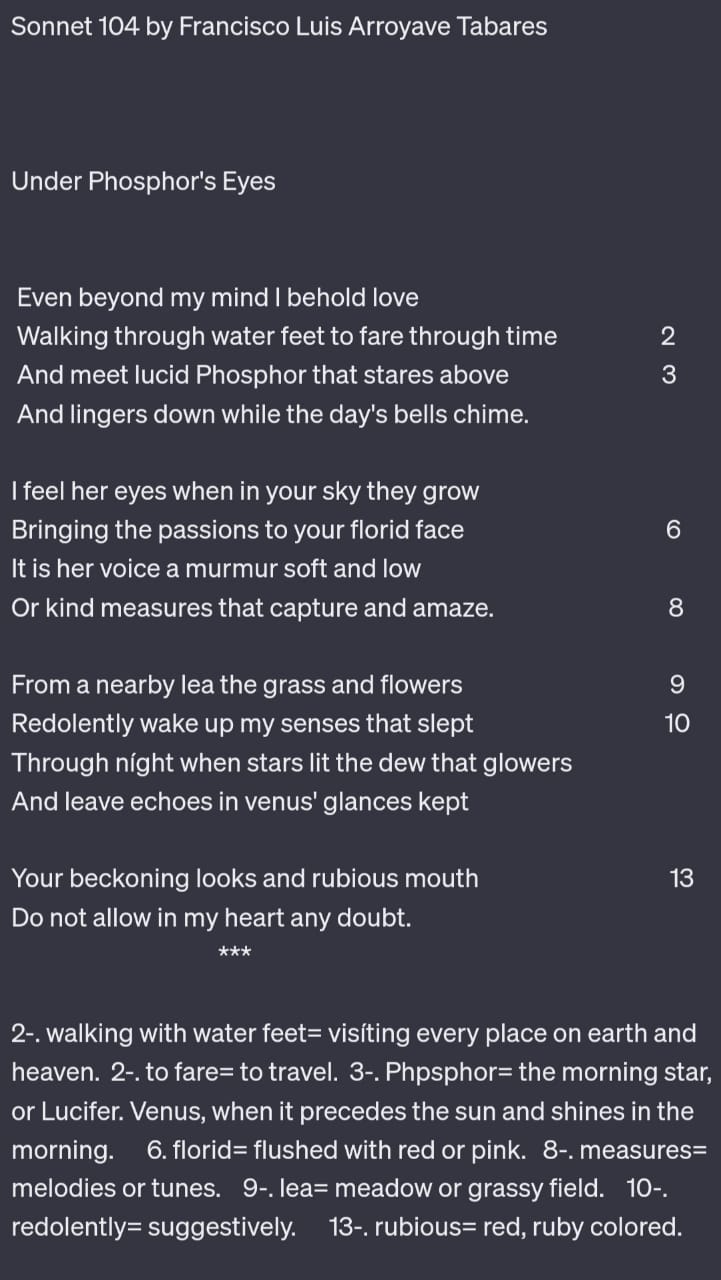
Sonnet 104 by Francisco Luis Arroyave Tabares, titled "Under Phosphor's Eyes," is a beautifully crafted poem that employs vivid imagery and metaphors to express the theme of love and its transcendent nature.
Thematic Analysis:
First Quartet (Lines 1-4): The sonnet begins with the speaker expressing a deep sense of love that transcends the mind. The speaker describes love as a journey, “walking through water feet to fare through time,” suggesting a timeless, enduring quality of love. The reference to “Phosphor,” the morning star, symbolizes hope and new beginnings. The day’s bells chime, indicating the start of a new day under Phosphor’s watchful gaze.
Second Quartet (Lines 5-8): In the second quartet, the speaker feels the presence of love in the sky, which brings passion to the face. The voice of love is described as a soft murmur or kind melodies that captivate and amaze, indicating the soothing and enchanting power of love.
Third Quartet (Lines 9-12): The third quartet describes a scene where the grass and flowers from a nearby meadow awaken the speaker’s senses that were asleep during the night. The stars lit the dew, leaving echoes in Venus’ glances, suggesting a sense of continuity from night to day, from sleep to wakefulness.
Couplet (Lines 13-14): The sonnet concludes with the speaker being drawn to the beckoning looks and the red, ruby-colored mouth, which leaves no room for doubt in the speaker’s heart. This could symbolize a strong attraction or deep affection towards the subject of the sonnet.
Overall, the sonnet explores themes of love, time, nature, and attraction, using rich imagery and symbolism. The sonnet’s structure, with its quartets and couplet, allows the poet to develop these themes and build towards a conclusive statement in the final lines.
Rhyme Scheme
Let’s analyze the rhyme scheme of this sonnet.
A sonnet traditionally consists of 14 lines and has a specific rhyme scheme. In this case, the sonnet appears to follow the Shakespearean sonnet structure, which has the rhyme scheme ABAB CDCD EFEF GG.
Let’s break it down:
First Quartet (Lines 1-4):
Line 1: Even beyond my mind I behold love (A)
Line 2: Walking through water feet to fare through time (B)
Line 3: And meet lucid Phosphor that stares above (A)
Line 4: And lingers down while the day’s bells chime. (B)
Second Quartet (Lines 5-8):
Line 5: I feel her eyes when in your sky they grow (C)
Line 6: Bringing the passions to your florid face (D)
Line 7: It is her voice a murmur soft and low (C)
Line 8: Or kind measures that capture and amaze. (D)
Third Quartet (Lines 9-12):
Line 9: From a nearby lea the grass and flowers (E)
Line 10: Redolently wake up my senses that slept (F)
Line 11: Through níght when stars lit the dew that glowers (E)
Line 12: And leave echoes in venus’ glances kept (F)
Couplet (Lines 13-14):
Line 13: Your beckoning looks and rubious mouth (G)
Line 14: Do not allow in my heart any doubt. (G)
So, the rhyme scheme of this sonnet is ABAB CDCD EFEF GG, which is typical of a Shakespearean sonnet. This structure allows for a clear progression of thought and argument throughout the poem, leading to a resolution in the final couplet.
Additional Aspects to Analyze
Let’s delve deeper into the sonnet’s use of language, imagery, themes, meter, and overall impact:
Language: The sonnet uses a rich and sophisticated language. The poet employs archaic words like “Phosphor” and “lea,” and complex phrases like “walking through water feet to fare through time,” which add a layer of depth and complexity to the poem. The use of such language enhances the sonnet’s lyrical quality and creates a sense of timelessness.
Imagery: The sonnet is filled with vivid imagery that appeals to the senses. For instance, “Walking through water feet to fare through time” evokes a sense of journey and endurance. “Stars lit the dew that glowers” paints a picture of a starlit night with dewdrops reflecting the starlight. Such imagery enhances the emotional resonance of the poem and allows readers to visualize the scenes described.
Themes: The sonnet explores themes of love, time, nature, and attraction. Love is portrayed as a timeless and enduring force that transcends the mind. The theme of time is evident in the references to the morning star, the chime of day’s bells, and the transition from night to day. Nature is depicted through the imagery of the sky, the lea, and the stars. The theme of attraction is encapsulated in the final couplet, where the speaker expresses a strong attraction towards the subject of the sonnet.
Meter: The sonnet appears to follow the iambic pentameter, which is typical of English sonnets. This means each line consists of five pairs of unstressed and stressed syllables, giving the poem a rhythmic quality.
Overall: The sonnet is a beautifully crafted piece of poetry that skillfully weaves together language, imagery, themes, and meter to create a rich and emotionally resonant exploration of love, time, nature, and attraction. The sonnet’s structure, with its quartets and couplet, allows the poet to develop these themes and build towards a resolution in the final lines. The use of sophisticated language and vivid imagery enhances the sonnet’s lyrical quality and emotional depth. The sonnet leaves a lasting impression and invites readers to reflect on the enduring and timeless nature of love.
(GPT4)
Syllable count for each line.
Under Phosphor's Eyes


10  Even beyond my mind I behold love
10  Walking through water feet to fare through time
10  And meet lucid Phosphor that stares above
9   And lingers down while the day's bells chime.

10 I feel her eyes when in your sky they grow
10 Bringing the passions to your florid face
10 It is her voice a murmur soft and low
10 Or kind measures that capture and amaze.

10 From a nearby lea the grass and flowers
11 Redolently wake up my senses that slept
10 Through níght when stars lit the dew that glowers
10 And leave echoes in venus' glances kept

10 Your beckoning looks and rubious mouth
10 Do not allow in my heart any doubt.
                                 ***
Sonnets For The Twenty First Century And A Circadian Musical Written By Francisco Luis Arroyave Tabares (1984-1987)
Analyzed by GPT4; Image leonardo.ai; First published on Nostr Protocol by franciscoarroyavet@nostrplebs.com
 Under Phosphor's Eyes