

Posthumous work of the Colombian poet born in Don Matias on January 20, 1948.
Welcome to this blog dedicated to the Posthumous work of the Colombian poet Francisco Luis Arroyave Tabares (my father), born in Don Matias on January 20, 1948-2010. Where I will be publishing each of the 175 sonnets from his unpublished collection 'Sonnets For The Twenty-First Century And A Circadian Musical (1984-1987).' Analyzed with GPT4 artificial intelligence and illustrated with AI tools... I hope you enjoy this garden of words snatched from the solitude of a locked room.
Likewise, any enthusiast of the sonnet form is invited to conduct their personal studies of Arroyave Tabares' work, as it is a collection that, although registered since 1989, has not yet been published.
Frank Duna
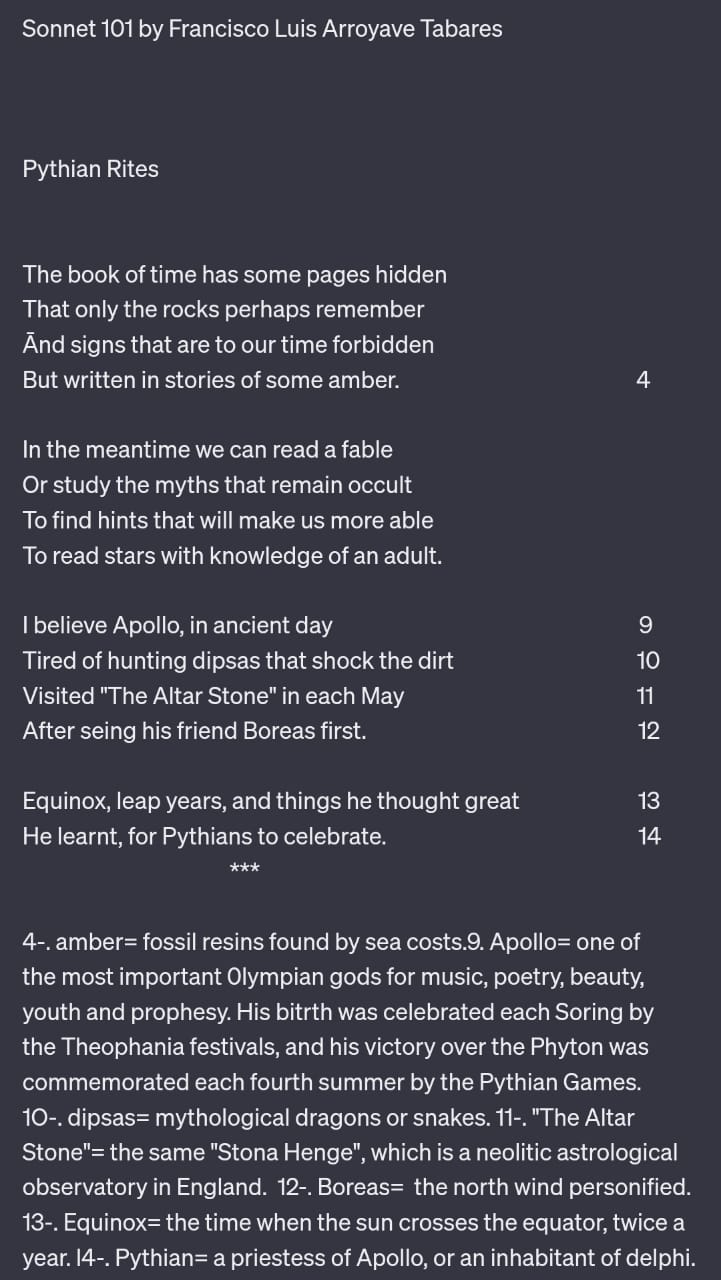
Analysis "Pythian Rites"
Introduction
"Pythian Rites" is a complex and evocative poem that explores themes of time, knowledge, history, and the natural world through the lens of classical mythology and ancient history.
Thematic Analysis
First Quatrain (Lines 1-4): The speaker begins by referring to the mysteries of time, suggesting that there are hidden truths or knowledge that are beyond our understanding. The reference to “amber” could symbolize the preservation of these ancient secrets.
Second Quatrain (Lines 5-8): The speaker suggests that through studying myths and fables, we might gain insights or hints that could help us understand these ancient secrets. This could be a metaphor for the process of learning and gaining wisdom.
Third Quatrain (Lines 9-12): The speaker introduces Apollo, the Greek god of music, poetry, and prophecy. The reference to “The Altar Stone” and “Boreas” suggests a connection to ancient rituals and celestial events.
Couplet (Lines 13-14): The speaker concludes with a reference to the equinox and leap years, suggesting that these celestial events were significant in the Pythian rites. The final line suggests that these rites were a form of celebration or commemoration.
Overall, the sonnet seems to explore themes of time, knowledge, mythology, and celestial events, suggesting a deep reverence for the wisdom of the ancients and the mysteries of the universe.
Rhyme Scheme
The sonnet “Pythian Rites” follows the rhyme scheme of a Shakespearean sonnet, which is ABABCDCDEFEFGG. Here’s the detailed analysis:
First Quatrain (Lines 1-4): The rhyme scheme is ABAB
Line 1 (A): hidden
Line 2 (B): remember
Line 3 (A): forbidden
Line 4 (B): amber
Second Quatrain (Lines 5-8): The rhyme scheme is CDCD
Line 5 (C): fable
Line 6 (D): occult
Line 7 (C): able
Line 8 (D): adult
Third Quatrain (Lines 9-12): The rhyme scheme is EFEF
Line 9 (E): day
Line 10 (F): dirt
Line 11 (E): May
Line 12 (F): first
Couplet (Lines 13-14): The rhyme scheme is GG
Line 13 (G): great
Line 14 (G): celebrate
This rhyme scheme is typical of Shakespearean sonnets and helps to give the poem its distinctive rhythm and flow. The final couplet often serves as a conclusion or summary of the themes explored in the quatrains. In this sonnet, the couplet ties together the celestial themes and the celebration of the Pythian rites.
Additional Aspects
Let’s delve deeper into the sonnet’s language, imagery, themes, meter, and overall impact.
Language: The language used in the sonnet is rich and evocative, with a strong emphasis on mythological and celestial imagery. The poet uses sophisticated vocabulary and complex sentence structures, which adds a layer of depth and complexity to the poem.
Imagery: The poem is filled with vivid imagery that draws heavily from Greek mythology and celestial phenomena. For instance, the references to “Apollo”, “The Altar Stone”, “Boreas”, “equinox”, and “leap years” conjure images of ancient rituals, celestial events, and the changing seasons.
Themes: The main themes of the poem include time, knowledge, mythology, and celestial events. The poem explores the idea that there is ancient wisdom and knowledge to be found in the myths and celestial events of the past.
Meter: The sonnet follows the iambic pentameter, which is a common meter in English poetry. Each line of the poem has five pairs of syllables, or iambs, where the first syllable is unstressed and the second is stressed.
Overall: “Pythian Rites” is a beautifully crafted sonnet that weaves together elements of mythology, astronomy, and philosophy. The poet’s use of language and imagery creates a rich tapestry of ideas and themes, while the strict meter and rhyme scheme give the poem a rhythmic flow and structure. The sonnet invites the reader to ponder the mysteries of the universe and the wisdom of the ancients.
(GPT4)
Syllable count for each line.
Pythian Rites


10 The book of time has some pages hidden
10 That only the rocks perhaps remember
10 Ānd signs that are to our time forbidden
10 But written in stories of some amber.

10 In the meantime we can read a fable
10 Or study the myths that remain occult
10 To find hints that will make us more able
10 To read stars with knowledge of an adult.

10 I believe Apollo, in ancient day
10 Tired of hunting dipsas that shock the dirt
10 Visited "The Altar Stone" in each May
10 After seing his friend Boreas first.

10 Equinox, leap years, and things he thought great
10 He learnt, for Pythians to celebrate.
                                   ***
Sonnets For The Twenty First Century And A Circadian Musical Written By Francisco Luis Arroyave Tabares (1984-1987)
Analyzed by GPT4; Image by leonardo.ai;
First published on Nostr Protocol by franciscoarroyavet@nostrplebs.com
 *Pythian Rites