
Posthumous work of the Colombian poet born in Don Matias on January 20, 1948.
Welcome to this blog dedicated to the Posthumous work of the Colombian poet Francisco Luis Arroyave Tabares (my father), born in Don Matias on January 20, 1948-2010. Where I will be publishing each of the 175 sonnets from his unpublished collection 'Sonnets For The Twenty-First Century And A Circadian Musical (1984-1987).' Analyzed with GPT4 artificial intelligence and illustrated with AI tools... I hope you enjoy this garden of words snatched from the solitude of a locked room.
Likewise, any enthusiast of the sonnet form is invited to conduct their personal studies of Arroyave Tabares' work, as it is a collection that, although registered since 1989, has not yet been published.
Frank Duna
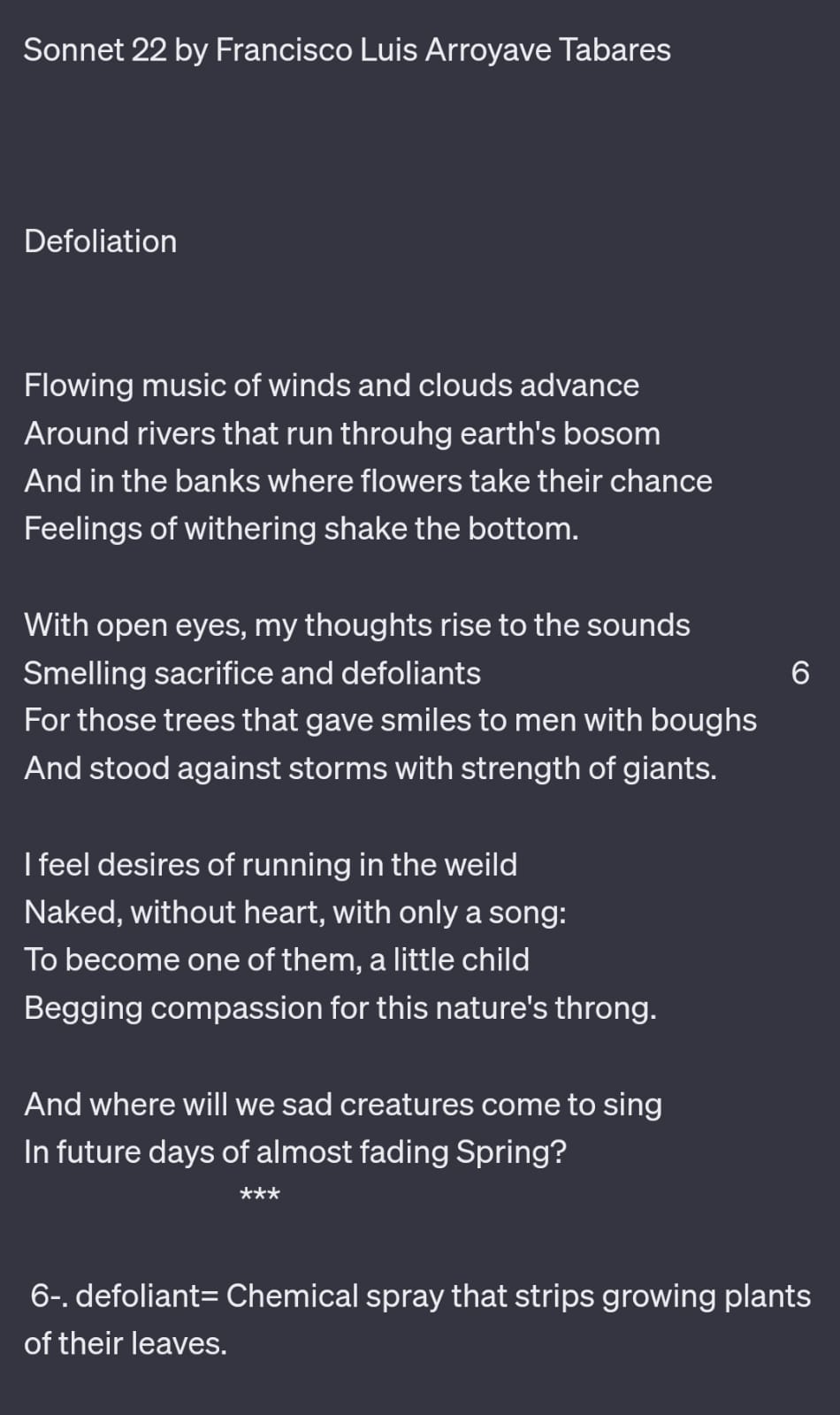
Analysis "Defoliation"
Introduction
Sonnet 22 by Francisco Luis Arroyave Tabares, titled "Defoliation," is a reflection on the relationship between humans and nature. particularly focusing on the impact of human actions on the environment.
Thematic Analysis
Quatrain 1: The first quatrain introduces the theme of nature and its elements. The poet uses vivid imagery to describe the music of winds and clouds, rivers running through the earth’s bosom, and flowers on the banks. The last line introduces a sense of decay or change with the phrase “feelings of withering.”
Quatrain 2: The second quatrain continues the theme of nature but introduces human elements. The poet speaks of sacrifice and defoliants, hinting at the impact of human actions on nature. The trees are personified as entities that gave smiles and stood against storms, symbolizing their resilience.
Quatrain 3: In the third quatrain, the poet expresses a desire to become one with nature, to run in the wild, naked and heartless, with only a song. This could symbolize a longing for innocence and a return to a more natural state of being.
Couplet: The concluding couplet presents a bleak future where nature is fading, and it questions where humans, referred to as “sad creatures,” will sing in the future. This could be interpreted as a commentary on the potential consequences of environmental degradation.
Overall, the sonnet seems to explore themes of nature, human impact on the environment, and a longing for a return to a more harmonious existence with the natural world. It serves as a poignant reminder of the beauty of nature and the importance of preserving it for future generations.
Structure and Rhyme Scheme
Let’s analyze the rhyme scheme of the sonnet “Defoliation” by Francisco Luis Arroyave Tabares. A sonnet traditionally has 14 lines and a specific rhyme scheme.
Here’s the sonnet with the rhyme scheme labeled:
1-.  Flowing music of winds and clouds advance (A)
2-.  Around rivers that run through earth's bosom (B)
3-.  And in the banks where flowers take their chance (A)
4-.  Feelings of withering shake the bottom. (B)

5-.  With open eyes, my thoughts rise to the sounds (C)
6-.  Smelling sacrifice and defoliants (D)
7-.  For those trees that gave smiles to men with boughs (C)
8-.  And stood against storms with strength of giants. (D)

9-.  I feel desires of running in the wild (E)
10. Naked, without heart, with only a song: (F)
11-. To become one of them, a little child (E)
12-. Begging compassion for this nature 's throng. (F)

13-. And where will we sad creatures come to sing (G)
14-. In future days of almost fading Spring? (G)
The rhyme scheme of this sonnet is ABAB CDCD EFEF GG, which is a typical structure for an English or Shakespearean sonnet. Each letter represents the end rhyme sound of each line. For example, “advance” (A) rhymes with “chance” (A), “bosom” (B) rhymes with “bottom” (B), and so on. The final two lines (GG) form a rhymed couplet, which often provides a summary or a conclusion to the poem. In this case, the couplet presents a bleak future where nature is fading.
This detailed rhyme scheme contributes to the rhythm and flow of the sonnet, enhancing its musical quality and making it more enjoyable to read or listen to. It also helps to emphasize certain ideas and themes in the poem. For instance, the rhymed couplet at the end helps to highlight the poet’s concern for the future of nature.
Analysis of Aspects
Let’s delve deeper into the sonnet “Defoliation” by Francisco Luis Arroyave Tabares:
Language and Imagery: The language used in the sonnet is rich and descriptive, creating vivid imagery that engages the senses. Phrases like “Flowing music of winds and clouds advance” and “Smelling sacrifice and defoliants” paint a clear picture in the reader’s mind and evoke specific emotions. The poet also uses personification, attributing human characteristics to non-human entities, such as trees that “gave smiles to men with boughs” and “stood against storms with strength of giants.”
Themes: The sonnet explores several themes, including nature, human impact on the environment, and a longing for a return to a more harmonious existence with the natural world. The title “Defoliation” and the reference to defoliants suggest a critique of human actions that harm the environment. The poet’s desire to run in the wild and become one with nature reflects a yearning for innocence and a simpler, more natural state of being.
Meter: The sonnet appears to follow the iambic pentameter, which is a common meter in English poetry and consists of five pairs of unstressed and stressed syllables per line. However, without the original text in its native language, it’s difficult to confirm the exact meter.
Overall, “Defoliation” is a beautifully crafted sonnet that uses vivid imagery and emotive language to explore important themes. The poet’s use of rhyme and meter enhances the musical quality of the poem and adds to its overall impact. The sonnet serves as a poignant reminder of the beauty of nature and the importance of preserving it for future generations. It invites readers to reflect on their relationship with the natural world and consider the consequences of their actions. It’s a powerful piece of poetry that leaves a lasting impression.
(GPT4)
Syllable count for each line.
Defoliation


10 Flowing music of winds and clouds advance
10 Around rivers that run throuhg earth's bosom
10 And in the banks where flowers take their chance
10 Feelings of withering shake the bottom.

10 With open eyes, my thoughts rise to the sounds
10 Smelling sacrifice and defoliants
10 For those trees that gave smiles to men with boughs
10 And stood against storms with strength of giants.

10 I feel desires of running in the weild
10 Naked, without heart, with only a song:
10 To become one of them, a little child
10 Begging compassion for this nature 's throng.

10 And where will we sad creatures come to sing
10 In future days of almost fading Spring?
                           ***
Sonnets For The Twenty First Century And A Circadian Musical Written By Francisco Luis Arroyave Tabares (1984-1987)
Analyzed by GPT4; Image by leonardo.ai;
First published on Nostr Protocol by franciscoarroyavet@nostrplebs.com
 Defoliation