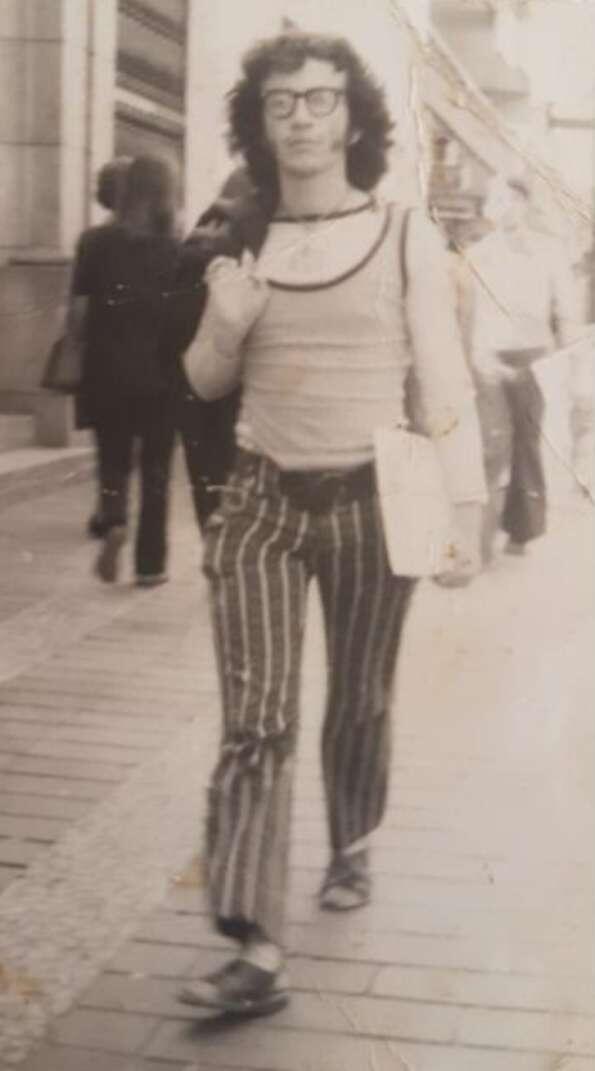
Posthumous work of the Colombian poet born in Don Matias on January 20, 1948.
Welcome to this blog dedicated to the Posthumous work of the Colombian poet Francisco Luis Arroyave Tabares (my father), born in Don Matias on January 20, 1948-2010. Where I will be publishing each of the 175 sonnets from his unpublished collection 'Sonnets For The Twenty-First Century And A Circadian Musical (1984-1987).' Analyzed with GPT4 artificial intelligence and illustrated with AI tools... I hope you enjoy this garden of words snatched from the solitude of a locked room.
Likewise, any enthusiast of the sonnet form is invited to conduct their personal studies of Arroyave Tabares' work, as it is a collection that, although registered since 1989, has not yet been published.
Frank Duna
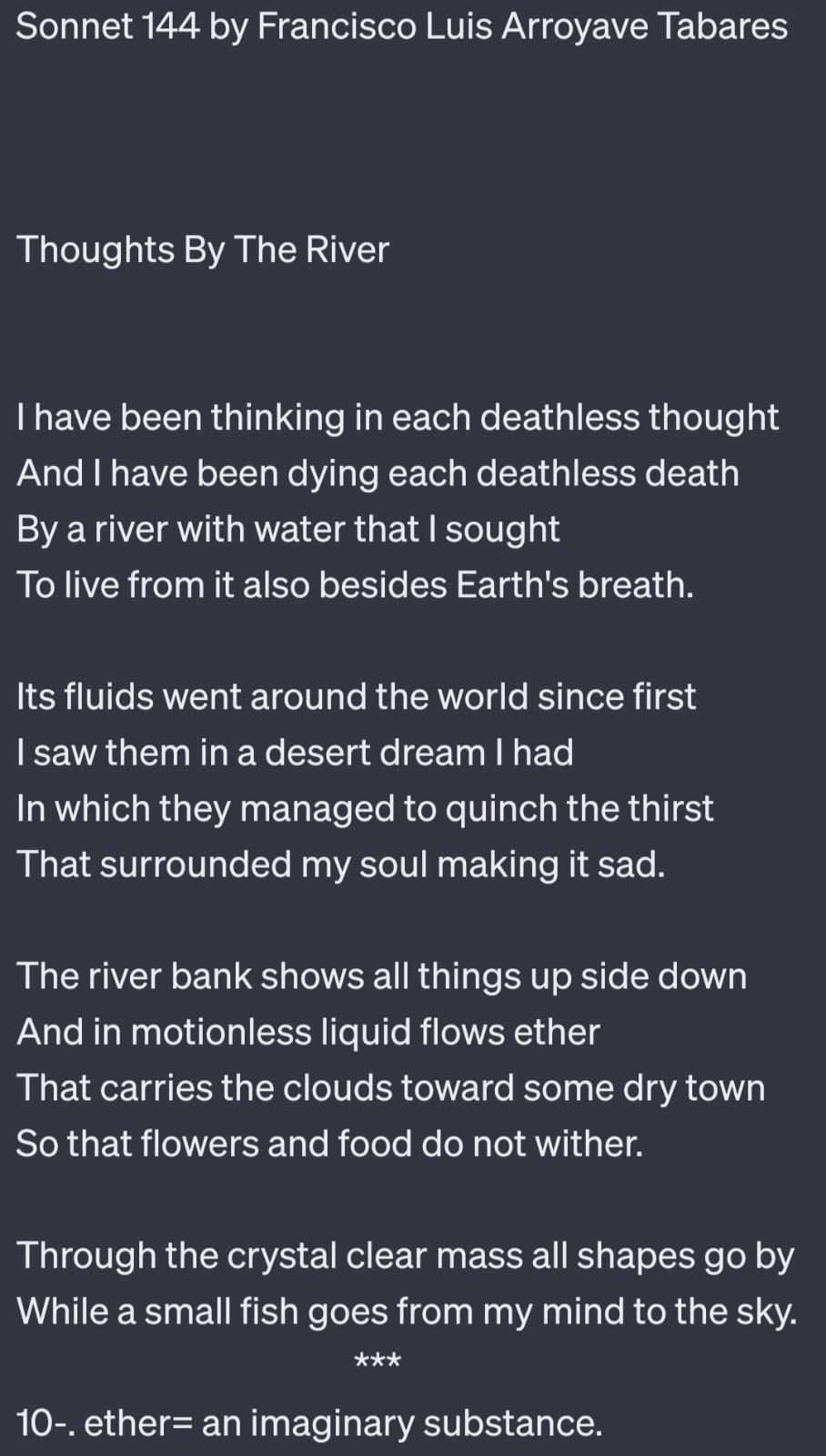
Analysis "Thoughts By The River"
Introduction
"Sonnet 144" by Francisco Luis Arroyave Tabares is a reflective piece that contemplates life, death, and the profound connection between the speaker and a river. The poet delves into the dual nature of existence, where thoughts seem eternal, yet death is an inevitable part of life.
Thematic Analysis
First Quatrain: The speaker reflects on their thoughts and experiences, symbolizing their life journey. The river is a metaphor for life, and the speaker seeks to live not just from the Earth’s breath, but also from the river’s water, suggesting a desire for a deeper, more spiritual existence.
Second Quatrain: The speaker recalls a dream where the river quenched their soul’s thirst, alleviating sadness. This could symbolize the healing and transformative power of nature and introspection.
Third Quatrain: The speaker observes the river bank, where everything appears upside down, possibly symbolizing a shift in perspective or a reflection on the impermanence of life. The “motionless liquid” that carries clouds to a dry town could represent the cycle of life and the interconnectedness of all things.
Couplet: The speaker watches shapes pass through the clear water, ending with a small fish swimming from their mind to the sky. This could symbolize the liberation of thoughts or ideas, or the transcendence of the mundane to reach a higher plane of existence.
The term “ether” in line 10 is defined by the poet as an imaginary substance, which could be interpreted as a spiritual or metaphysical element that permeates all of existence.
Structure and Rhyme Scheme
The sonnet “Thoughts By The River” follows the traditional English (or Shakespearean) sonnet form in terms of its rhyme scheme. Here’s a detailed analysis:
First Quatrain (Lines 1-4): The rhyme scheme is ABAB.
Line 1 (A): thought
Line 2 (B): death
Line 3 (A): sought
Line 4 (B): breath
Second Quatrain (Lines 5-8): The rhyme scheme is CDCD.
Line 5 (C): first
Line 6 (D): had
Line 7 (C): thirst
Line 8 (D): sad
Third Quatrain (Lines 9-12): The rhyme scheme is EFEF.
Line 9 (E): down
Line 10 (F): ether
Line 11 (E): town
Line 12 (F): wither
Couplet (Lines 13-14): The rhyme scheme is GG.
Line 13 (G): by
Line 14 (G): sky
So, the overall rhyme scheme of the sonnet is ABAB CDCD EFEF GG, which is typical of an English sonnet. This structure allows for a clear progression of thought and argument throughout the poem, culminating in a summarizing or surprising couplet at the end. In this case, the couplet provides a beautiful and thought-provoking conclusion to the speaker’s reflections by the river.
Analysis of Aspects
Let’s delve deeper into the language, imagery, themes, meter, and overall impact of the sonnet “Thoughts By The River” by Francisco Luis Arroyave Tabares:
Language: The language used in the sonnet is quite formal and poetic, with a rich vocabulary. The poet uses words like “deathless”, “ether”, and “crystal clear mass” which add depth and complexity to the poem. The language is also quite abstract and metaphorical, inviting readers to interpret the poem in their own way.
Imagery: The poem is filled with vivid imagery that paints a picture in the reader’s mind. From the “river with water” to the “motionless liquid” and the “small fish” swimming from the mind to the sky, the poet uses these images to convey complex emotions and ideas. The imagery is both concrete (like the river and the fish) and abstract (like the ether and the upside-down reflections), creating a rich tapestry of visual elements.
Themes: The main themes of the poem include introspection, nature, life and death, and spiritual transcendence. The speaker reflects on their thoughts and experiences by the river, using the natural elements as metaphors for life’s journey and spiritual quest. The theme of death is also present, but it’s portrayed as “deathless death”, suggesting a transformation or rebirth rather than an end.
Meter: The poem appears to follow the iambic pentameter, which is typical of traditional English sonnets. This means each line consists of five pairs of unstressed and stressed syllables, creating a rhythmic flow. However, there might be slight variations in some lines, adding a unique rhythm to the poem.
Overall, the sonnet is a profound and thought-provoking piece of poetry. It invites readers to reflect on their own life journey and spiritual quest, using the river as a powerful symbol. The combination of rich language, vivid imagery, deep themes, and rhythmic meter creates a captivating and impactful reading experience.
(GPT4)
Syllable count for each line.
Thoughts By The River


10 I have been thinking in each deathless thought
10 And I have been dying each deathless death
10 By a river with water that I sought
10 To live from it also besides Earth's breath.

10 Its fluids went around the world since first
10 I saw them in a desert dream I had
9  In which they managed to quinch the thirst
10 That surrounded my soul making it sad.

10 The river bank shows all things up side down
10 And in motionless liquid flows ether
10 That carries the clouds toward some dry town
10 So that flowers and food do not wither.

10 Through the crystal clear mass all shapes go by
11 While a small fish goes from my mind to the sky.
                                           ***
Sonnets For The Twenty First Century And A Circadian Musical Written By Francisco Luis Arroyave Tabares (1984-1987)
Analyzed by GPT4; Image by leonardo.ai
First published on Nostr Protocol by franciscoarroyavet@nostrplebs.com
 Thoughts By The River