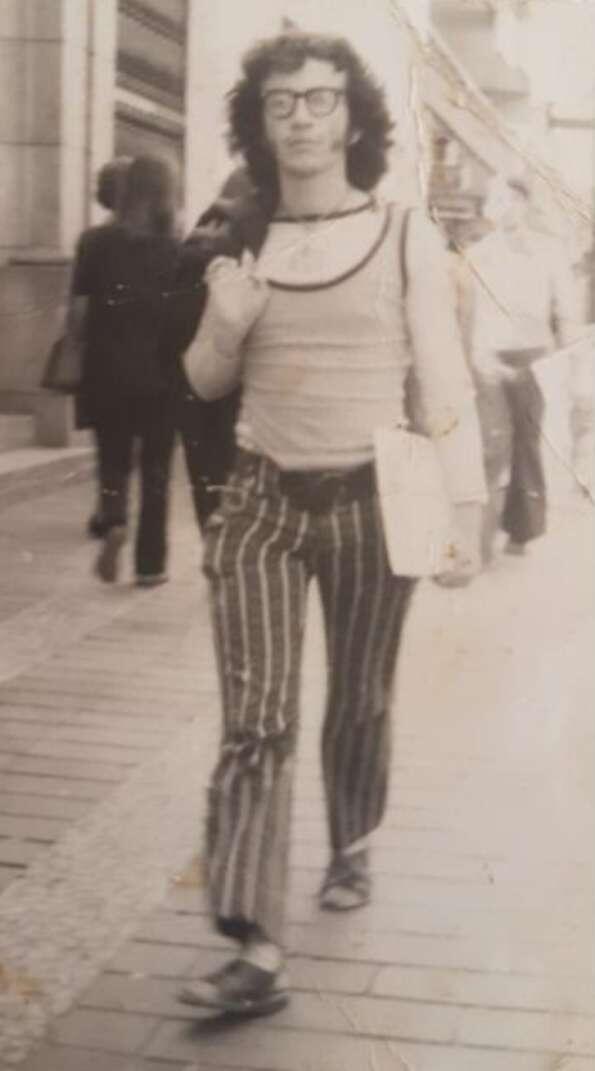
Posthumous work of the Colombian poet born in Don Matias on January 20, 1948.
Welcome to this blog dedicated to the Posthumous work of the Colombian poet Francisco Luis Arroyave Tabares (my father), born in Don Matias on January 20, 1948-2010. Where I will be publishing each of the 175 sonnets from his unpublished collection 'Sonnets For The Twenty-First Century And A Circadian Musical (1984-1987).' Analyzed with GPT4 artificial intelligence and illustrated with AI tools... I hope you enjoy this garden of words snatched from the solitude of a locked room.
Likewise, any enthusiast of the sonnet form is invited to conduct their personal studies of Arroyave Tabares' work, as it is a collection that, although registered since 1989, has not yet been published.
Frank Duna
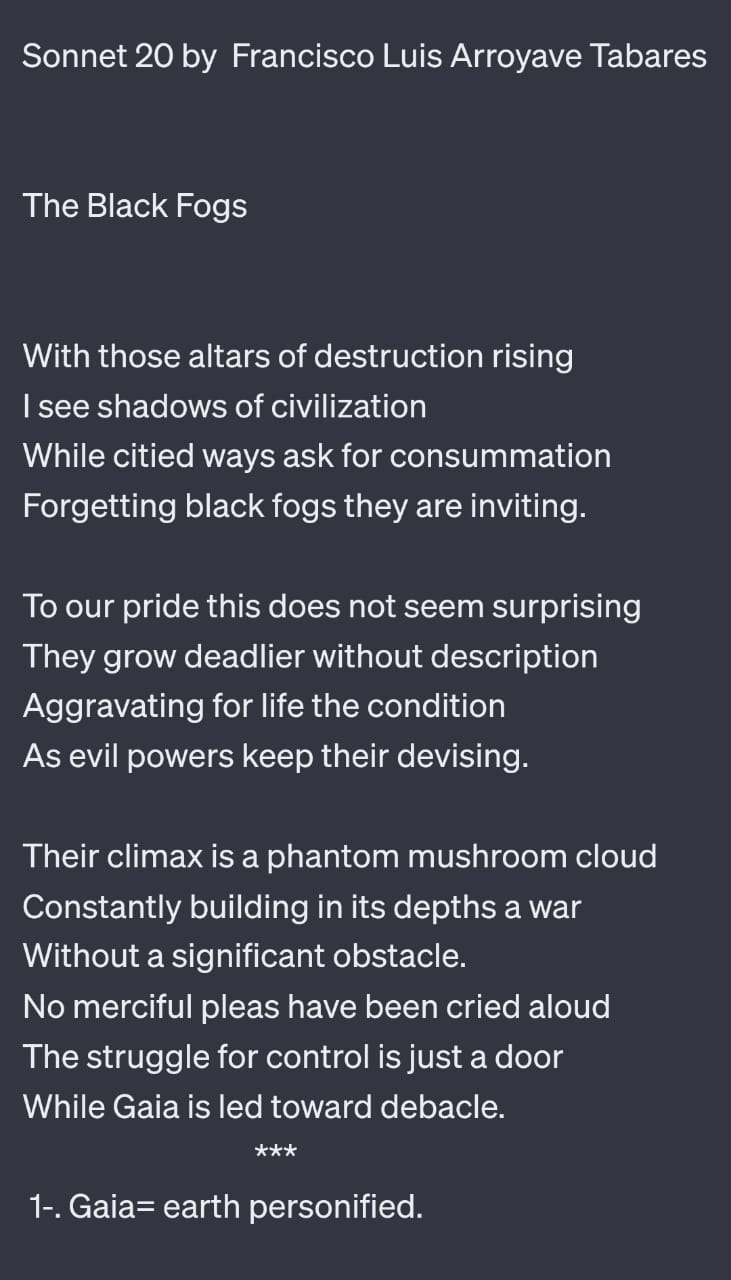
Analysis "The Black Fogs"
Introduction
Sonnet 20 by Francisco Luis Arroyave Tabares, titled "The Black Fogs," is a reflection on the destructive forces of human civilization and their impact on the Earth.
Thematic Analysis
In the octave, the poet describes the destructive forces of human civilization, symbolized by “altars of destruction” and “black fogs”. These forces are growing increasingly deadly, threatening life itself. The octave ends with a critique of the “evil powers” that continue to exacerbate this situation.
The sestet introduces the image of a “phantom mushroom cloud”, a clear reference to nuclear warfare. This threat is constantly building, with no significant obstacles to its progress. Despite the dire situation, no pleas for mercy have been heard. The sonnet concludes with the image of Gaia, the personification of Earth, being led towards a disaster.
Overall, the sonnet presents a stark critique of human civilization’s destructive tendencies and the potential for self-inflicted disaster. The transition from the octave to the sestet marks a shift from a general critique to a more specific warning about the consequences of these actions. The sonnet uses vivid imagery and strong language to convey its message, making it a powerful commentary on the state of the world.
Structure and Rhyme Scheme
The sonnet “The Black Fogs” follows the rhyme scheme of a Petrarchan sonnet, which is typically divided into an octave (the first eight lines) and a sestet (the last six lines). The rhyme scheme is as follows:
Octave:
rising (A)
civilization (B)
consummation (B)
inviting (A)
surprising (A)
description (B)
condition (B)
devising (A)
Sestet:
cloud (C)
war (D)
obstacle (E)
aloud (C)
door (D)
debacle (E)
In the octave, the rhyme scheme is ABBAABBA, which is a common pattern in Petrarchan sonnets. The sestet follows the CDECDE rhyme scheme, which is one of the variations found in Petrarchan sonnets. The transition from the octave to the sestet also marks a shift in the poem’s focus, from a general critique of human civilization’s destructive tendencies to a more specific warning about the consequences of these actions. The consistent rhyme scheme throughout the sonnet helps to tie these two parts together, reinforcing the overall message of the poem.
Analysis of Aspects
Let’s delve deeper into the analysis of the sonnet “Black Fogs” by Francisco Luis Arroyave Tabares.
Language and Imagery: The sonnet uses a formal and elevated language, which is typical of the sonnet form. The imagery is vivid and powerful, invoking the destructive forces of human civilization and the looming threat of nuclear warfare. The “altars of destruction”, “black fogs”, and “phantom mushroom cloud” are particularly striking images that convey the poem’s themes effectively.
Themes: The primary theme of the sonnet is the critique of human civilization’s destructive tendencies and the potential for self-inflicted disaster. This is conveyed through the images of destruction and the references to the “evil powers” that exacerbate the situation. The sonnet also touches on themes of pride, control, and the disregard for the natural world (represented by Gaia).
Meter: The sonnet appears to be written in iambic pentameter, which is the most common meter in English sonnets. This means each line typically contains five iambs, or pairs of unstressed and stressed syllables. For example, the line “With those altars of destruction rising” can be broken down into iambs as follows: “With THOSE / alTARS / of DES / trucTION / RISing”.
Overall, the sonnet is a powerful critique of human civilization’s destructive tendencies. It uses vivid imagery and strong language to convey its message, and the formal structure of the sonnet form adds to its impact. The transition from the octave to the sestet, along with the consistent rhyme scheme and meter, helps to tie the poem together and reinforce its themes. The sonnet is a stark warning about the consequences of our actions and a call to change our ways before it’s too late.
(GPT4)
Syllable count for each line.
The Black Fogs


10 With those altars of destruction rising
10 I see shadows of civilization
10 While citied ways ask for consummation
10 Forgetting black fogs they are inviting.

10 To our pride this does not seem surprising
10 They grow deadlier without description
10 Aggravating for life the condition
10 As evil powers keep their devising.

10 Their climax is a phantom mushroom cloud
10 Constantly building in its depths a war
10 Without a significant obstacle.
10 No merciful pleas have been cried aloud
10 The struggle for control is just a door
10 While Gaia is led toward debacle.
                                 ***
Sonnets For The Twenty First Century And A Circadian Musical Written By Francisco Luis Arroyave Tabares (1984-1987)
Analyzed by GPT4; Image by leonardo.ai;
First published on Nostr Protocol by franciscoarroyavet@nostrplebs.com
 The Black Fogs