
Posthumous work of the Colombian poet born in Don Matias on January 20, 1948.
Welcome to this blog dedicated to the Posthumous work of the Colombian poet Francisco Luis Arroyave Tabares (my father), born in Don Matias on January 20, 1948-2010. Where I will be publishing each of the 175 sonnets from his unpublished collection 'Sonnets For The Twenty-First Century And A Circadian Musical (1984-1987).' Analyzed with GPT4 artificial intelligence and illustrated with AI tools... I hope you enjoy this garden of words snatched from the solitude of a locked room.
Likewise, any enthusiast of the sonnet form is invited to conduct their personal studies of Arroyave Tabares' work, as it is a collection that, although registered since 1989, has not yet been published.
Frank Duna
Analysis "Home Celebration"
Introduction
Sonnet 94 by Francisco Luis Arroyave Tabares, titled "Home Celebration," is a beautiful exploration of the speaker's inner world and his relationship with the external environment.
Thematic Analysis
The octave (lines 1-8) sets up the emotional and thematic context of the poem. It begins with the speaker expressing how they’ve opened their mind to dispel boredom and melancholy, and have embraced harmony and love. This is a metaphorical journey of self-discovery and emotional growth. The speaker then contrasts their past, where their dreams were scolded by the sky, with their present state of tranquility and purpose. The octave thus establishes a transition from a state of ennui to one of peace and purpose.
The sextet (lines 9-14) builds upon the foundation laid by the octave. It introduces the theme of nature and divine celebration. The speaker perceives a secret celebration in nature, which offers its universal dome, a metaphor for the vastness and inclusivity of the natural world. The speaker feels a deep connection with the divine, symbolized by the “lucid sun” that brings light to their soul. The sonnet concludes with a sense of communal joy, as the speaker extends the celebration to others who also find joy in their home.
In summary, the octave and sextet work together to convey a journey from personal introspection to universal celebration, from solitude to community, and from ennui to exultation. The sonnet beautifully encapsulates the transformative power of self-discovery and the joy of finding one’s place in the world.
Rhyme Scheme
The rhyme scheme ABBA ABBA CDCDCD, is a variant of the Petrarchan sonnet form. Let’s break it down:
ABBA ABBA: This is the pattern for the octave (the first eight lines). In this scheme, the first and fourth lines rhyme (A), as do the second and third lines (B). This pattern is then repeated for the next four lines. CDCDCD: This is the pattern for the sestet (the last six lines). Each pair of lines (C, D, C, D, C, D) has its own rhyme. Applying this to the sonnet “Home Celebration” by Francisco Luis Arroyave Tabares:
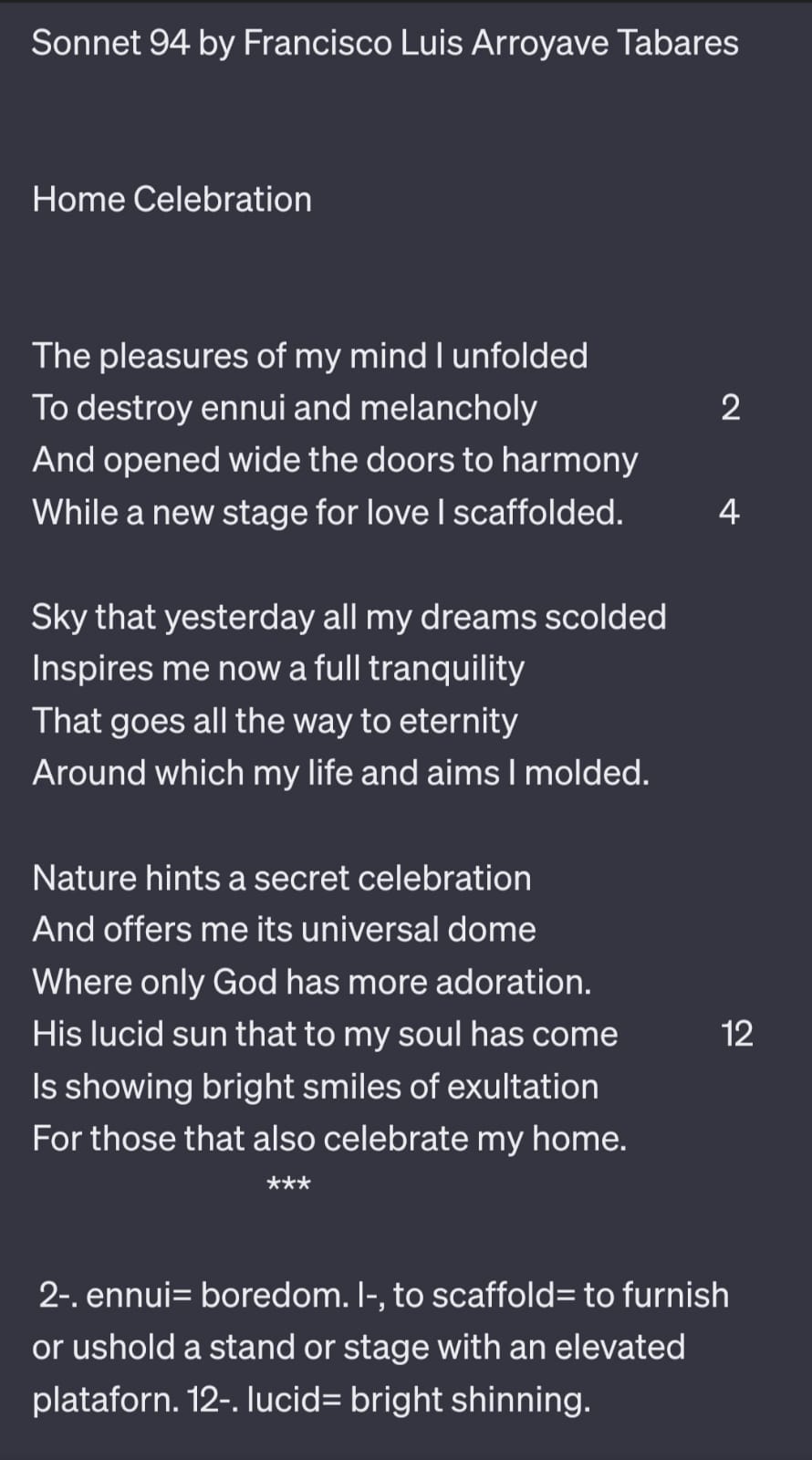
The pleasures of my mind I unfolded (A)
To destroy ennui and melancholy (B)
And opened wide the doors to harmony (B)
While a new stage for love I scaffolded. (A)

Sky that yesterday all my dreams scolded (A)
Inspires me now a full tranquility (B)
That goes all the way to eternity (B)
Around which my life and aims I molded. (A)

Nature hints a secret celebration (C)
And offers me its universal dome (D)
Where only God has more adoration. (C)

His lucid sun that to my soul has come (D)
Is showing bright smiles of exultation (C)
For those that also celebrate my home. (D)
This rhyme scheme contributes to the overall structure and flow of the sonnet, creating a sense of unity and progression from the octave to the sestet. It also adds a musical quality to the poem, enhancing its lyrical beauty. The change in rhyme scheme from the octave to the sestet often signals a shift in theme or tone, adding depth and complexity to the sonnet. In this case, the octave focuses on personal introspection and transformation, while the sestet expands to include nature, the divine, and the community.
Additional Aspects
Let’s delve into the analysis of “Home Celebration” by Francisco Luis Arroyave Tabares:
Language: The language used in the sonnet is rich and evocative. The poet uses a variety of literary devices such as metaphors (“The pleasures of my mind I unfolded”, “Nature hints a secret celebration”) and personification (“Sky that yesterday all my dreams scolded”). The language is also characterized by a high degree of abstraction, which allows for multiple interpretations.
Imagery: The sonnet is filled with vivid imagery that appeals to the senses. For instance, the “lucid sun” that brings light to the speaker’s soul creates a powerful visual image. Similarly, the “universal dome” of nature suggests a vast, encompassing space that is both awe-inspiring and comforting.
Themes: The sonnet explores several themes, including self-discovery, transformation, nature, divinity, and community. The speaker’s journey from ennui to exultation reflects the theme of personal growth and transformation. The references to nature and the “lucid sun” highlight the theme of divine connection and spiritual enlightenment. Finally, the celebration of home suggests a sense of belonging and community.
Meter: The sonnet follows the traditional iambic pentameter, which is a line of verse with five metrical feet, each consisting of one short (or unstressed) syllable followed by one long (or stressed) syllable. This gives the poem a rhythmic quality and enhances its musicality.
Overall: “Home Celebration” is a beautifully crafted sonnet that skillfully combines language, imagery, and meter to explore profound themes. The sonnet takes the reader on a journey from personal introspection to universal celebration, creating a deeply moving and thought-provoking reading experience. The poet’s use of language and imagery is particularly effective in conveying the speaker’s emotional transformation and their connection with nature and the divine. The sonnet’s traditional structure and meter add to its lyrical beauty and underscore its themes.
(GPT4)
Syllable count for each line.
Home Celebration


10 The pleasures of my mind I unfolded
10 To destroy ennui and melancholy
10 And opened wide the doors to harmony
10 While a new stage for love I scaffolded.

10 Sky that yesterday all my dreams scolded
10 Inspires me now a full tranquility
10 That goes all the way to eternity
10 Around which my life and aims I molded.

10 Nature hints a secret celebration
10 And offers me its universal dome
10 Where only God has more adoration.
10 His lucid sun that to my soul has come
10 Is showing bright smiles of exultation
10 For those that also celebrate my home.
                                    ***
Sonnets For The Twenty First Century And A Circadian Musical Written By Francisco Luis Arroyave Tabares (1984-1987)
Analyzed by GPT4; Image by leonardo.ai;
First published on Nostr Protocol by franciscoarroyavet@nostrplebs.com
 *Home Celebration