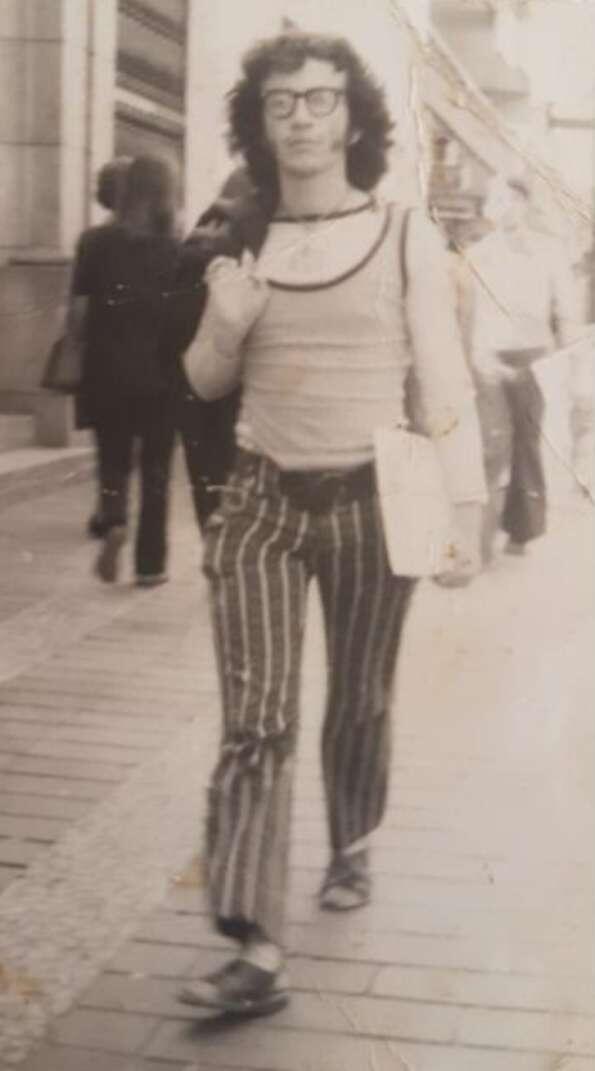
Posthumous work of the Colombian poet born in Don Matias on January 20, 1948.
Welcome to this blog dedicated to the Posthumous work of the Colombian poet Francisco Luis Arroyave Tabares (my father), born in Don Matias on January 20, 1948-2010. Where I will be publishing each of the 175 sonnets from his unpublished collection 'Sonnets For The Twenty-First Century And A Circadian Musical (1984-1987).' Analyzed with GPT4 artificial intelligence and illustrated with AI tools... I hope you enjoy this garden of words snatched from the solitude of a locked room.
Likewise, any enthusiast of the sonnet form is invited to conduct their personal studies of Arroyave Tabares' work, as it is a collection that, although registered since 1989, has not yet been published.
Frank Duna
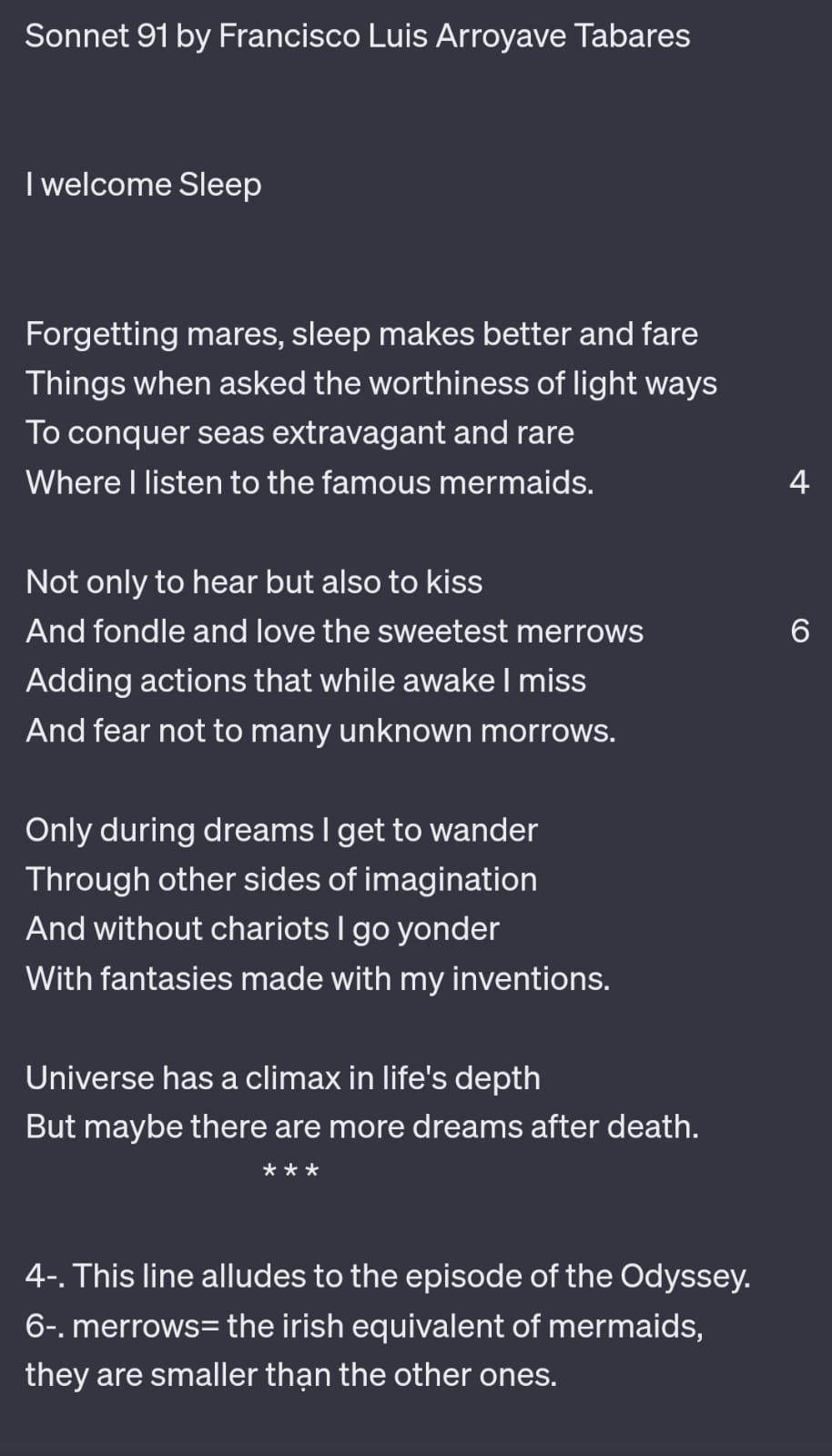
Analysis "I welcome Sleep"
Introduction
Sonnet 91 by Francisco Luis Arroyave Tabares is a contemplative piece that explores the themes of sleep, dreams, and the possibilities of the unknown.
Thematic Analysis
First Quatrain (Lines 1-4): The speaker welcomes sleep as it provides an escape from reality. The speaker desires to conquer extravagant and rare seas, where they can listen to the famous mermaids, an allusion to the Odyssey.
Second Quatrain (Lines 5-8): The speaker expresses a desire not only to hear but also to kiss and love the sweetest merrows, the Irish equivalent of mermaids. These actions are ones the speaker misses while awake, and they do not fear the unknown future.
Third Quatrain (Lines 9-12): The speaker states that only in dreams do they get to explore other sides of their imagination. They travel without chariots, using only their fantasies and inventions.
Final Couplet (Lines 13-14): The speaker reflects on the climax of life in the universe and wonders if there might be more dreams after death.
Overall, the sonnet explores the theme of dreams as an escape from reality, a place where one’s deepest desires and fantasies can be realized. It also contemplates the nature of life and death, suggesting that dreams might continue even after life ends. The use of allusions and metaphors enriches the poem, adding layers of meaning and depth. The sonnet adheres to the traditional rhyme scheme of a Shakespearean sonnet: ABAB CDCD EFEF GG.
Rhyme Scheme
Let’s analyze the rhyme scheme of this sonnet in detail. A Shakespearean sonnet typically follows the ABAB CDCD EFEF GG rhyme scheme. Here’s how it applies to this sonnet:
First Quatrain (Lines 1-4):
Line 1 (A): Forgetting mares, sleep makes better and fare
Line 2 (B): Things when asked the worthiness of light ways
Line 3 (A): To conquer seas extravagant and rare
Line 4 (B): Where I listen to the famous mermaids.
Second Quatrain (Lines 5-8):
Line 5 (C): Not only to hear but also to kiss
Line 6 (D): And fondle and love the sweetest merrows
Line 7 (C): Adding actions that while awake I miss
Line 8 (D): And fear not to many unknown morrows.
Third Quatrain (Lines 9-12):
Line 9 (E): Only during dreams I get to wander
Line 10 (F): Through other sides of imagination
Line 11 (E): And without chariots I go yonder
Line 12 (F): With fantasies made with my inventions.
Final Couplet (Lines 13-14):
Line 13 (G): Universe has a climax in life’s depth
Line 14 (G): But maybe there are more dreams after death.
So, the rhyme scheme of this sonnet is ABAB CDCD EFEF GG, which is typical of a Shakespearean sonnet. The final couplet (GG) often serves as a conclusion or a summarizing thought to the rest of the poem. In this case, it reflects on the nature of life and the possibility of dreams after death. This detailed analysis of the rhyme scheme helps us understand the structure and flow of the sonnet. It’s interesting to see how the poet has used this structure to explore the themes of dreams, imagination, and the nature of life and death.
Additional Aspects
Let’s delve deeper into the sonnet’s use of language, imagery, themes, meter, and overall impact.
**Language: **The sonnet uses a rich and evocative language. The poet’s choice of words such as “merrows”, “chariots”, and “yonder” gives the poem a timeless and universal quality. The language is also quite descriptive, painting vivid pictures in the reader’s mind.
Imagery: The sonnet is filled with powerful imagery. The “extravagant and rare seas”, the “famous mermaids”, and the “sweetest merrows” all serve to create a dreamlike and fantastical atmosphere. The imagery used in the sonnet is not only visually striking but also deeply symbolic, representing the speaker’s desires and fantasies.
Themes: The main themes of the sonnet are dreams, imagination, and the nature of life and death. The speaker sees dreams as an escape from reality, a place where they can live out their fantasies. The sonnet also contemplates the nature of life and death, suggesting that dreams might continue even after life ends.
Meter: The sonnet follows the traditional iambic pentameter, which is a line of verse with five metrical feet, each consisting of one short (or unstressed) syllable followed by one long (or stressed) syllable. This gives the poem a rhythmic and melodic quality.
Overall: the sonnet is a beautifully crafted piece of poetry. It uses rich language and vivid imagery to explore deep and profound themes. The use of a traditional sonnet form, complete with a consistent rhyme scheme and meter, adds to the poem’s charm and appeal. The sonnet leaves the reader with much to ponder, particularly about the nature of dreams and the mysteries of life and death. It’s a testament to the poet’s skill and creativity.
(GPT4)
Syllable count for each line.
I welcome Sleep


10 Forgetting mares, sleep makes better and fare
10 Things when asked the worthiness of light ways
10 To conquer seas extravagant and rare
10 Where I listen to the famous mermaids.

10 Not only to hear but also to kiss
10 And fondle and love the sweetest merrows
10 Adding actions that while awake I miss
10 And fear not to many unknown morrows.

10 Only during dreams I get to wander
10 Through other sides of imagination
10 And without chariots I go yonder
10 With fantasies made with my inventions.

10 Universe has a climax in life's depth
10 But maybe there are more dreams after death.
                                         ***
Sonnets For The Twenty First Century And A Circadian Musical Written By Francisco Luis Arroyave Tabares (1984-1987)
Analyzed by GPT4; Image by leonardo.ai;
First published on Nostr Protocol by franciscoarroyavet@nostrplebs.com
 *I welcome Sleep