
Posthumous work of the Colombian poet born in Don Matias on January 20, 1948.
Welcome to this blog dedicated to the Posthumous work of the Colombian poet Francisco Luis Arroyave Tabares (my father), born in Don Matias on January 20, 1948-2010. Where I will be publishing each of the 175 sonnets from his unpublished collection 'Sonnets For The Twenty-First Century And A Circadian Musical (1984-1987).' Analyzed with GPT4 artificial intelligence and illustrated with AI tools... I hope you enjoy this garden of words snatched from the solitude of a locked room.
Likewise, any enthusiast of the sonnet form is invited to conduct their personal studies of Arroyave Tabares' work, as it is a collection that, although registered since 1989, has not yet been published.
Frank Duna
Analysis "Summer Reverie"
Introduction
The sonnet captures a moment of intense introspection and desire, where the speaker is drawn to an enigmatic vision that awakens deep emotions within them.
Thematic Analysis
Quatrain 1: This quatrain speaks of anticipation and renewal. The speaker is eagerly awaiting the return of their beloved, and this anticipation is mirrored in the budding of flowers and a new flame burning within them. There’s a sense of joy and rejuvenation in nature’s music.
Quatrain 2: The second quatrain continues the theme of anticipation and renewal. The speaker interprets messages in the traveling clouds and sees significance in the work of bees. The arrival of spring brings unique feelings and experiences.
Quatrain 3: The third quatrain introduces a dreamlike quality. The speaker travels through various places in their dreams, finding traces of their beloved in many faces. Despite the separation, there’s a sense of hope and absence of sorrow.
Couplet: The final couplet concludes the sonnet with a beautiful image of the beloved’s presence being felt in the things she loved and in the whispering winds. It’s a poignant reminder of her pervasive influence and the enduring love the speaker holds for her.
Overall, the sonnet beautifully captures themes of love, anticipation, renewal, and the enduring presence of a beloved person. It uses vivid imagery and metaphors to convey deep emotional states.
Rhyme Scheme
Let’s analyze the rhyme scheme of this sonnet. A traditional Shakespearean sonnet has a rhyme scheme of ABAB CDCD EFEF GG. Let’s see how this sonnet fits into that pattern:
Quatrain 1:
A Behold!, my beloved will be returning,
B In the puffing of the buds I can see
A A new flame inside me has been burning
B And Nature's music has that special glee.
Quatrain 2:
C I can read between the clouds that travel
D The messages that on their way they bring
C Each working bee is to me a martel
D So unique in the dawning of this spring.
Quatrain 3:
E When last night, I rode through many places
F On wings of dreams that were gone by the morn
E I found her etched in many faces
F And she still was without signs of forlorn.
Couplet:
G Things she used to love have today her glow
G And all the winds spell her name when they blow.
As you can see, the sonnet follows the traditional Shakespearean rhyme scheme perfectly. This structure contributes to the rhythm and flow of the poem, guiding the reader through its themes and emotions. The final couplet (GG) often provides a resolution or summary of the preceding quatrains, as it does in this sonnet. The rhyme scheme is an integral part of the sonnet form, adding musicality and emphasis to the poet’s words.
Additional Aspects
let’s delve deeper into the sonnet’s use of language, imagery, themes, meter, and overall impact:
Language and Imagery: The sonnet uses rich and evocative language to paint vivid images in the reader’s mind. Phrases like “puffing of the buds”, “flame inside me”, “Nature’s music”, “clouds that travel”, and “wings of dreams” create a sensory experience that brings the poem to life. The language is both descriptive and emotive, effectively conveying the speaker’s anticipation, joy, and enduring love.
Themes: The sonnet explores themes of love, anticipation, renewal, and the enduring presence of a beloved person. The speaker’s anticipation of their beloved’s return is mirrored in the budding of flowers and the arrival of spring, symbolizing renewal and rebirth. The theme of enduring love is evident in the speaker’s dreamlike journey and the pervasive influence of the beloved.
Meter: The sonnet follows the traditional iambic pentameter of Shakespearean sonnets, which means each line consists of five pairs of unstressed and stressed syllables. This rhythmic pattern gives the poem a musical quality and guides the reader through its themes and emotions.
Overall: The sonnet is a beautiful exploration of love and anticipation, conveyed through rich language and vivid imagery. The use of traditional sonnet structure and meter adds a rhythmic and musical quality to the poem, enhancing its emotional impact. The sonnet effectively captures the speaker’s emotional state and creates a sensory experience for the reader, making it a powerful piece of poetry.
(GPT4)
Syllable count for each line.
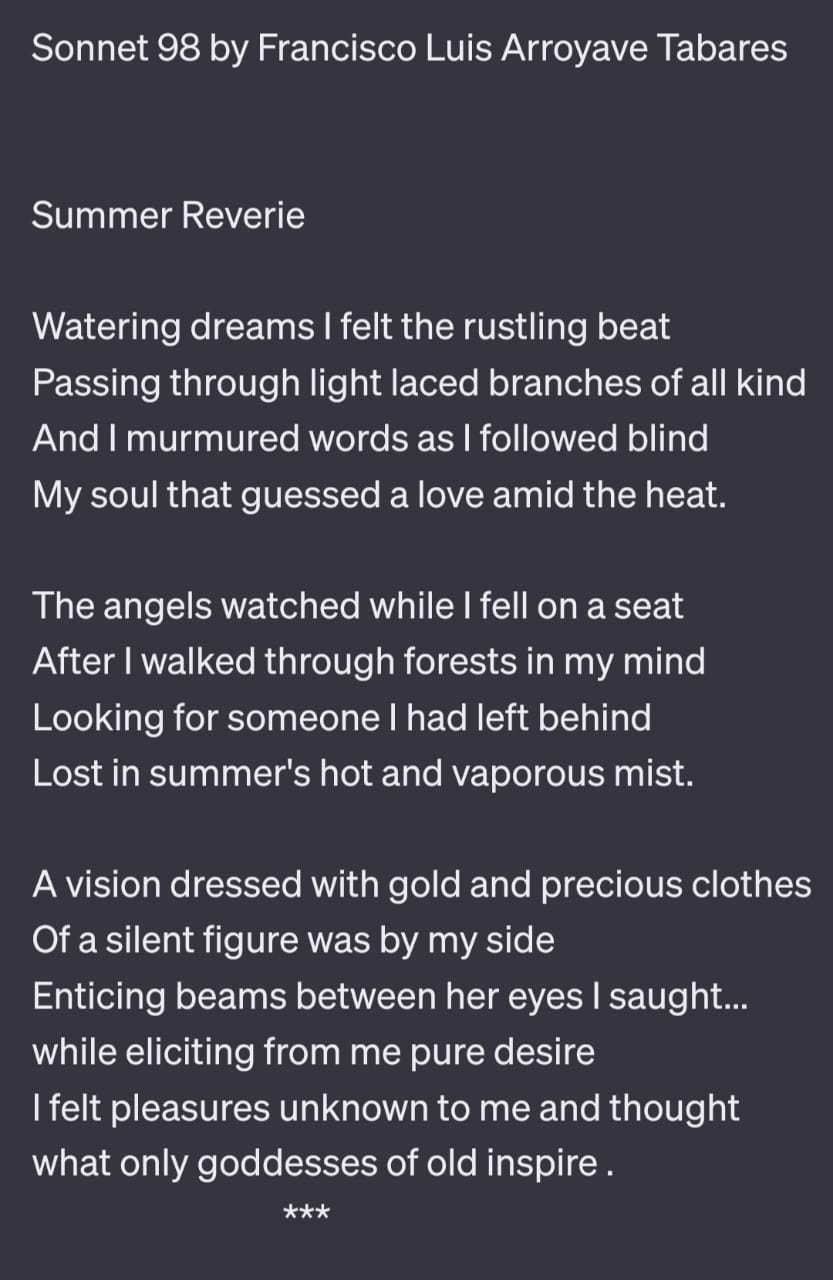
Summer Reverie


10 Watering dreams I felt the rustling beat
10 Passing through light laced branches of all kind
10 And I murmured words as I followed blind
10 My soul that guessed a love amid the heat.

10 The angels watched while I fell on a seat
10 After I walked through forests in my mind
10 Looking for someone I had left behind
10 Lost in summer's hot and vaporous mist.

10 A vision dressed with gold and precious clothes
10 Of a silent figure was by my side
10 Enticing beams between her eyes I saught...
10 While eliciting from me pure desire
10 I felt pleasures unknown to me and thought
10 what only goddesses of old inspire .
                                   ***
Sonnets For The Twenty First Century And A Circadian Musical Written By Francisco Luis Arroyave Tabares (1984-1987)
Analyzed by GPT4; Image by leonardo.ai;
First published on Nostr Protocol by franciscoarroyavet@nostrplebs.com
 Summer Reverie