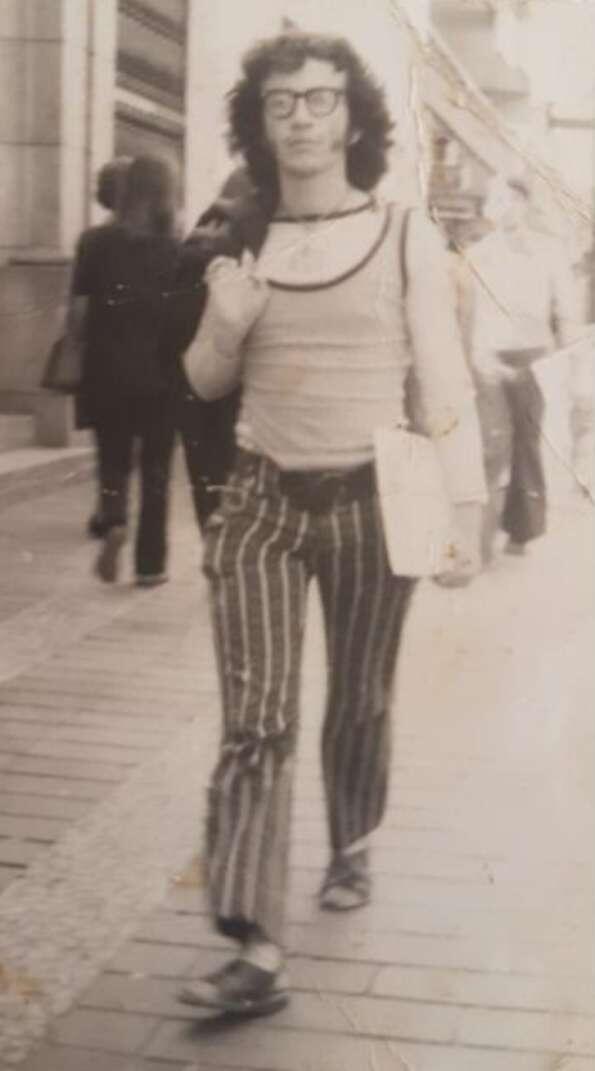
Posthumous work of the Colombian poet born in Don Matias on January 20, 1948.
Welcome to this blog dedicated to the Posthumous work of the Colombian poet Francisco Luis Arroyave Tabares (my father), born in Don Matias on January 20, 1948-2010. Where I will be publishing each of the 175 sonnets from his npublished collection 'Sonnets For The Twenty-First Century And A Circadian Musical (1984-1987).' Analyzed with GPT4 artificial intelligence and illustrated with AI tools... I hope you enjoy this garden of words snatched from the solitude of a locked room.
Likewise, any enthusiast of the sonnet form is invited to conduct their personal studies of Arroyave Tabares' work, as it is a collection that, although registered since 1989, has not yet been published.
Frank Duna
Analysis "One Thing Remains"
Introduction
Sonnet 70 by Francisco Luis Arroyave Tabares, titled "One Thing Remains," is a beautifully crafted poem that explores themes of self-realization, transformation, longing, and love.
Thematic Analysis
In the first quatrain, the speaker reflects on his past, acknowledging his youthful blindness that led him to value deceit and false self-enlargement (conceit). This suggests a period of self-deception and arrogance in his past, where he strayed from the truth and defended his inflated self-worth.
The second quatrain marks a shift in the speaker's life. He describes his transformation as an adventure, requiring patience and a change in perspective. The speaker has moved on to "other seas," a metaphor for new experiences or perspectives, and his "measures," or actions, now sing of hope in a more natural and truthful environment ("green woods").
The third quatrain introduces the timeless element that remains unchanged despite the speaker's transformation - his longing for the unnamed "you." His desires have not faded but have grown in the darkness, suggesting a sense of unfulfilled love or longing that persists despite his personal growth and change.
The concluding couplet reaffirms the speaker's enduring love. He promises to "rehearse love each day for a while," indicating his commitment to expressing his feelings, until he reaches the "kingdom of your smile," a metaphor for the reciprocation of his love or the happiness he seeks in the beloved's acceptance.
Overall, this sonnet is a journey of self-discovery and transformation, marked by enduring love. It beautifully captures the speaker's evolution from a self-deceptive youth to a more mature and truthful individual, all the while maintaining a deep, unchanging love for the unnamed "you."
Rhyme Scheme
The sonnet follows the Shakespearean rhyme scheme, which is ABAB CDCD EFEF GG. Let’s break it down:
Quatrain 1:
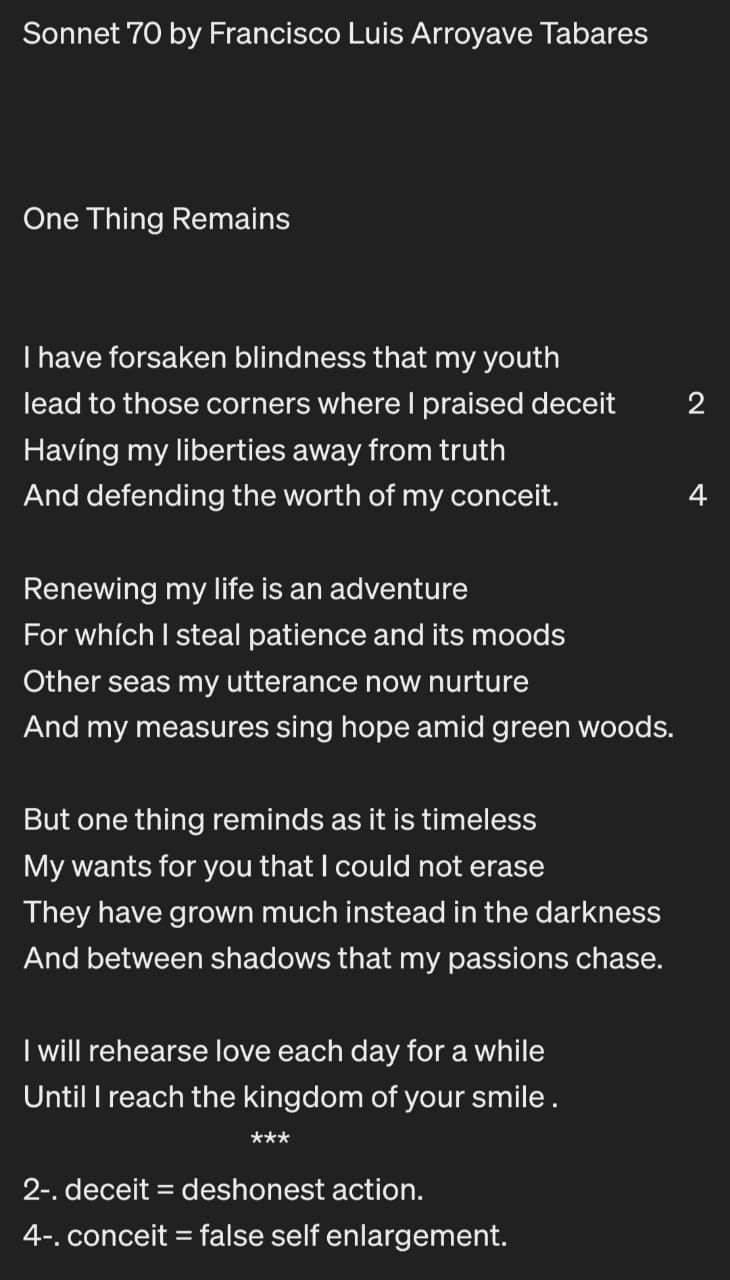
Line 1 (A): I have forsaken blindness that my youth
Line 2 (B): Lead to those corners where I praised deceit
Line 3 (A): Having my liberties away from truth
Line 4 (B): And defending the worth of my conceit.
Quatrain 2:
Line 5 (C): Renewing my life is an adventure
Line 6 (D): For which I steal patience and its moods
Line 7 (C): Other seas my utterance now nurture
Line 8 (D): And my measures sing hope amid green woods.
Quatrain 3:
Line 9 (E): But one thing reminds as it is timeless
Line 10 (F): My wants for you that I could not erase
Line 11 (E): They have grown much instead in the darkness
Line 12 (F): And between shadows that my passions chase.
Couplet:
Line 13 (G): I will rehearse love each day for a while
Line 14 (G): Until I reach the kingdom of your smile.
In this sonnet, each line ends with a word that rhymes with another line’s end word according to the pattern ABAB CDCD EFEF GG. This pattern is typical of a Shakespearean sonnet and helps to give the poem a rhythmic and harmonious sound. The final couplet (GG) often serves as a conclusion or a summary of the themes explored in the quatrains. In this case, it concludes with the speaker’s vow to continue loving until they reach the reciprocation of their feelings, symbolized by the “kingdom of your smile”.
Additional Aspects to Analyze
While we've covered the general themes, structure, and rhyme scheme of Sonnet 70 by Francisco Luis Arroyave Tabares, there are still several aspects that can be further analyzed, including the use of imagery, meter, and tone.
Language: The language used in the sonnet is formal and poetic, with a rich vocabulary. The poet uses words like “forsaken”, “deceit”, “conceit”, “utterance”, and “timeless”, which add depth and complexity to the poem.
Imagery: The sonnet is filled with vivid imagery that paints a picture in the reader’s mind. For instance, “Other seas my utterance now nurture” and “my measures sing hope amid green woods” create a sense of exploration and hope. The “darkness” and “shadows” in the third quatrain evoke a sense of mystery and longing.
Themes: The main themes of the sonnet are self-reflection, personal growth, enduring love, and hope. The speaker reflects on their past mistakes, embarks on a journey of self-improvement, and despite all changes, their love for someone remains constant.
Meter: The sonnet appears to follow the iambic pentameter, which is a common meter in English poetry and particularly in sonnets. In iambic pentameter, each line consists of five iambs, a metrical foot consisting of one unstressed syllable followed by one stressed syllable (da-DUM). For example, in the line “I have forsaken blindness that my youth”, “I have” is one iamb, “for-sa-” is another, and so on.
Overall, the sonnet is a beautifully crafted piece of poetry that explores the human condition through the lens of personal growth and enduring love. The use of formal language, vivid imagery, and traditional sonnet structure all contribute to its depth and complexity. The final couplet leaves the reader with a sense of hope and anticipation for the speaker’s love to be reciprocated. It’s a testament to the poet’s skill and creativity.
(GPT4)
Syllable count for each line
One Thing Remains


10 I have forsaken blindness that my youth
10 Iead to those corners where I praised deceit
10 Havíng my liberties away from truth
10 And defending the worth of my conceit.

10 Renewing my life is an adventure
9  For whích I steal patience and its moods
10 Other seas my utterance now nurture
10 And my measures sing hope amid green woods.

10 But one thing reminds as it is timeless
10 My wants for you that I could not erase
10 They have grown much instead in the darkness
10 And between shadows that my passions chase.

10 I will rehearse love each day for a while
10 Until I reach the kingdom of your smile.
                                  ***
Sonnets For The Twenty First Century And A Circadian Musical Written By Francisco Luis Arroyave Tabares (1984-1987)
Analyzed by GPT4; Image by leonardo.ai;
First published on Nostr Protocol by franciscoarroyavet@nostrplebs.com

One Thing Remains