
Posthumous work of the Colombian poet born in Don Matias on January 20, 1948.
Welcome to this blog dedicated to the Posthumous work of the Colombian poet Francisco Luis Arroyave Tabares (my father), born in Don Matias on January 20, 1948-2010. Where I will be publishing each of the 175 sonnets from his unpublished collection 'Sonnets For The Twenty-First Century And A Circadian Musical (1984-1987).' Analyzed with GPT4 artificial intelligence and illustrated with AI tools... I hope you enjoy this garden of words snatched from the solitude of a locked room.
Likewise, any enthusiast of the sonnet form is invited to conduct their personal studies of Arroyave Tabares' work, as it is a collection that, although registered since 1989, has not yet been published.
Frank Duna
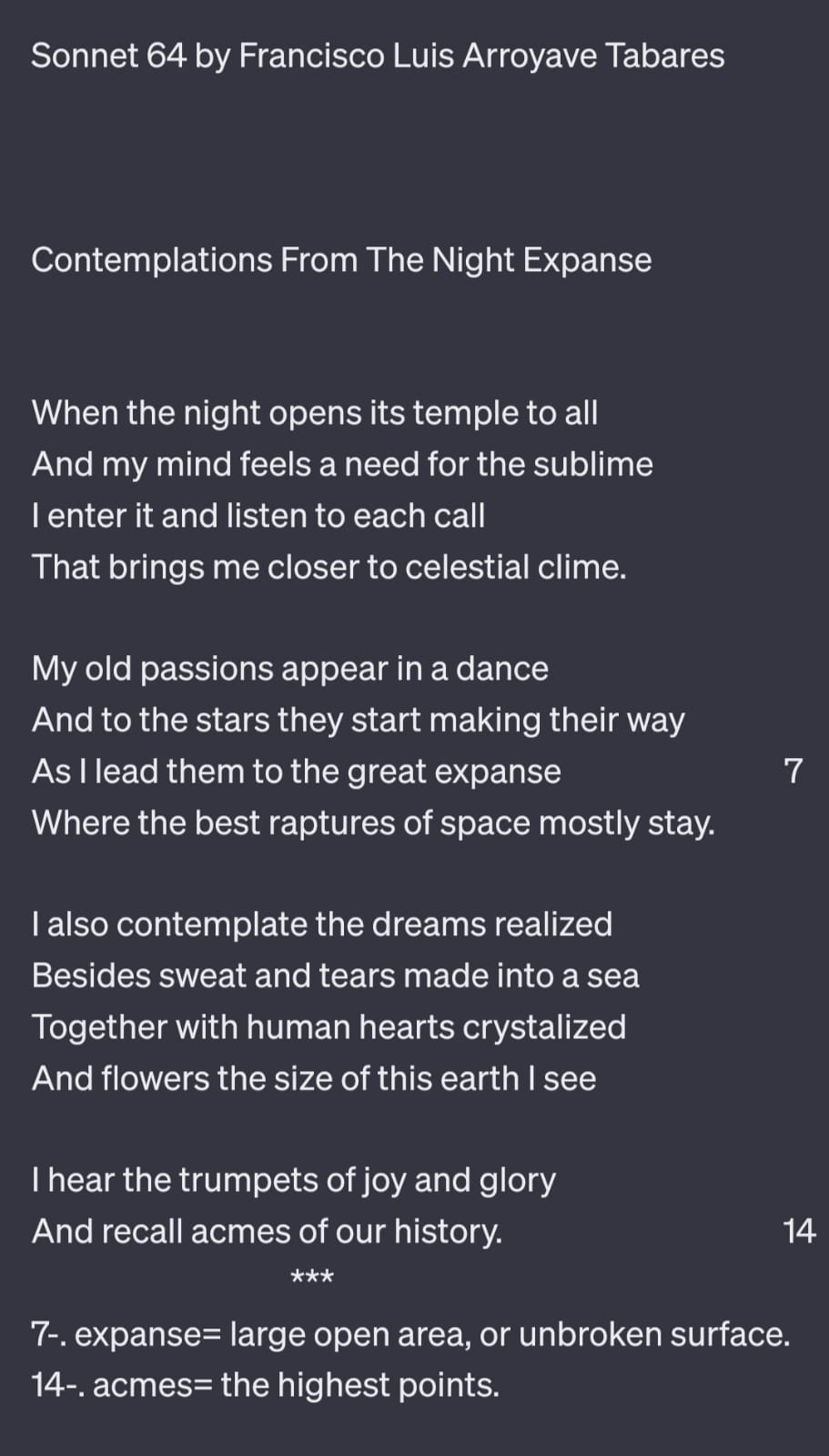
Analysis "Contemplations From The Night Expanse"
Introduction
This sonnet, written by Francisco Luis Arroyave Tabares, is a contemplative piece that explores the vastness of the night sky and the profound emotions it evokes. The speaker finds solace and inspiration in the night, using it as a metaphor for the human experience and the depth of our emotions and dreams.
Thematic Analysis
First Quatrain (lines 1-4): The speaker describes the opening of the night and their entrance into it, drawn by a need for the sublime. They listen to each call that brings them closer to the celestial realm. This quatrain sets the scene and introduces the theme of seeking the sublime in the celestial.
Second Quatrain (lines 5-8): The speaker’s old passions are personified, dancing and making their way to the stars. The speaker leads them to the great expanse, where the best raptures of space mostly stay. This quatrain continues the celestial journey, adding a layer of personal introspection and emotional depth.
Third Quatrain (lines 9-12): The speaker contemplates realized dreams, sweat and tears made into a sea, human hearts crystallized, and flowers the size of the earth. This quatrain introduces a more concrete reflection on human experiences and achievements, still within the celestial context.
Couplet (lines 13-14): The speaker hears the trumpets of joy and glory and recalls the highest points of our history. This couplet concludes the sonnet with a triumphant note, tying together the celestial journey with human achievement and history.
Overall, the sonnet uses celestial imagery to explore themes of human passion, achievement, and history. The speaker’s journey through the night sky serves as a metaphor for introspection and contemplation of the human condition. The sonnet beautifully blends the vastness of the cosmos with the depth of human emotion and experience.
Rhyme Scheme
The sonnet follows the ABAB CDCD EFEF GG rhyme scheme, which is typical of a Shakespearean sonnet. Here’s how it works:
First Quatrain (lines 1-4):
Line 1 (A): When the night opens its temple to all
Line 2 (B): And my mind feels a need for the sublime
Line 3 (A): I enter it and listen to each call
Line 4 (B): That brings me closer to celestial clime.
Second Quatrain (lines 5-8):
Line 5 (C): My old passions appear in a dance
Line 6 (D): And to the stars they start making their way
Line 7 (C): As I lead them to the great expanse
Line 8 (D): Where the best raptures of space mostly stay.
Third Quatrain (lines 9-12):
Line 9 (E): I also contemplate the dreams realized
Line 10 (F): Besides sweat and tears made into a sea
Line 11 (E): Together with human hearts crystalized
Line 12 (F): And flowers the size of this earth I see
Couplet (lines 13-14):
Line 13 (G): I hear the trumpets of joy and glory
Line 14 (G): And recall acmes of our history.
This rhyme scheme helps to structure the sonnet and guide its flow, creating a sense of unity and completeness. The final couplet (GG) often serves as a conclusion or summary, providing a satisfying resolution to the themes explored in the quatrains. In this sonnet, the couplet brings together the celestial journey with human achievement and history, tying together the themes of the poem.
Additional Aspects to Analyze
In addition to the rhyme scheme, there are several other aspects of Sonnet 64 that can be analyzed:
Language and Imagery: The language used in this sonnet is rich and evocative, with a strong emphasis on celestial and cosmic imagery. The poet uses phrases like “night opens its temple”, “celestial clime”, “great expanse”, and “raptures of space” to create a vivid picture of the night sky and the cosmos. This imagery serves to elevate the themes of the poem, making the reader feel as though they are embarking on a grand, celestial journey.
Themes: The main themes of the poem are introspection, human passion, achievement, and history. The speaker’s journey through the night sky serves as a metaphor for introspection and contemplation of the human condition. The poem beautifully blends the vastness of the cosmos with the depth of human emotion and experience.
Meter: The sonnet appears to be written in iambic pentameter, which is a common meter in English poetry and is particularly associated with sonnets. In iambic pentameter, each line consists of five iambs - pairs of syllables where the first is unstressed and the second is stressed. This gives the poem a rhythmic quality and helps to guide its flow.
Overall, this sonnet is a beautiful exploration of the human condition set against the backdrop of the cosmos. The poet skillfully uses language and imagery to create a vivid picture of the night sky, and uses this celestial journey as a metaphor for introspection and contemplation of human passion, achievement, and history. The use of iambic pentameter gives the poem a rhythmic quality and helps to guide its flow, while the traditional sonnet structure provides a sense of unity and completeness. The final couplet provides a satisfying resolution to the themes explored in the quatrains, tying together the celestial journey with human achievement and history. The sonnet is a testament to the power of poetry to explore deep and complex themes in a concise and structured form.
(GPT4)
Syllable count for each line
Contemplations From The Night Expanse


10 When the night opens its temple to all
10 And my mind feels a need for the sublime
10 I enter it and listen to each call
10 That brings me closer to celestial clime.

9  My old passions appear in a dance
10 And to the stars they start making their way
9  As I lead them to the great expanse
10 Where the best raptures of space mostly stay.

11 I also contemplate the dreams realized
10 Besides sweat and tears made into a sea
10 Together with human hearts crystalized
10 And flowers the size of this earth I see

10 I hear the trumpets of joy and glory
10 And recall acmes of our history .
                               ***
Sonnets For The Twenty First Century And A Circadian Musical Written By Francisco Luis Arroyave Tabares (1984-1987)
Analyzed by GPT4; Image by leonardo.ai
First published on Nostr Protocol by franciscoarroyavet@nostrplebs.com
 Contemplations From The Night Expanse