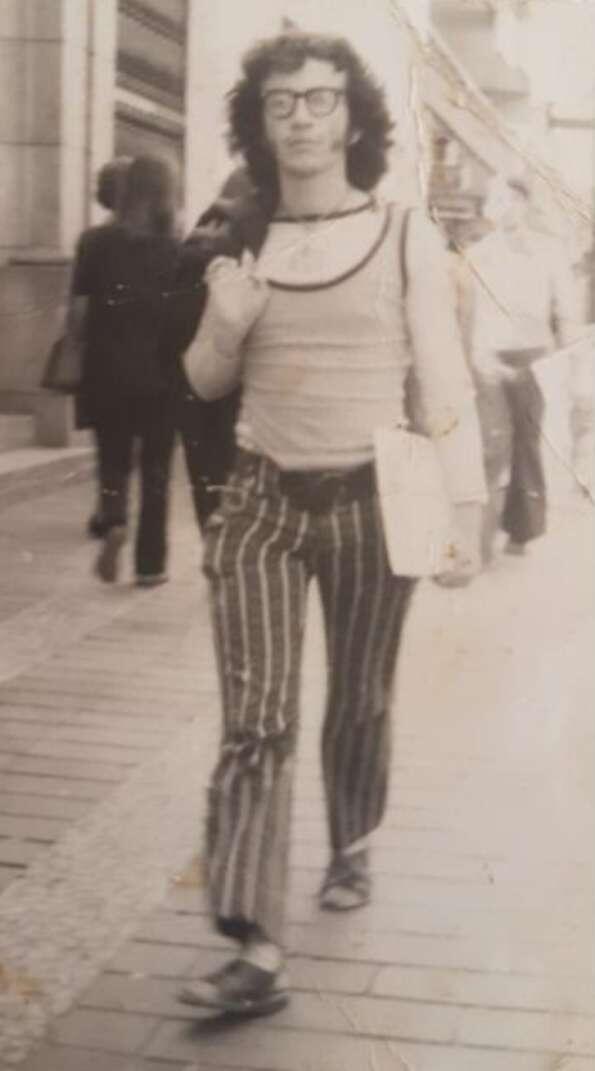
Posthumous work of the Colombian poet born in Don Matias on January 20, 1948.
Welcome to this blog dedicated to the Posthumous work of the Colombian poet Francisco Luis Arroyave Tabares (my father), born in Don Matias on January 20, 1948-2010. Where I will be publishing each of the 175 sonnets from his unpublished collection 'Sonnets For The Twenty-First Century And A Circadian Musical (1984-1987).' Analyzed with GPT4 artificial intelligence and illustrated with AI tools... I hope you enjoy this garden of words snatched from the solitude of a locked room.
Likewise, any enthusiast of the sonnet form is invited to conduct their personal studies of Arroyave Tabares' work, as it is a collection that, although registered since 1989, has not yet been published.
Frank Duna
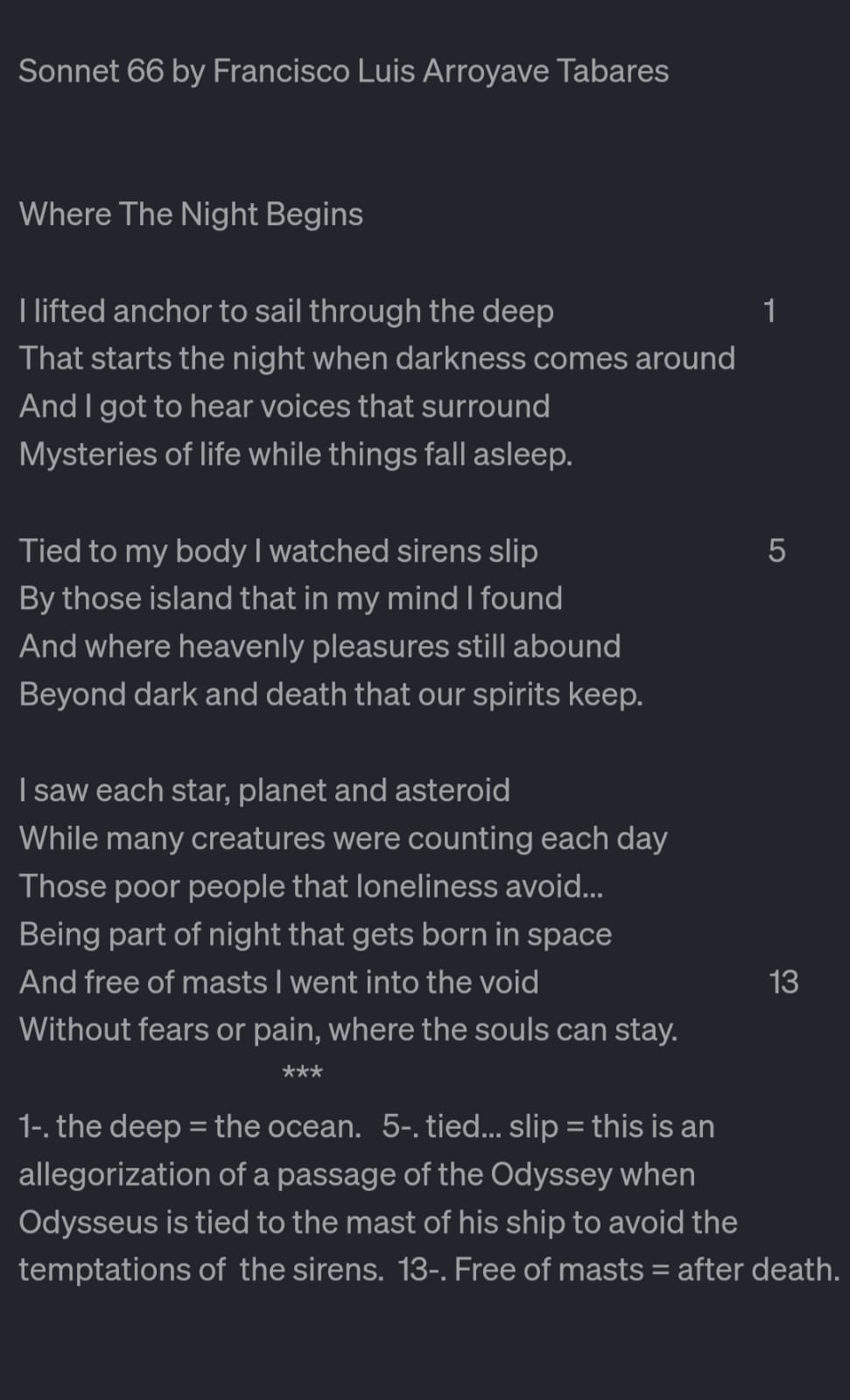
Analysis "Where The Night Begins"
Introduction
The sonnet "Where The Night Begins" by Francisco Luis Arroyave Tabares explores the concept of the unknown, both in the physical world and in the spiritual realm.
Thematic Analysis
Octave (lines 1-8): The octave introduces the speaker’s journey into the night, symbolizing a journey into the unknown or perhaps the subconscious. The speaker hears voices that reveal life’s mysteries as the world falls asleep, suggesting a journey into deeper understanding or introspection. The reference to the sirens and the islands in the speaker’s mind alludes to the Odyssey, indicating a personal journey fraught with temptations and challenges. The octave ends with a contemplation of life, death, and the spirit, setting a contemplative and somewhat somber tone.
Sextet (lines 9-14): The sextet continues the celestial journey, observing stars, planets, and asteroids, perhaps symbolizing the vastness of the universe and our small place within it. The speaker notes the loneliness of people, possibly reflecting on the human condition. The final lines describe becoming part of the night born in space, and entering the void free of masts (symbolizing death), where souls can exist without fear or pain. This could be interpreted as a longing for peace, release, or transcendence.
Overall, the sonnet explores themes of life, death, the human condition, and the quest for understanding and peace. It uses rich imagery and allusion to convey a deep and introspective journey. The octave sets up the journey and its challenges, while the sextet brings the speaker’s observations and the ultimate desire for peace and freedom. The sonnet beautifully balances the exploration of external (celestial bodies, the night) and internal (loneliness, fear, peace) landscapes.
Rhyme Scheme
Let’s analyze the rhyme scheme of the sonnet “Where The Night Begins” by Francisco Luis Arroyave Tabares. The rhyme scheme is ABBA ABBA CDC DCD, which is a variant of the Petrarchan sonnet form.
Octave (lines 1-8): The rhyme scheme for the octave is ABBA ABBA. Let’s see how this works in the poem:
A: I lifted anchor to sail through the deep (1)
B: That starts the night when darkness comes around (2)
B: And I got to hear voices that surround (3)
A: Mysteries of life while things fall asleep. (4)

A: Tied to my body I watched sirens slip (5)
B: By those island that in my mind I found (6)
B: And where heavenly pleasures still abound (7)
A: Beyond dark and death that our spirits keep. (8)
Sextet (lines 9-14): The rhyme scheme for the sextet is CDC DCD. Let’s see how this works in the poem:
C: I saw each star, planet and asteroid (9)
D: While many creatures were counting each day (10)
C: Those poor people that loneliness avoid… (11)

D: Being part of night that gets born in space (12)
C: And free of masts I went into the void (13)
D: Without fears or pain, where the souls can stay. (14)
This detailed analysis shows how the poet has structured the sonnet with a specific rhyme scheme, which adds a rhythmic quality to the poem and enhances its overall impact. The ABBA ABBA pattern in the octave creates a mirrored effect, while the CDC DCD pattern in the sextet provides a sense of closure to the poem. This intricate rhyme scheme contributes to the beauty and depth of the sonnet.
Additional Aspects to Analyze
In addition to analyzing the poem's structure and rhyme scheme, there are other elements that are worth exploring to gain a deeper understanding of the poem. Some of these elements include:
Language and Imagery: The language used in the sonnet is rich and evocative, creating vivid imagery that engages the reader’s senses and imagination. The poet uses metaphors such as “I lifted anchor to sail through the deep” and “Tied to my body I watched sirens slip” to create a sense of journey and exploration. The imagery of the night, stars, planets, and asteroids paints a picture of a vast, mysterious universe, reflecting the inner journey of the speaker.
Themes: The sonnet explores several themes, including life, death, the human condition, and the quest for understanding and peace. The journey into the night can be seen as a metaphor for the exploration of the unknown or the subconscious. The reference to the sirens and the islands in the speaker’s mind suggests a personal journey fraught with temptations and challenges. The contemplation of life, death, and the spirit in the octave, and the longing for peace, release, or transcendence in the sextet, further deepen these themes.
Meter: The sonnet follows the traditional iambic pentameter, which is a line of verse with five metrical feet, each consisting of one short (or unstressed) syllable followed by one long (or stressed) syllable. This gives the poem a rhythmic quality and enhances its overall impact.
Overall, “Where The Night Begins” is a beautifully crafted sonnet that uses rich language and imagery to explore deep and introspective themes. The poet skillfully balances the exploration of external (celestial bodies, the night) and internal (loneliness, fear, peace) landscapes, creating a poem that is both thought-provoking and emotionally resonant. The intricate rhyme scheme and the use of iambic pentameter add to the beauty and depth of the sonnet. It’s a wonderful example of the power of poetry to convey complex ideas and emotions.
(GPT4)
Syllable count for each line
Where The Night Begins


10 I lifted anchor to sail through the deep
10 That starts the night when darkness comes around
10 And I got to hear voices that surround
10 Mysteries of life while things fall asleep.

10 Tied to my body I watched sirens slip
10 By those island that in my mind I found
10 And where heavenly pleasures still abound
10 Beyond dark and death that our spirits keep.

10 I saw each star, planet and asteroid
10 While many creatures were counting each day
10 Those poor people that loneliness avoid...
10 Being part of night that gets born in space
10 And free of masts I went into the void
10 Without fears or pain, where the souls can stay.
                                         ***
Sonnets For The Twenty First Century And A Circadian Musical Written By Francisco Luis Arroyave Tabares (1984-1987)
Analyzed by GPT4; Image by leonardo.ai;
First published on Nostr Protocol by franciscoarroyavet@nostrplebs.com
 Where The Night Begins