
Posthumous work of the Colombian poet born in Don Matias on January 20, 1948.
Welcome to this blog dedicated to the Posthumous work of the Colombian poet Francisco Luis Arroyave Tabares (my father), born in Don Matias on January 20, 1948-2010. Where I will be publishing each of the 175 sonnets from his unpublished collection 'Sonnets For The Twenty-First Century And A Circadian Musical (1984-1987).' Analyzed with GPT4 artificial intelligence and illustrated with AI tools... I hope you enjoy this garden of words snatched from the solitude of a locked room.
Likewise, any enthusiast of the sonnet form is invited to conduct their personal studies of Arroyave Tabares' work, as it is a collection that, although registered since 1989, has not yet been published.
Frank Duna
Analysis "Hestia And Hathor"
Introduction
Sonnet 102, titled "Hestia And Hathor," is a beautiful piece of poetry that explores themes of love, time, transformation, and the divine.
Thematic Analysis
First Quatrain: The speaker expresses a sense of optimism and possibility, attributing these feelings to the growth of love in his heart. The imagery of “a spray of fantasies” and “heaven is somewhere now visible” suggests a transformative power of love that makes the impossible seem possible.
Second Quatrain: The speaker uses the metaphor of time as a “fair butterfly” that glides on “soft winds” born in the mouth of the beloved. This contrasts with the past “days of murkiness” when time felt like a “prickly thorn”. This suggests a shift from a harsh past to a more pleasant present, brought about by the presence of the beloved.
Third Quatrain: The speaker introduces Hestia and Hathor, goddesses symbolizing the hearth and love respectively. Their arrival brings a “new air and look” to the speaker’s home, indicating a positive change. The speaker also mentions being bound by the beloved’s gaze, suggesting a deep connection and possibly a sense of captivity in love.
Couplet: The couplet concludes the sonnet with a cosmic image of stars rendezvousing in their bodies and heating their blood with passion’s melody. This could symbolize the intense physical and emotional connection between the speaker and the beloved.
Overall, the sonnet explores themes of love, transformation, and the power of divine intervention in human affairs. The speaker’s emotions and experiences are vividly portrayed through rich metaphors and references to mythology. The sonnet beautifully captures the transformative power of love and the profound impact it can have on one’s perception of time, space, and reality.
Rhyme Scheme
The sonnet “Hestia And Hathor” follows the Shakespearean sonnet rhyme scheme, which is ABABCDCDEFEFGG. Here’s a breakdown of the rhyme scheme in this sonnet:
First Quatrain (ABAB):
A: through
B: possible
A: grew
B: visible
Second Quatrain (CDCD):
C: harmless
D: born
C: murkiness
D: thorn
Third Quatrain (EFEF):
E: around
F: look
E: bound
F: undertook
Couplet (GG):
G: body
G: melody
In each quatrain, the first and third lines rhyme with each other, and the second and fourth lines form another pair of rhyming lines. The final two lines of the sonnet form a rhyming couplet. This pattern creates a clear and pleasing rhythm to the poem, and it also helps to emphasize the themes and emotions expressed in each section of the sonnet. The final rhyming couplet often serves as a summary or conclusion, providing a satisfying closure to the poem. In this sonnet, the final couplet “The stars will rendezvous in our body / And heat our blood with passions melody” beautifully encapsulates the intense love and passion expressed throughout the poem.
Additional Aspects
Let’s delve deeper into the sonnet “Hestia And Hathor” by Francisco Luis Arroyave Tabares.
Language: The language used in the sonnet is rich and poetic, with a strong emphasis on metaphor and imagery. The diction is sophisticated, and the syntax is complex, with phrases like “a spray of fantasies” and “Time is a fair butterfly with harmless glides”. The use of archaic language, such as “thee” and “thou”, adds a touch of antiquity and formality to the poem.
Imagery: The sonnet is filled with vivid imagery that brings the themes and emotions to life. For example, “a spray of fantasies” and “heaven is somewhere now visible” create a sense of wonder and possibility, while “Time is a fair butterfly with harmless glides” and “days of murkiness” contrast the pleasant present with a harsh past. The final image of stars rendezvousing in their bodies and heating their blood with passion’s melody is particularly striking, symbolizing the intense physical and emotional connection between the speaker and the beloved.
Themes: The main themes of the sonnet are love, transformation, and divine intervention. Love is portrayed as a powerful force that can transform one’s perception of time and reality, as seen in the shift from “days of murkiness” to a time when “all things are possible”. The arrival of the goddesses Hestia and Hathor symbolizes divine intervention, suggesting that love can bring about positive changes and blessings.
Meter: The sonnet follows the iambic pentameter, which is a common meter in English poetry. Each line consists of five pairs of unstressed and stressed syllables, creating a rhythmic pattern that enhances the musicality of the poem.
Overall: “Hestia And Hathor” is a beautifully crafted sonnet that explores the transformative power of love through rich language, vivid imagery, and deep themes. The use of mythology adds a layer of complexity and depth to the poem, while the strict structure and rhythm of the sonnet form provide a pleasing framework for the expression of these ideas. The sonnet is a testament to the power of poetry to capture and convey the complexities and nuances of human emotion.
(GPT4)
Syllable count for each line.
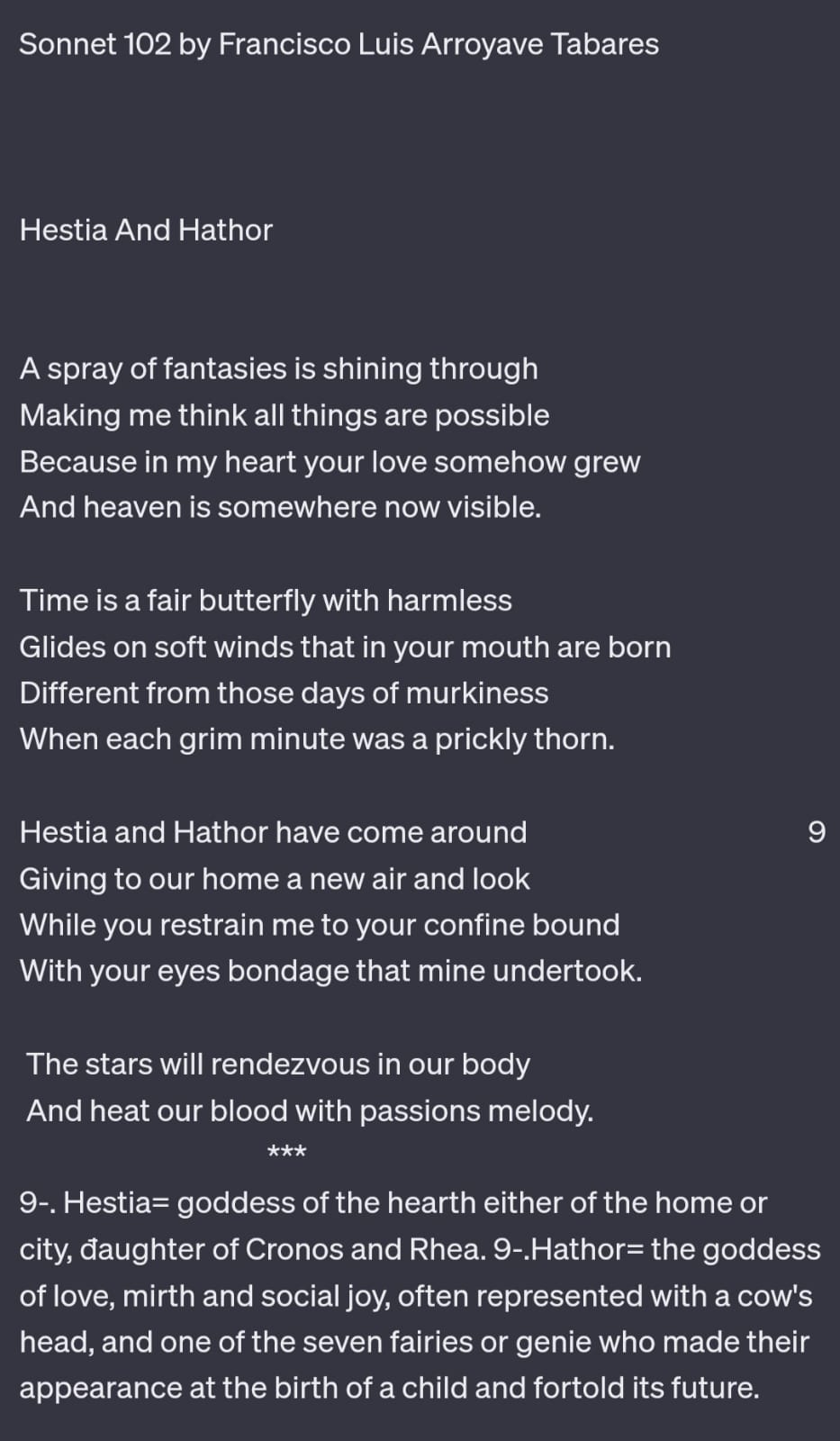
Hestia And Hathor


10 A spray of fantasies is shining through
10 Making me think all things are possible
10 Because in my heart your love somehow grew
10 And heaven is somewhere now visible.

10 Time is a fair butterfly with harmless
10 Glides on soft winds that in your mouth are born
10 Different from those days of murkiness
10 When each grim minute was a prickly thorn.

10 Hestia and Hathor have come around
10 Giving to our home a new air and look
10 While you restrain me to your confine bound
10 With your eyes bondage that mine undertook.

10  The stars will rendezvous in our body
10  And heat our blood with passions melody.
                                       ***
Sonnets For The Twenty First Century And A Circadian Musical Written By Francisco Luis Arroyave Tabares (1984-1987)
Analyzed by GPT4; Image by leonardo.ai;
First published on Nostr Protocol by franciscoarroyavet@nostrplebs.com
 *Hestia And Hathor