
Posthumous work of the Colombian poet born in Don Matias on January 20, 1948.
Welcome to this blog dedicated to the Posthumous work of the Colombian poet Francisco Luis Arroyave Tabares (my father), born in Don Matias on January 20, 1948-2010. Where I will be publishing each of the 175 sonnets from his unpublished collection 'Sonnets For The Twenty-First Century And A Circadian Musical (1984-1987).' Analyzed with GPT4 artificial intelligence and illustrated with AI tools... I hope you enjoy this garden of words snatched from the solitude of a locked room.
Likewise, any enthusiast of the sonnet form is invited to conduct their personal studies of Arroyave Tabares' work, as it is a collection that, although registered since 1989, has not yet been published.
Frank Duna
Analysis "Ceasing To Be"
Introduction
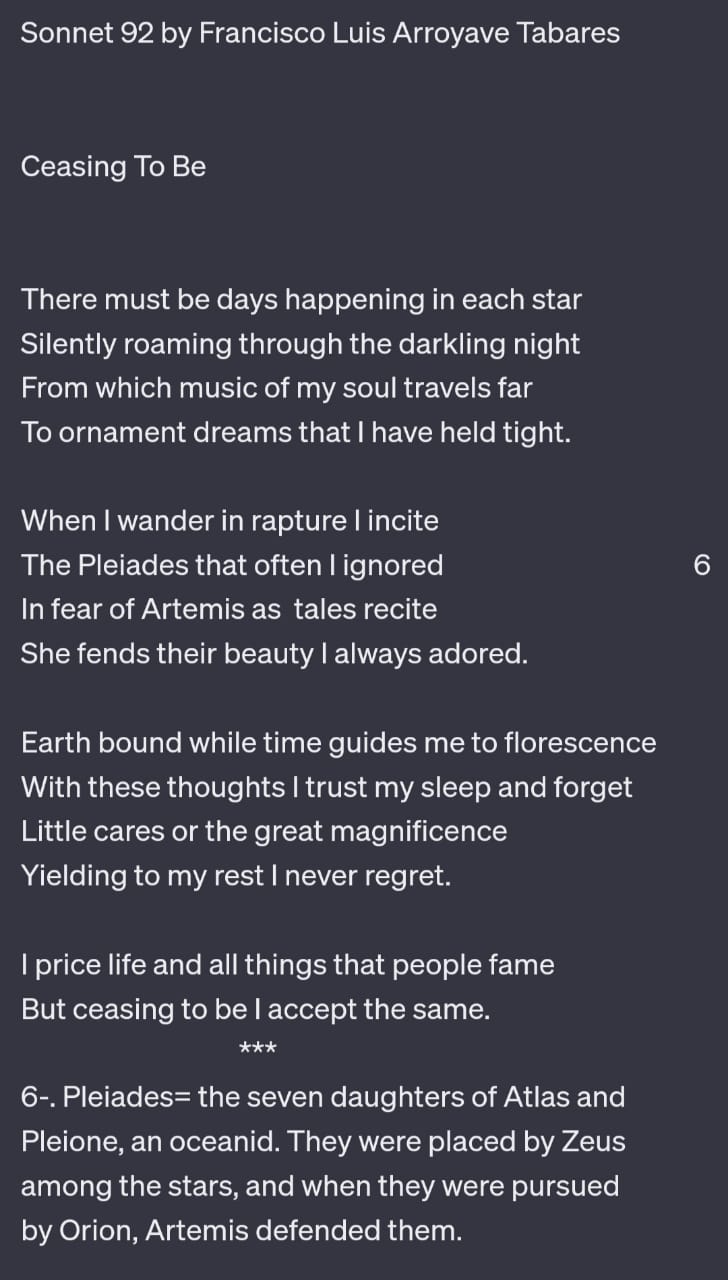
Sonnet 92 by Francisco Luis Arroyave Tabares, titled "Ceasing To Be," is a contemplative piece that explores the themes of existence, mortality, and the sublime beauty of the universe.
Thematic Analysis
First Quatrain: The first quatrain introduces the theme of the poem. The speaker talks about days that are happening in each star, symbolizing the vastness of the universe and the speaker’s connection to it. The music of the speaker’s soul travels far to ornament dreams, suggesting a deep introspection and spiritual journey.
Second Quatrain: In the second quatrain, the speaker refers to the Pleiades, a cluster of stars, which he often ignored due to fear of Artemis, the Greek goddess who defended them. This could symbolize the speaker’s fear of exploring certain aspects of life or self, represented by the beauty of the Pleiades.
Third Quatrain: The third quatrain talks about the speaker being earthbound while time guides him to florescence. He trusts his sleep and forgets little cares or the great magnificence, indicating a surrender to the natural process of life and time.
Couplet: The final couplet reveals the speaker’s acceptance of life and all its fame, but also the inevitability of ceasing to exist. This acceptance of mortality brings a sense of peace and resolution to the poem.
Overall, the sonnet explores themes of introspection, connection with the universe, fear, time, and acceptance of mortality. The use of celestial imagery adds a layer of depth and complexity to these themes. The sonnet beautifully captures the human condition and our place in the universe.
Rhyme Scheme
The sonnet follows the rhyme scheme of a Shakespearean sonnet, which is abab cdcd efef gg. Let’s break it down:
First Quatrain (abab):
“star” (a)
“night” (b)
“far” (a)
“tight” (b)
Second Quatrain (cdcd):
“incite” (c)
“ignored” (d)
“recite” (c)
“adored” (d)
Third Quatrain (efef):
“florescence” (e)
“forget” (f)
“magnificence” (e)
“regret” (f)
Couplet (gg):
“fame” (g)
“same” (g)
In each quatrain, the first and third lines rhyme with each other, and the second and fourth lines rhyme with each other. The final two lines form a rhymed couplet. This structure creates a clear and rhythmic pattern that guides the flow of the poem. It’s a common structure in English sonnets and is often used to build and then resolve a theme or argument. In this case, the theme revolves around introspection, connection with the universe, and acceptance of mortality. The final couplet provides a resolution or conclusion to these themes.
Additional Aspects
Let’s delve deeper into the analysis of “Ceasing To Be” by Francisco Luis Arroyave Tabares:
Language: The language used in the sonnet is rich and poetic, with a formal tone that is characteristic of traditional sonnets. The poet uses sophisticated vocabulary and complex sentence structures, which adds depth and complexity to the poem.
Imagery: The sonnet is filled with celestial imagery, such as “days happening in each star,” “music of my soul travels far,” and references to the Pleiades and Artemis. This imagery creates a sense of vastness and infinity, and it also symbolizes the speaker’s introspective journey and connection with the universe.
Themes: The main themes of the sonnet are introspection, connection with the universe, fear, time, and acceptance of mortality. The speaker explores these themes through his reflections on his place in the universe, his fears and desires, and his acceptance of the natural process of life and death.
Meter: Each line has 10 syllables and follows the iambic pentameter pattern. The final couplet often delivers the resolution or “punchline” of the sonnet, and the consistent meter helps to emphasize this conclusion.
Overall: the sonnet is a profound exploration of the human condition and our place in the universe. The use of celestial imagery, combined with the themes of introspection and acceptance of mortality, creates a sonnet that is both thought-provoking and emotionally resonant. The poet’s skillful use of language and structure enhances these themes and contributes to the overall impact of the poem. The sonnet leaves the reader with a sense of peace and resolution, as well as a deeper understanding of the themes explored. It’s a beautiful piece of poetry that captures the complexity and beauty of human existence.
(GPT4)
Syllable count for each line.
Ceasing To Be


10 There must be days happening in each star
10 Silently roaming through the darkling night
10 From which music of my soul travels far
10 To ornament dreams that I have held tight.

10 When I wander in rapture I incite
10 The Pleiades that often I ignored
10 In fear of Artemis as  tales recite
10 She fends their beauty I always adored.

10 Earth bound while time guides me to florescence
10 With these thoughts I trust my sleep and forget
10 Little cares or the great magnificence
10 Yielding to my rest I never regret.

10 I price life and all things that people fame
10 But ceasing to be I accept the same.
                                      ***
Sonnets For The Twenty First Century And A Circadian Musical Written By Francisco Luis Arroyave Tabares (1984-1987)
Analyzed by GPT4; Image by leonardo.ai;
First published on Nostr Protocol by franciscoarroyavet@nostrplebs.com
 Ceasing To Be