
Posthumous work of the Colombian poet born in Don Matias on January 20, 1948
Welcome to this blog dedicated to the Posthumous work of the Colombian poet Francisco Luis Arroyave Tabares (my father), born in Don Matias on January 20, 1948-2010. Where I will be publishing each of the 175 sonnets from his unpublished collection 'Sonnets For The Twenty-First Century And A Circadian Musical (1984-1987).' Analyzed with GPT4 artificial intelligence and illustrated with AI tools... I hope you enjoy this garden of words snatched from the solitude of a locked room.
Likewise, any enthusiast of the sonnet form is invited to conduct their personal studies of Arroyave Tabares' work, as it is a collection that, although registered since 1989, has not yet been published.
Frank Duna
Analysis "Earth Weeping In Pain"
Introduction
"Earth Weeping In Pain" by Francisco Luis Arroyave Tabares is a contemplative poem that explores themes of love, human nature, the passage of time, and the relationship between humanity and the earth. The poem is structured in four main sections, each followed by a shorter stanza that serves as a reflection or commentary on the preceding section.
Thematic Analysis
In the first section, the speaker describes witnessing love and beauty in nature, as well as feelings of guilt for the suffering of the less fortunate. The earth is personified as weeping in pain, burdened by the weight of human actions. The following short stanza introduces the idea of youth and the persistence of memories, suggesting that the speaker's soul refuses to age.
The second section discusses the power of words and the collective lament of the earth's suffering. It touches on themes of redemption and forgiveness, as well as the human desire to seek pleasure and fill the void left by past actions. The subsequent short stanza suggests that tragedy can transform into a blessing, as hope and the will to rise above adversity emerge.
In the third section, the speaker contemplates the cyclical nature of life and the interplay between life and death. The poem questions why humans fear the end and why they have forgotten the joys of their existence, instead of focusing on the challenges and conflicts they face. The following short stanza describes a theatrical scene, perhaps symbolizing the performative nature of human life.
The final section considers the limitations of human knowledge and the potential need to return to nature for solutions. The poem acknowledges the inevitability of human longing and the desire to connect with the cosmos. The closing short stanza reiterates the theme of the earth's pain, suggesting that it may change or transform into something else.
Overall, "Earth Weeping In Pain" is a reflective and introspective poem that delves into the complexities of human existence, the passage of time, and the relationship between humanity and the natural world. The poem encourages readers to consider their own actions and the impact they have on the earth, as well as the potential for hope, redemption, and transformation.
Structure and Rhyme Scheme
"Earth Weeping In Pain" by Francisco Luis Arroyave Tabares features a combination of different rhyme schemes throughout the poem. The poem is divided into four main sections, each followed by a shorter stanza. Let's analyze the rhyme scheme in each section and the shorter stanzas.
Section I:
The rhyme scheme in this section follows the pattern ABAB CDCD EFEF GG, with three quatrains and a final rhyming couplet.
Short stanza after Section I:
The rhyme scheme in this short stanza is AABB, which is a simple quatrain with alternating rhymes.
Section II:
This section, like the previous one,follows the Shakespearean sonnet form, with a rhyme scheme of ABAB CDCD EFEF GG.
Short stanza after Section II:
The rhyme scheme in this short stanza is AABBA, which is a limerick form. Limericks are typically humorous and have a distinct rhythm, but in this case, the content is more serious and reflective.
Section III:
This section follows a petrarchan sonnet form, with a rhyme scheme of ABBA ABBA CDC DCD.
Short stanza after Section III:
The rhyme scheme in this short stanza is AABCC, which is a cinquain with an alternating rhyme pattern.
Section IV:
This section, like the previous one, follows the same petrarchan sonnet form, with a rhyme scheme of ABBA ABBA CDC DCD.
Short stanza after Section IV:
The rhyme scheme in this short stanza is AABBA, which is the same limerick form as the short stanza after Section II.
In summary, the main sections of the poem follow the Shakespearean and Petrarchan sonnet form, while the shorter stanzas between the sections have different rhyme schemes, including AABB, AABBA, and AABCC. This combination of rhyme schemes adds variety and interest to the poem, while also providing a sense of structure and cohesion.
Analysis of Aspects
The use of varied rhyme schemes in "Earth Weeping In Pain" contributes to the poem's overall structure and impact. The combination of the Shakespearean and petrarchan sonnet form in the main sections and the different rhyme schemes in the shorter stanzas creates a sense of balance and contrast. Here are some additional insights into the poem's structure and the role of rhyme:
1. Connection to tradition: By using the Shakespearean and petrarchan sonnet form in the main sections, the poet connects the poem to a long-standing tradition in literature. Sonnets have been used for centuries to explore themes of love, nature, and the human condition, which are also central to this poem.
2. Contrast and emphasis: The different rhyme schemes in the shorter stanzas create a contrast with the main sections, emphasizing the reflective and introspective nature of these stanzas. The varied rhyme schemes also serve to break up the poem, making it more accessible and engaging for the reader.
3. Musicality and rhythm: The use of rhyme contributes to the poem's musicality and rhythm, making it more enjoyable to read and easier to remember. The combination of different rhyme schemes adds variety and interest, preventing the poem from becoming monotonous or predictable.
4. Reinforcing themes and ideas: The varied rhyme schemes can also be seen as a reflection of the poem's themes and ideas. The poem explores the complexities of human existence, the passage of time, and the relationship between humanity and the natural world. The use of different rhyme schemes mirrors these complexities and reinforces the idea that life is multifaceted and ever-changing.
5. Unity and coherence: Despite the varied rhyme schemes, the poem maintains a sense of unity and coherence. The Shakespearean and petrarchan sonnet form provides a consistent structure for the main sections, while the shorter stanzas serve as interludes that connect and comment on the preceding sections.
In conclusion, the use of varied rhyme schemes in "Earth Weeping In Pain" enhances the poem's structure, musicality, and thematic depth. The combination of the Shakespearean and Petrarchan sonnet form and the different rhyme schemes in the shorter stanzas creates a sense of balance and contrast, while also reinforcing the poem's themes and ideas. This intricate structure contributes to the poem's overall impact and invites readers to engage with its content on multiple levels.
(GPT4)
Syllable count for each line.
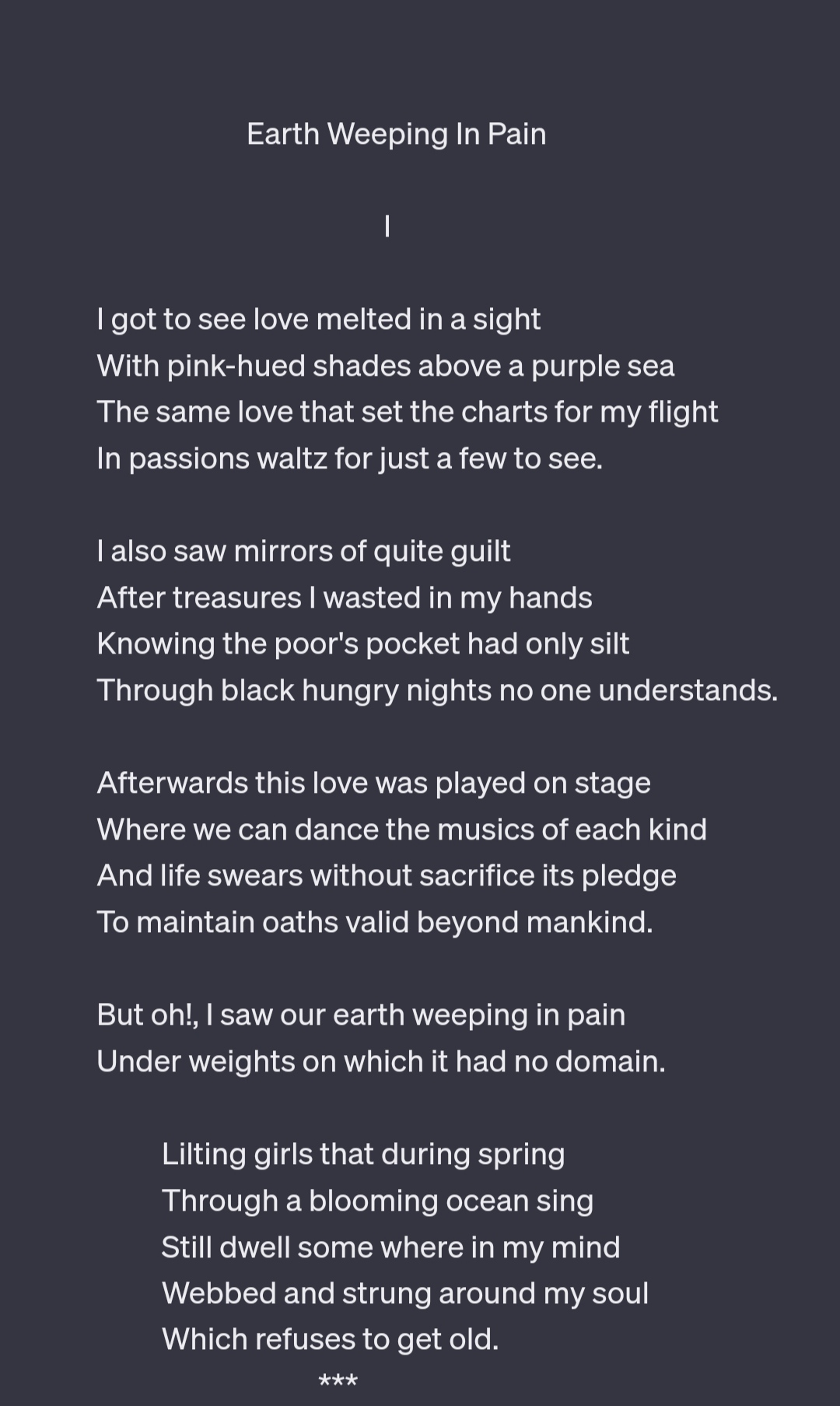
Earth Weeping In Pain

I

10 I got to see love melted in a sight
10 With pink-hued shades above a purple sea
10 The same love that set the charts for my flight
10 In passions waltz for just a few to see.

9   I also saw mirrors of quite guilt
10 After treasures I wasted in my hands
10 Knowing the poor's pocket had only silt
10 Through black hungry nights no one understands.

9   Afterwards this love was played on stage
10 Where we can dance the musics of each kind
10 And life swears without sacrifice its pledge
10 To maintain oaths valid beyond mankind.

10 But oh!, I saw our earth weeping in pain
10 Under weights on which it had no domain.

7 Lilting girls that during spring
7 Through a blooming ocean sing
7 Still dwell some where in my mind
7 Webbed and strung around my soul
7 Which refuses to get old.

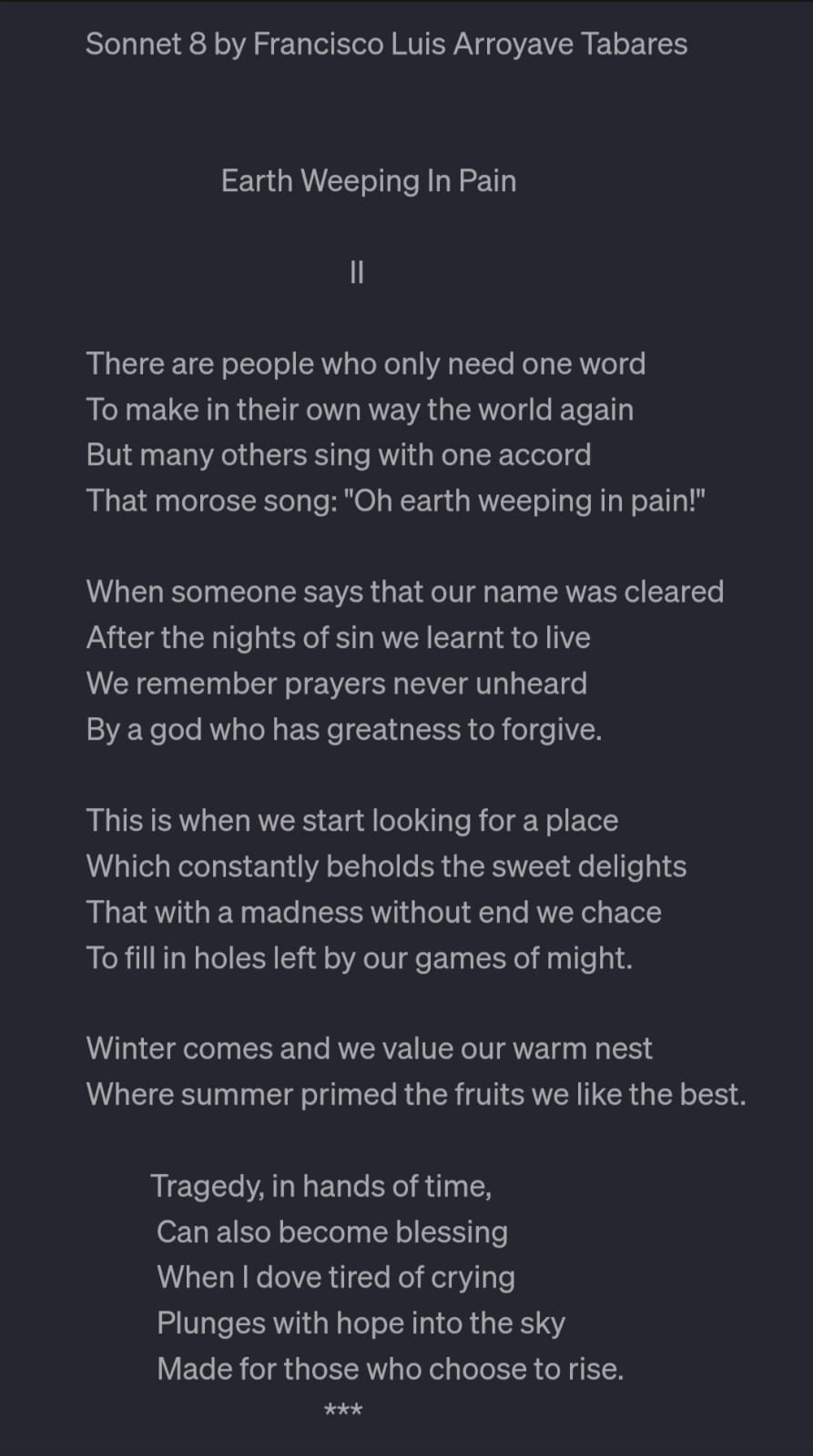
II

10 There are people who only need one word
10 To make in their own way the world again
10 But many others sing with one accord
10 That morose song: "Oh earth weeping in pain!"

9   When someone says that our name was cleared
10 After the nights of sin we learnt to live
10 We remember prayers never unheard
10 By a god who has greatness to forgive.

10 This is when we start looking for a place
10 Which constantly beholds the sweet delights
10 That with a madness without end we chace
10 To fill in holes left by our games of might.

10 Winter comes and we value our warm nest
10Where summer primed the fruits we like the best.

7 Tragedy, in hands of time,
7 Can also become blessing
7 When I dove tired of crying
8 Plunges with hope into the sky
7 Made for those who choose to rise.

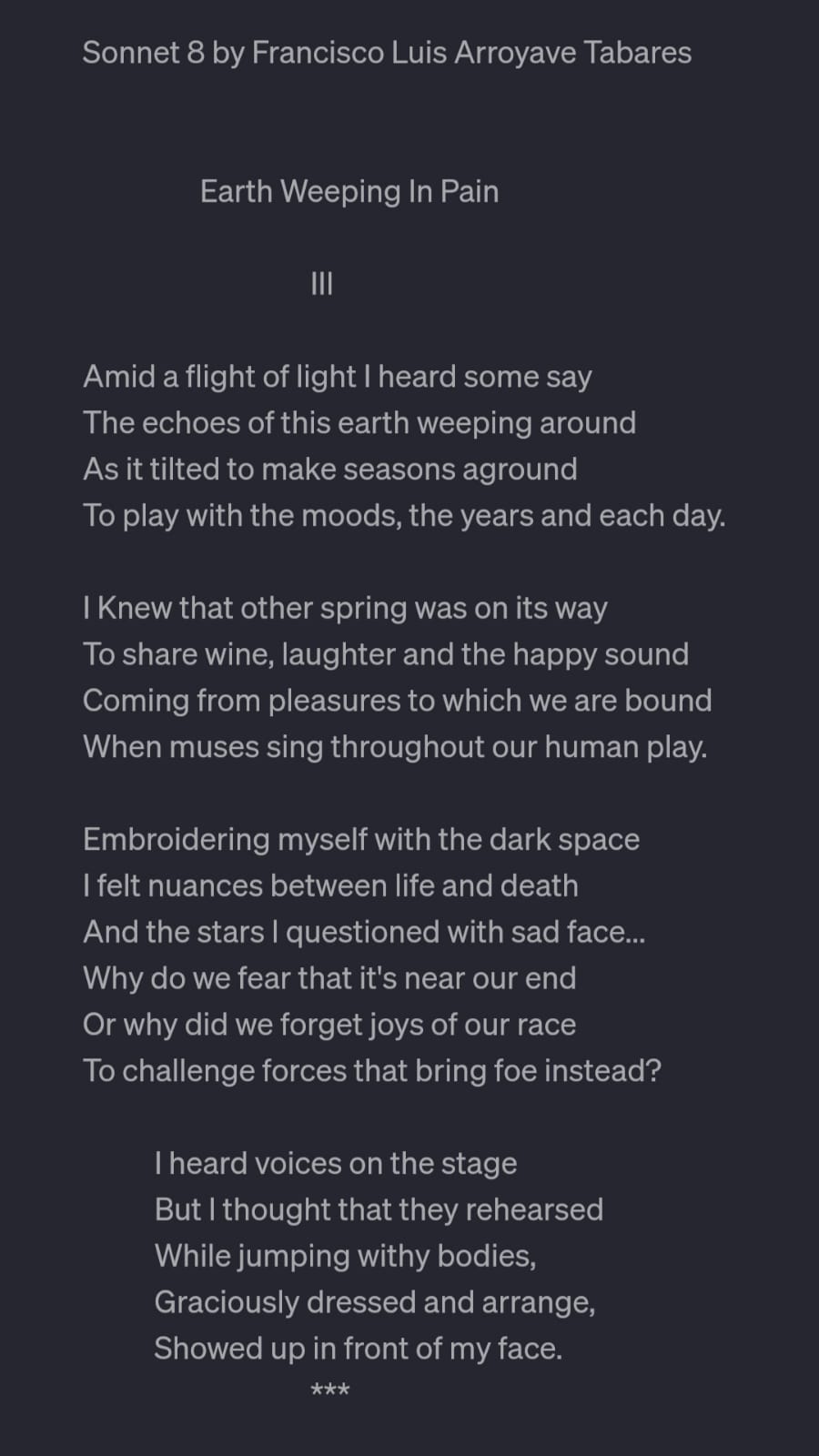
III

10 Amid a flight of light I heard some say
10 The echoes of this earth weeping around
10 As it tilted to make seasons aground
10 To play with the moods, the years and each day.

10 I Knew that other spring was on its way
10 To share wine, laughter and the happy sound
10 Coming from pleasures to which we are bound
10 When muses sing throughout our human play.
10 Embroidering myself with the dark space

10 I felt nuances between life and death
9  And the stars I questioned with sad face...
9  Why do we fear that it's near our end
10 Or why did we forget joys of our race
10 To challenge forces that bring foe instead?

7 I heard voices on the stage
7 But I thought that they rehearsed
7 While jumping withy bodies,
7 Raciously dressed and arrange,
7 Showed up in front of my face.

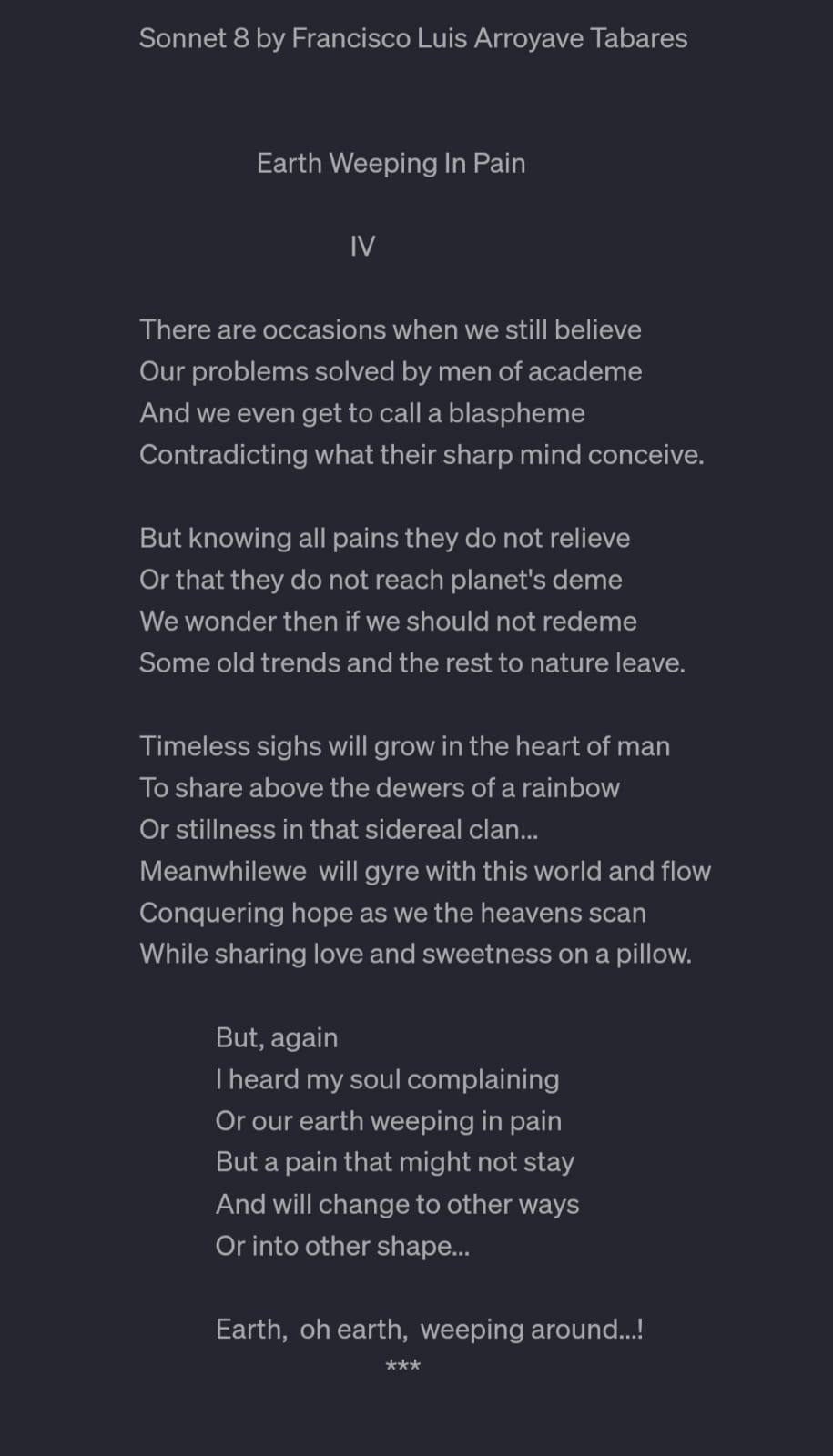
IV

10 There are occasions when we still believe
10 Our problems solved by men of academe
10 And we even get to call a blaspheme
10 Contradicting what their sharp mind conceive.

10 But knowing all pains they do not relieve
9  Or that they do not reach planet's deme
10 We wonder then if we should not redeme
10 Some old trends and the rest to nature leave.

10 Timeless sighs will grow in the heart of man
11  To share above the dewers of a rainbow
10 Or stillness in that sidereal clan...
10 Meanwhilewe  will gyre with this world and flow
10 Conquering hope as we the heavens scan
11  While sharing love and sweetness on a pillow.

3 But, again
7 I heard my soul complaining
7 Or our earth weeping in pain
7 But a pain that might not stay
7 And will change to other ways
6 Or into other shape...

7 Earth,  oh earth,  weeping around...!
Sonnets For The Twenty First Century And A Circadian Musical Written By Francisco Luis Arroyave Tabares (1984-1987)
Analyzed by GPT4; Image by soselplanetatenecesita.blogspot.com;
First published on Nostr Protocol by franciscoarroyavet@nostrplebs.com
 Earth Weeping In Pain