
Posthumous work of the Colombian poet born in Don Matias on January 20, 1948.
Welcome to this blog dedicated to the Posthumous work of the Colombian poet Francisco Luis Arroyave Tabares (my father), born in Don Matias on January 20, 1948-2010. Where I will be publishing each of the 175 sonnets from his unpublished collection 'Sonnets For The Twenty-First Century And A Circadian Musical (1984-1987).' Analyzed with GPT4 artificial intelligence and illustrated with AI tools... I hope you enjoy this garden of words snatched from the solitude of a locked room.
Likewise, any enthusiast of the sonnet form is invited to conduct their personal studies of Arroyave Tabares' work, as it is a collection that, although registered since 1989, has not yet been published.
Frank Duna
Analysis "Heart Rain"
Introduction
"Sonnet 93" by Francisco Luis Arroyave Tabares, titled "Heart Rain," is a poem that explores themes of cleansing, transformation, and emotional renewal through the metaphor of rain.
Thematic Analysis
Octave (first eight lines): The octave of the sonnet describes the speaker’s emotional state and the transformative power of rain. The speaker allows the rain to wash away the memories that have been burdening them, symbolized by the “weight in my chest with pound of lead”. The rain reaches the speaker’s heart, reviving it from a state of glory-less existence and causing flowers (symbolizing new experiences or emotions) to grow. This change gives way to new stories, indicating a shift in the speaker’s life or perspective.
Sextet (last six lines): The sextet continues the theme of transformation and healing. The speaker’s tears are lost in the rain, suggesting a cathartic release of emotion. The speaker then observes fresh new shadows, possibly indicating new opportunities or changes. The repeated sound of the rain (“Tic, splash, tic, splash”) emphasizes its soothing, rhythmic nature. The speaker expresses a wish for a storm to soothe their pain and scatter the threats surrounding their hearts, further emphasizing the healing power of rain.
Overall, the sonnet uses the metaphor of rain to depict a journey of emotional healing and transformation. The octave sets up the initial state of emotional burden and the transformative power of rain, while the sextet explores the aftermath of this transformation and the speaker’s hopeful outlook. The sonnet beautifully captures the human experience of healing and the power of nature in facilitating this process.
Rhyme Scheme
Let’s analyze the rhyme scheme of the sonnet “Heart Rain” by Francisco Luis Arroyave Tabares. The rhyme scheme is ABBA ABBA CDCDCD, which is a typical Italian or Petrarchan sonnet rhyme scheme.
Octave (first eight lines): The rhyme scheme for the octave is ABBA ABBA. Let’s break it down:
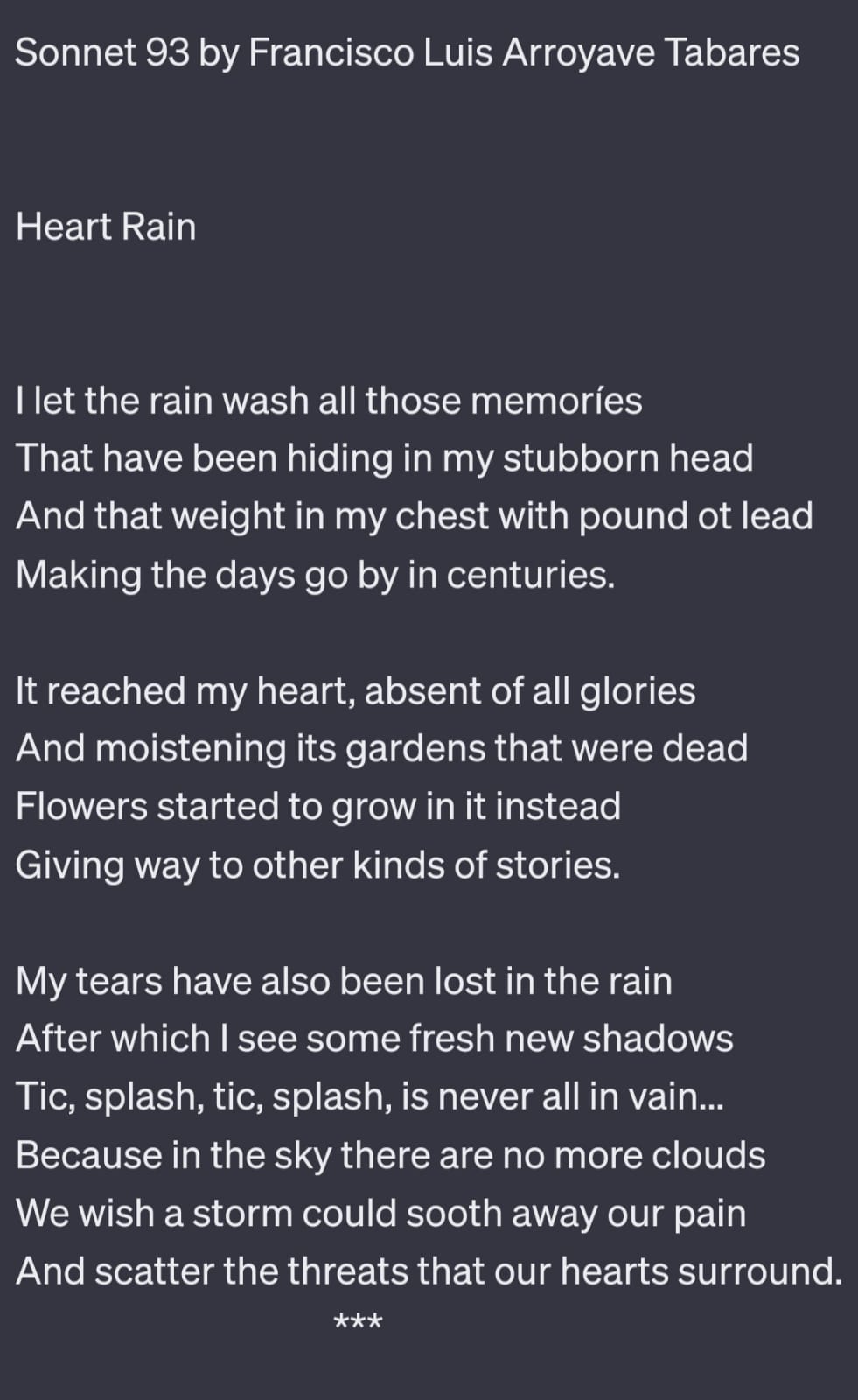
Line 1 (A): I let the rain wash all those memoríes
Line 2 (B): That have been hiding in my stubborn head
Line 3 (B): And that weight in my chest with pound ot lead
Line 4 (A): Making the days go by in centuries.
Line 5 (A): It reached my heart, absent of all glories
Line 6 (B): And moistening its gardens that were dead
Line 7 (B): Flowers started to grow in it instead
Line 8 (A): Giving way to other kinds of stories.
Sextet (last six lines): The rhyme scheme for the sextet is CDCDCD. Let’s break it down:
Line 9 (C): My tears have also been lost in the rain
Line 10 (D): After which I see some fresh new shadows
Line 11 (C): Tic, splash, tic, splash, is never all in vain…
Line 12 (D): Because in the sky there are no more clouds
Line 13 (C): We wish a storm could sooth away our pain
Line 14 (D): And scatter the threats that our hearts surround.
This detailed analysis of the rhyme scheme helps us appreciate the structure and rhythm of the sonnet. The poet has skillfully used the rhyme scheme to enhance the musicality and flow of the poem. The ABBA ABBA pattern in the octave creates a mirror-like reflection of sounds, while the alternating CDCDCD pattern in the sextet provides a rhythmic progression to the poem’s conclusion. This contributes to the overall emotional impact and thematic development of the sonnet.
Additional Aspects
Let’s delve deeper into the sonnet “Heart Rain” by Francisco Luis Arroyave Tabares.
Language: The language used in the sonnet is simple yet profound. The poet uses everyday words to express complex emotions and experiences. The use of first-person narrative makes the poem personal and relatable.
Imagery: The poem is rich in imagery. The rain washing away memories, the weight in the chest, the dead gardens in the heart coming back to life, tears lost in the rain, and the storm soothing away pain - all these create vivid mental pictures that engage the senses and evoke strong emotions.
Themes: The main themes of the poem are emotional healing, transformation, and the power of nature. The rain symbolizes cleansing and renewal, while the storm represents a powerful force that can soothe pain and scatter threats.
Meter: The sonnet follows the iambic pentameter, which is a common meter in English poetry. Each line consists of five pairs of unstressed and stressed syllables, giving the poem a rhythmic flow.
Overall: “Heart Rain” is a beautifully crafted sonnet that uses the power of nature as a metaphor for emotional healing and transformation. The poet skillfully uses language, imagery, and meter to convey deep emotional experiences and insights. The poem leaves a lasting impression and invites the reader to reflect on their own experiences of healing and transformation. It’s a testament to the poet’s ability to touch upon universal human experiences through the medium of poetry.
(GPT4)
Syllable count for each line.
Heart Rain


10 I let the rain wash all those memoríes
10 That have been hiding in my stubborn head
10 And that weight in my chest with pound ot lead
10 Making the days go by in centuries.

10 It reached my heart, absent of all glories
10 And moistening its gardens that were dead
10 Flowers started to grow in it instead
10 Giving way to other kinds of stories.

10 My tears have also been lost in the rain
10 After which I see some fresh new shadows
10 Tic, splash, tic, splash, is never all in vain...
10 Because in the sky there are no more clouds
10 We wish a storm could sooth away our pain
10 And scatter the threats that our hearts surround.
                                        ***
Sonnets For The Twenty First Century And A Circadian Musical Written By Francisco Luis Arroyave Tabares (1984-1987)
Analyzed by GPT4; Image by leonardo.ai;
First published on Nostr Protocol by franciscoarroyavet@nostrplebs.com
 *Heart Rain