
Posthumous work of the Colombian poet born in Don Matias on January 20, 1948.
Welcome to this blog dedicated to the Posthumous work of the Colombian poet Francisco Luis Arroyave Tabares (my father), born in Don Matias on January 20, 1948-2010. Where I will be publishing each of the 175 sonnets from his unpublished collection 'Sonnets For The Twenty-First Century And A Circadian Musical (1984-1987).' Analyzed with GPT4 artificial intelligence and illustrated with AI tools... I hope you enjoy this garden of words snatched from the solitude of a locked room.
Likewise, any enthusiast of the sonnet form is invited to conduct their personal studies of Arroyave Tabares' work, as it is a collection that, although registered since 1989, has not yet been published.
Frank Duna
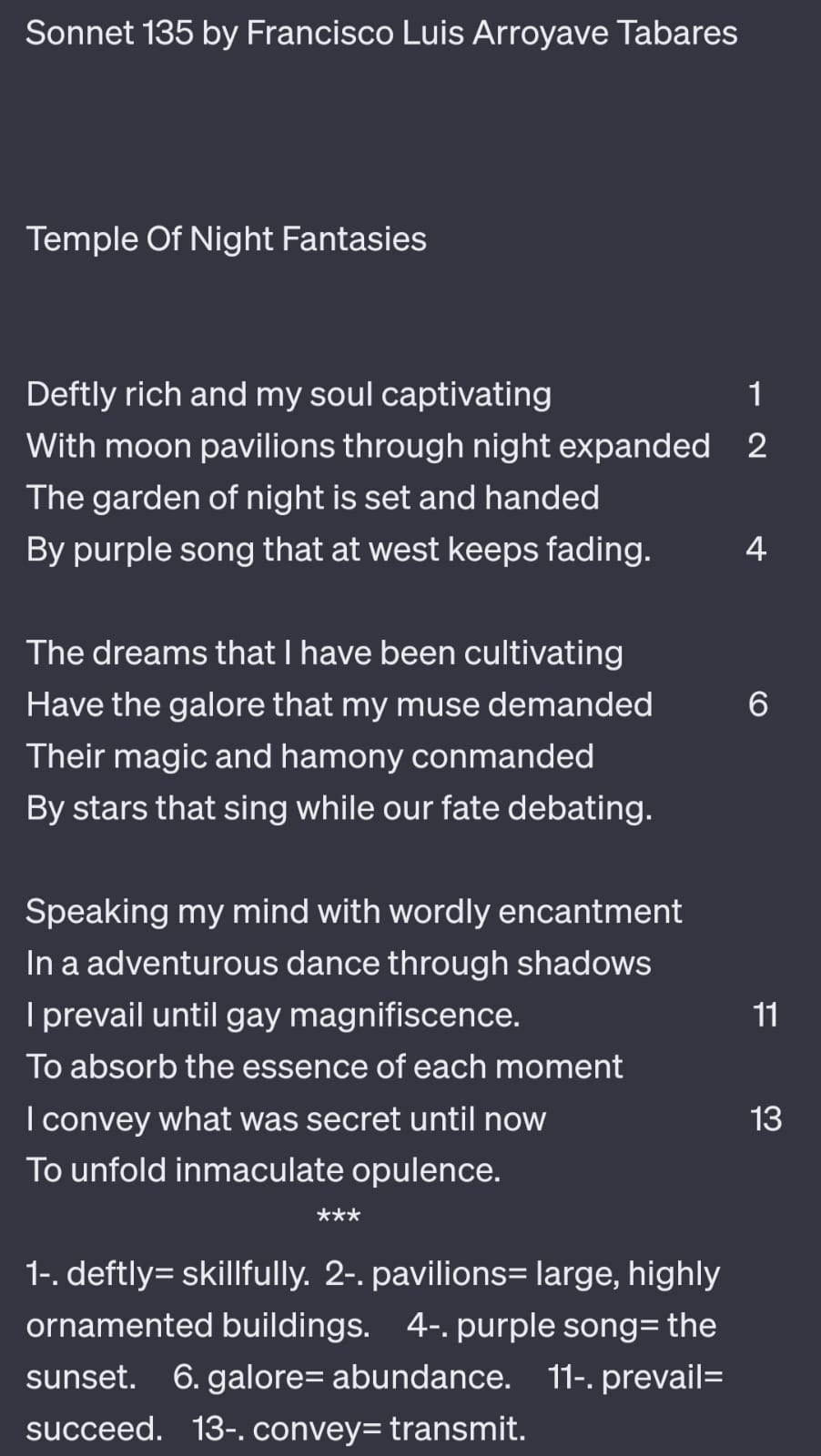
Temple Of Night Fantasies"
Introduction
"Temple Of Night Fantasies" is a sonnet that blends nature, creativity, and celestial imagery to convey a sense of enchantment and the pursuit of artistic fulfillment. The poem's structure and language contribute to its dreamlike and evocative quality.
Thematic Analysis
Octave (Lines 1-8): The octave introduces the setting as a “garden of night”, a place that is rich, captivating, and expanded through “moon pavilions”. This could symbolize a vast, enchanting, and mysterious realm that the speaker is exploring. The “purple song” that fades in the west might represent the sunset, indicating the transition from day to night. The speaker mentions dreams that have been cultivated with abundance (galore) and are commanded by the harmony and magic of the stars. This suggests that the speaker’s dreams or aspirations are influenced by the enchanting and mystical elements of the night.
Sestet (Lines 9-14): The sestet delves deeper into the speaker’s interaction with this night realm. The speaker uses worldly enchantment to express their thoughts, suggesting a deep connection with the mystical elements of the night. The speaker dances through shadows, perhaps symbolizing the exploration of unknown or hidden aspects of life or self. The speaker aims to absorb the essence of each moment and convey what was secret, unfolding immaculate opulence. This could mean that the speaker seeks to understand and express the profound and often hidden beauty or wisdom found in the depths of the night.
Overall, the sonnet seems to explore themes of mystery, exploration, self-discovery, and the beauty of the night. The octave sets the stage and presents the influence of the night on the speaker’s dreams, while the sestet delves into the speaker’s active engagement with the night and their quest for understanding and expression. The sonnet beautifully uses the metaphor of the night and its elements to depict a journey of exploration and discovery.
Structure and Rhyme Scheme
The sonnet “Temple Of Night Fantasies” follows the traditional structure of a sonnet with a rhyme scheme. Let’s break it down:
Octave (Lines 1-8): The rhyme scheme in the octave is ABBA ABBA:
Line 1 (A): captivating
Line 2 (B): expanded
Line 3 (B): handed
Line 4 (A): fading
Line 5 (A): cultivating
Line 6 (B): demanded
Line 7 (B): commanded
Line 8 (A): debating
Sestet (Lines 9-14): The rhyme scheme in the sestet is CDE CDE:
Line 9 (C): encantment
Line 10 (D): shadows
Line 11 (E): magnifiscence
Line 12 (C): moment
Line 13 (D): now
Line 14 (E): opulence
This analysis shows that the sonnet follows a strict rhyme scheme, which is typical of traditional sonnets. The rhyme adds a rhythmic quality to the poem and helps to emphasize certain words and ideas. It also creates a sense of unity and cohesion in the poem. The change in rhyme scheme from the octave to the sestet often signals a shift in theme or tone, which is a characteristic feature of sonnets. In this case, the octave sets the scene and introduces the theme, while the sestet explores the theme in more depth. The final couplet often provides a resolution or a summarizing statement, which is evident in this sonnet as well.
Analysis of Aspects
The sonnet “Temple Of Night Fantasies” by Francisco Luis Arroyave Tabares is a rich piece of poetry with a lot to unpack. Let’s delve into the language, imagery, themes, meter, and overall impact of the poem:
Language: The language used in the sonnet is highly descriptive and evocative. The poet uses words like “deftly”, “captivating”, “expanded”, “fading”, “cultivating”, “demanded”, “commanded”, “debating”, “encantment”, “shadows”, “magnifiscence”, “moment”, “now”, and “opulence”. These words create a vivid and engaging picture in the reader’s mind and add depth to the poem.
Imagery: The poem is filled with beautiful and striking imagery. The “garden of night”, “moon pavilions”, “purple song”, and “stars that sing” all contribute to a mystical and enchanting atmosphere. The imagery serves to transport the reader into the world of the poem and allows them to experience the emotions and sensations described by the poet.
Themes: The main themes of the poem appear to be exploration, self-discovery, and the beauty of the night. The poet explores these themes through the journey of the speaker in the poem, who navigates through the “garden of night” and interacts with its various elements.
Meter: The sonnet follows the traditional iambic pentameter, which is a type of metrical line used in traditional English poetry and verse drama. This means that each line of the poem has five metrical feet, each consisting of one short (or unstressed) syllable followed by one long (or stressed) syllable.
Overall, the sonnet is a beautifully crafted piece of poetry that uses language, imagery, and meter to explore its themes in a deep and engaging way. The poem leaves a lasting impression on the reader and invites them to delve into their own interpretations and experiences. The strict structure of the sonnet, combined with the creative use of language and imagery, results in a poem that is both traditional and innovative. The poem is a testament to the poet’s skill and creativity. It’s a wonderful example of how poetry can transport us to different worlds and offer new perspectives.
(GPT4)
Syllable count for each line.
Temple Of Night Fantasies


10 Deftly rich and my soul captivating
10 With moon pavilions through night expanded
10 The garden of night is set and handed
10 By purple song that at west keeps fading.

10 The dreams that I have been cultivating
10 Have the galore that my muse demanded
10 Their magic and hamony conmanded
10 By stars that sing while our fate debating.

10 Speaking my mind with wordly encantment
10 In a adventurous dance through shadows
10 I prevail until gay magnifiscence.
10 To absorb the essence of each moment
10 I convey what was secret until now
10 To unfold inmaculate opulence.
                                    ***
Sonnets For The Twenty First Century And A Circadian Musical Written By Francisco Luis Arroyave Tabares (1984-1987)
Analyzed by GPT4; Image by leonardo.ai;
First published on Nostr Protocol by franciscoarroyavet@nostrplebs.com
 Temple Of Night Fantasies