
Posthumous work of the Colombian poet born in Don Matias on January 20, 1948.
Welcome to this blog dedicated to the Posthumous work of the Colombian poet Francisco Luis Arroyave Tabares (my father), born in Don Matias on January 20, 1948-2010. Where I will be publishing each of the 175 sonnets from his unpublished collection 'Sonnets For The Twenty-First Century And A Circadian Musical (1984-1987).' Analyzed with GPT4 artificial intelligence and illustrated with AI tools... I hope you enjoy this garden of words snatched from the solitude of a locked room.
Likewise, any enthusiast of the sonnet form is invited to conduct their personal studies of Arroyave Tabares' work, as it is a collection that, although registered since 1989, has not yet been published.
Frank Duna
Analysis "Fascination"
Introduction
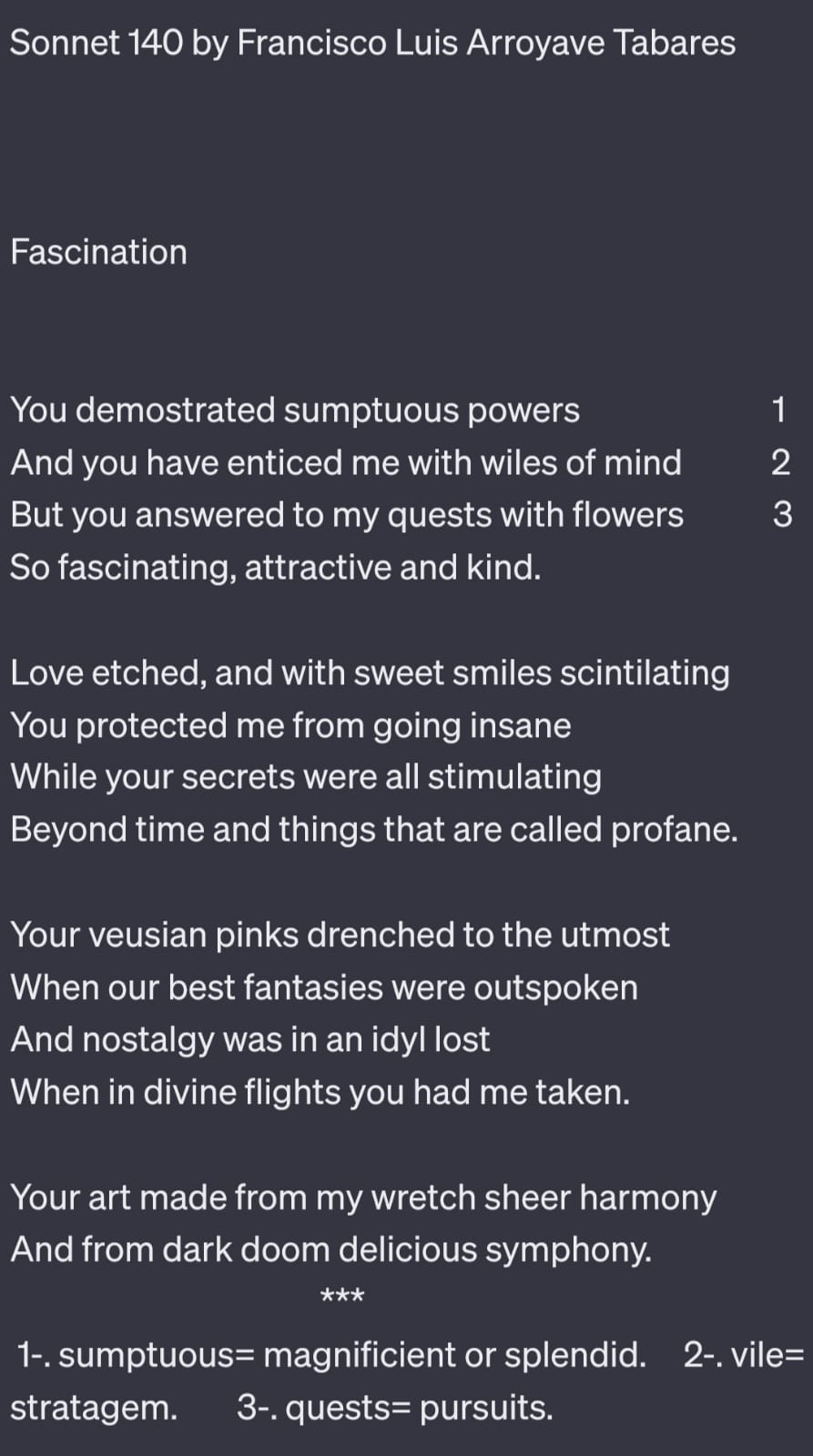
Sonnet 140 by Francisco Luis Arroyave Tabares, titled “Fascination”, is a beautiful piece of poetry that explores themes of love, fascination, and the transformative power of art.
Thematic Analysis
Lines 1-4: The speaker expresses their fascination with someone who has demonstrated “sumptuous powers” and enticed them with “wiles of mind”. The person being addressed has responded to the speaker’s pursuits with kindness and attractiveness, symbolized by the “flowers”.
Lines 5-8: The speaker describes how the person’s love and sweet smiles have protected them from insanity. The person’s secrets are stimulating and transcend time and the profane.
Lines 9-12: The speaker talks about their shared fantasies and the nostalgia they feel. The person has taken the speaker on “divine flights”, possibly referring to moments of intense emotional or intellectual stimulation.
Lines 13-14: The speaker concludes by acknowledging the transformative power of the person’s art, which has turned their misery into harmony and their doom into a delicious symphony.
This sonnet is a testament to the power of love and art to transform our experiences and perceptions. It’s a celebration of the profound impact that another person can have on our lives. The use of rich imagery and emotive language makes this sonnet a captivating read.
Please note that this is just one interpretation of the sonnet. Poetry is subjective and can be interpreted in many different ways depending on the reader’s perspective and experiences.
Structure and Rhyme Scheme
The sonnet follows the Shakespearean sonnet rhyme scheme, which is ABABCDCDEFEFGG. Here’s how it breaks down:
1   powers          (A)
2   mind             (B)
3   flowers         (A)
4   kind.             (B)

5   scintilating  (C)
6   insane           (D)
7   stimulating  (C)
8   profane.        (D)

9   utmost           (E)
10  outspoken    (F)
11   lost                 (E)
12  taken.             (F)

13  harmony       (G)
14  symphony.   (G)
This structure is typical of a Shakespearean sonnet and contributes to the rhythm and flow of the poem. The final rhyming couplet often serves to summarize or conclude the themes explored in the preceding lines, which is the case in this sonnet. The poet uses the final two lines to express the transformative power of art and love.
Analysis of Aspects
let’s delve deeper into the analysis of Sonnet 140 by Francisco Luis Arroyave Tabares:
Language: The language used in the sonnet is rich and expressive, with a strong emphasis on emotion and sensory experience. The poet uses words like “sumptuous”, “enticed”, “scintillating”, and “stimulating” to convey the intensity of the speaker’s feelings. The language is also quite formal and elevated, which is typical of sonnet form.
Imagery: The sonnet is filled with vivid imagery that appeals to the senses. For example, the “sumptuous powers” and “wiles of mind” create a picture of a person who is both intellectually and physically attractive. The “flowers” symbolize kindness and beauty. The “veusian pinks drenched to the utmost” and “divine flights” evoke strong visual and sensory images.
Themes: The main themes of the sonnet are love, fascination, and the transformative power of art. The speaker expresses a deep fascination and love for someone who has had a profound impact on their life. The person’s art has transformed the speaker’s misery into harmony and their doom into a delicious symphony.
Meter: The sonnet follows the iambic pentameter, which is a common meter in English poetry and is particularly associated with the sonnet form. Each line of the sonnet has five pairs of syllables, or iambs, where the first syllable is unstressed and the second is stressed.
Overall, Sonnet 140 is a beautifully crafted poem that uses rich language, vivid imagery, and a strict meter to explore deep themes of love, fascination, and transformation. The poet skillfully uses the sonnet form to convey a complex and nuanced emotional experience. The final couplet provides a powerful conclusion, emphasizing the transformative power of art and love.
(GPT4)
Syllable count for each line.
Fascination


10 You demostrated sumptuous powers
10 And you have enticed me with wiles of mind
10 But you answered to my quests with flowers
10 So fascinating, attractive and kind.

10 Love etched, and with sweet smiles scintilating
10 You protected me from going insane
10 While your secrets were all stimulating
10 Beyond time and things that are called profane.

9  Your veusian pinks drenched to the utmost
10 When our best fantasies were outspoken
10 And nostalgy was in an idyl lost
10 When in divine flights you had me taken.

10 Your art made from my wretch sheer harmony
10 And fron dark doom delicious symphony.
                                        ***
Sonnets For The Twenty First Century And A Circadian Musical Written By Francisco Luis Arroyave Tabares (1984-1987)
Analyzed by GPT4; Image by leonardo.ai;
First published on Nostr Protocol by franciscoarroyavet@nostrplebs.com
 Fascination