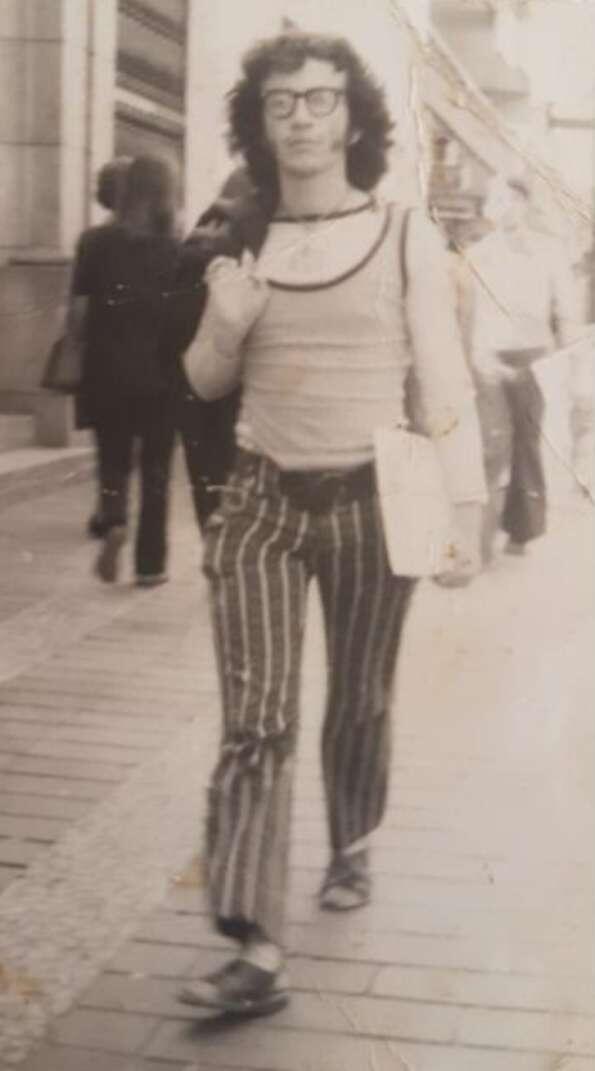
Posthumous work of the Colombian poet born in Don Matias on January 20, 1948.
Welcome to this blog dedicated to the Posthumous work of the Colombian poet Francisco Luis Arroyave Tabares (my father), born in Don Matias on January 20, 1948-2010. Where I will be publishing each of the 175 sonnets from his unpublished collection 'Sonnets For The Twenty-First Century And A Circadian Musical (1984-1987).' Analyzed with GPT4 artificial intelligence and illustrated with AI tools... I hope you enjoy this garden of words snatched from the solitude of a locked room.
Likewise, any enthusiast of the sonnet form is invited to conduct their personal studies of Arroyave Tabares' work, as it is a collection that, although registered since 1989, has not yet been published.
Frank Duna
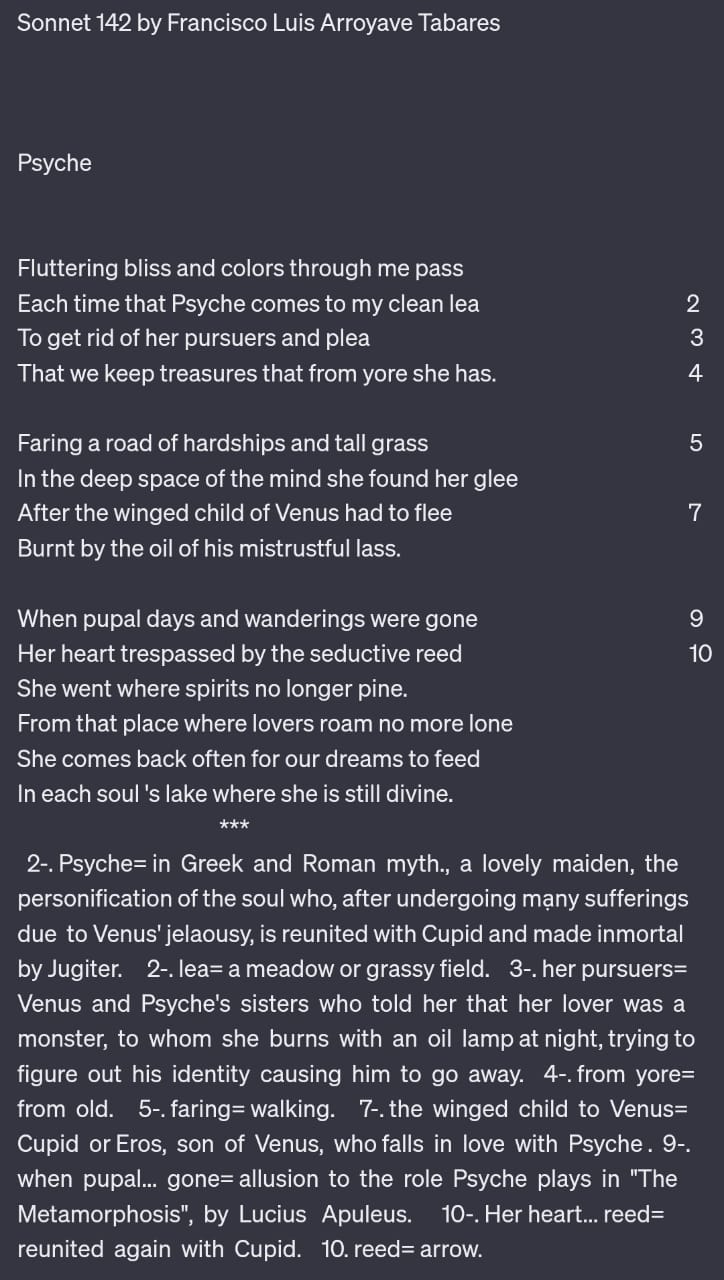
Analysis "Psyche"
Introduction
In the sonnet 142 "Psyche", the poet skillfully weaves references to classical mythology, particularly the myth of Psyche and Cupid, into a contemporary sonnet, creating a rich and layered exploration of themes such as love, perseverance, and spiritual fulfillment.
Thematic Analysis
In the octave (lines 1-8), the poet describes Psyche’s journey and struggles. Psyche, a personification of the soul, is depicted as seeking refuge in the speaker’s “clean lea” or meadow, away from her pursuers, Venus and her sisters. This is a reference to the mythological story where Psyche’s beauty incites the jealousy of Venus, leading to a series of trials for Psyche. The speaker also mentions the treasures that Psyche has from the past, possibly referring to her experiences and wisdom gained from her trials. The octave ends with a reference to Psyche’s lover, Cupid, who had to leave after Psyche accidentally burnt him with an oil lamp.
The sextet (lines 9-14) seems to depict Psyche’s transformation and enlightenment. The “pupal days and wanderings” could be a metaphor for her trials and tribulations, which are now over. Psyche’s heart is “trespassed by the seductive reed”, which could be a metaphor for Cupid’s arrow, signifying their reunion. The speaker then describes a place “where spirits no longer pine”, possibly referring to a state of peace or enlightenment that Psyche has achieved. The sonnet concludes with the idea that Psyche often returns to feed our dreams, suggesting that her divine presence continues to inspire and nurture the human soul.
Overall, the sonnet uses the story of Psyche to explore themes of struggle, transformation, love, and enlightenment. It beautifully intertwines mythological references with profound insights about the human condition.
Structure and Rhyme Scheme
The Petrarchan sonnet, also known as the Italian sonnet, follows a different rhyme scheme. Here’s the analysis:
The rhyme scheme of a Petrarchan sonnet is ABBA ABBA CDE CDE. Here’s how it breaks down in this sonnet:
Lines 1 (pass), 2 (lea), 3 (plea), and 4 (has) rhyme with each other (A)
Lines 5 (grass), 6 (glee), 7 (flee), and 8 (lass) rhyme with each other (B)
This completes the octave, which typically presents a problem or a conflict in a sonnet.
 9 (gone), 12 (lone),  rhyme with each other (C)
10 (reed), 13 (feed),  rhyme with each other (D)
11 (pine), 14 (divine), rhyme with each other (E)
This completes the sextet, which typically resolves the problem or conflict presented in the octave.
So, the correct rhyme scheme of this sonnet is ABBA ABBA CDE CDE, which is typical of a Petrarchan sonnet. This structure allows the poet to develop a theme or problem in the octave and then provide a resolution in the sextet. In this sonnet, the poet uses this structure to explore the journey and transformation of Psyche, providing a profound commentary on the human condition.
Analysis of Aspects
The sonnet “Psyche” by Francisco Luis Arroyave Tabares is a rich and complex piece of poetry that uses a variety of literary techniques to convey its themes.
Language and Imagery: The language used in the sonnet is highly metaphorical and allusive, drawing heavily on the myth of Psyche from Greek and Roman mythology. The imagery is vivid and evocative, painting a picture of Psyche’s journey and transformation. For example, phrases like “Fluttering bliss and colors through me pass” and “Faring a road of hardships and tall grass” create a sense of movement and struggle, while “In the deep space of the mind she found her glee” suggests a journey of self-discovery and enlightenment.
Themes: The sonnet explores several themes, including love, struggle, transformation, and enlightenment. The story of Psyche serves as a metaphor for the human condition, with its trials, tribulations, and eventual transcendence. The recurring theme of love, represented by the relationship between Psyche and Cupid, adds a layer of emotional depth to the poem.
Meter: The sonnet follows the traditional meter of a Petrarchan sonnet, which is iambic pentameter. This means each line consists of five pairs of unstressed and stressed syllables, giving the poem a rhythmic quality.
Overall, The sonnet is a beautifully crafted piece of poetry that uses the myth of Psyche as a vehicle to explore profound themes related to the human condition. The use of vivid imagery, coupled with the rhythmic quality of the iambic pentameter, makes it a pleasure to read and contemplate. The sonnet’s structure, with its octave presenting a problem or conflict and the sextet offering a resolution or commentary, allows for a nuanced exploration of its themes. The final couplet provides a powerful conclusion, suggesting that Psyche’s divine presence continues to inspire and nurture the human soul.
(GPT4)
Syllable count for each line.
Psyche


10 Fluttering bliss and colors through me pass
10 Each time that Psyche comes to my clean lea
10 To get rid of her pursuers and plea
10 That we keep treasures that from yore she has.

10 Faring a road of hardships and tall grass
11 In the deep space of the mind she found her glee
11 After the winged child of Venus had to flee
10 Burnt by the oil of his mistrustful lass.

10 When pupal days and wanderings were gone
10 Her heart trespassed by the seductive reed
9  She went where spirits no longer pine.
10 From that place where lovers roam no more lone
10 She comes back often for our dreams to feed
10 In each soul 's lake where she is still divine.
                                          ***
Sonnets For The Twenty First Century And A Circadian Musical Written By Francisco Luis Arroyave Tabares (1984-1987)
Analyzed by GPT4; Image by leonardo.ai;
First published on Nostr Protocol by franciscoarroyavet@nostrplebs.com
 Psyche