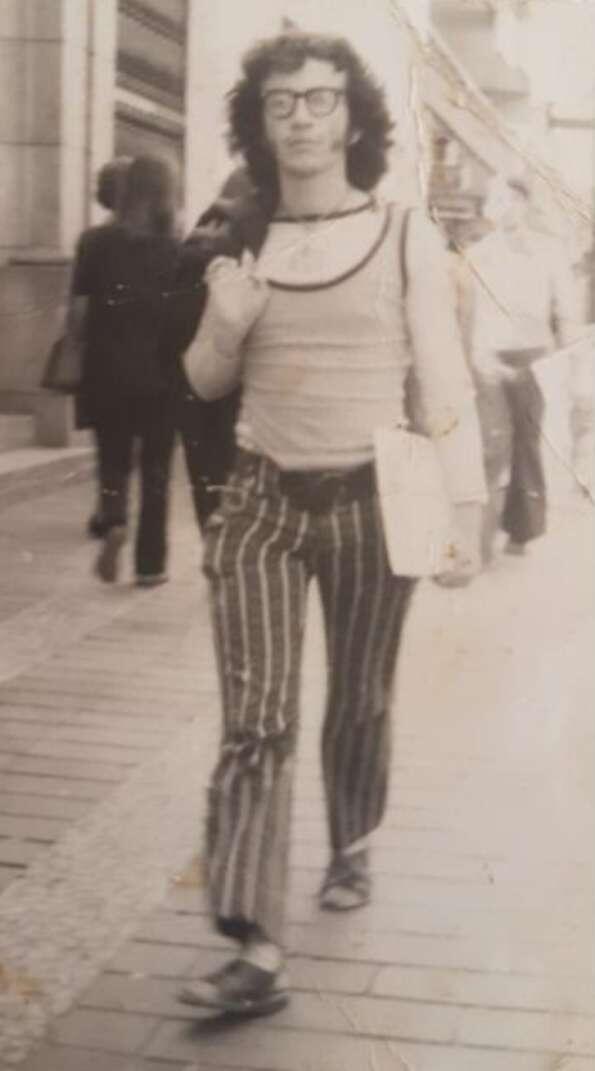
Posthumous work of the Colombian poet born in Don Matias on January 20, 1948.
Welcome to this blog dedicated to the Posthumous work of the Colombian poet Francisco Luis Arroyave Tabares (my father), born in Don Matias on January 20, 1948-2010. Where I will be publishing each of the 175 sonnets from his unpublished collection 'Sonnets For The Twenty-First Century And A Circadian Musical (1984-1987).' Analyzed with GPT4 artificial intelligence and illustrated with AI tools... I hope you enjoy this garden of words snatched from the solitude of a locked room.
Likewise, any enthusiast of the sonnet form is invited to conduct their personal studies of Arroyave Tabares' work, as it is a collection that, although registered since 1989, has not yet been published.
Frank Duna
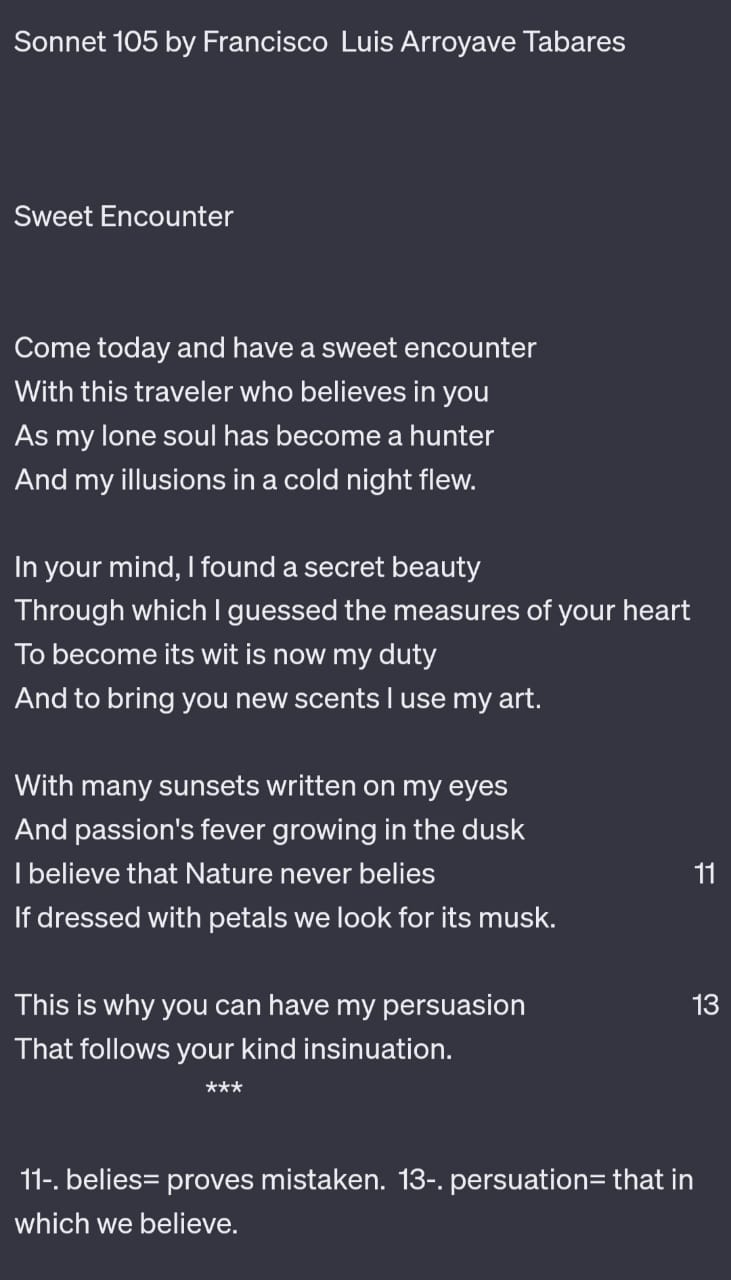
Analysis "Sweet Encounter"
Introduction
Sonnet 105 by Francisco Luis Arroyave Tabares, titled "Sweet Encounter," is a beautiful piece of poetry that employs traditional sonnet structure and themes of love, nature, and self-discovery.
Thematic Analysis
First quatrain introduces the speaker as a traveler, a seeker, who is in search of a sweet encounter with the person to whom the poem is addressed. The speaker's soul is described as a hunter, suggesting a sense of longing and pursuit. The speaker's illusions are said to have flown away in a cold night, indicating a sense of loss or disillusionment.
Second quatrain, the speaker delves into the mind of the person they are addressing, finding a "secret beauty" there. This suggests a deep connection and understanding between the speaker and the addressee. The speaker feels it's their duty to understand the addressee's heart and to bring new experiences ("new scents") to them.
Third quatrain uses vivid imagery of sunsets and dusk to convey the passage of time and the growth of passion. The speaker asserts their belief in the truth of nature, suggesting that if we approach it with appreciation and respect ("dressed with petals"), we can discover its essence ("musk").
Couplet: offers a resolution: the speaker is persuaded by the addressee's "kind insinuation," suggesting a mutual understanding and connection. The speaker is willing to follow the addressee's lead, indicating trust and affection.
Overall, "Sweet Encounter" is a sonnet that explores themes of longing, connection, understanding, and the beauty of nature. It uses vivid imagery and metaphor to convey the speaker's emotions and beliefs.
Rhyme Scheme
The sonnet “Sweet Encounter” follows the Shakespearean sonnet rhyme scheme, which is ABAB CDCD EFEF GG. Let’s break it down:
Quatrain 1:
Come today and have a sweet encounter (A)
With this traveler who believes in you (B)
As my lone soul has become a hunter (A)
And my illusions in a cold night flew. (B)
Quatrain 2:
In your mind, I found a secret beauty (C)
Through which I guessed the measures of your heart (D)
To become its wit is now my duty (C)
And to bring you new scents I use my art. (D)
Quatrain 3:
With many sunsets written on my eyes (E)
And passion's fever growing in the dusk (F)
I believe that Nature never belies (E)
If dressed with petals we look for its musk. (F)
Couplet:
This is why you can have my persuasion (G)
That follows your kind insinuation. (G)
In each quatrain, the first and third lines rhyme (A and A, C and C, E and E), and the second and fourth lines rhyme (B and B, D and D, F and F). The final couplet (GG) also rhymes. This pattern creates a pleasing rhythm and helps to emphasize the themes and emotions in the poem. It’s a common structure in English sonnets, and it works well in this poem to highlight the speaker’s longing, discovery, duty, and trust in nature.
Additional Aspects
let’s delve deeper into the sonnet’s use of language, imagery, themes, meter, and overall impact:
Language: The language used in the sonnet is rich and evocative, with a formal tone that is typical of sonnets. The poet uses sophisticated vocabulary and complex sentence structures, which adds depth to the poem and allows for multiple layers of meaning.
Imagery: The sonnet is filled with vivid imagery that appeals to the senses. For example, “With many sunsets written on my eyes” paints a picture of a person who has experienced much and seen many things. “And passion’s fever growing in the dusk” evokes a sense of intense emotion that is heightened as night falls.
Themes: The main themes of the sonnet are longing, discovery, duty, and trust in nature. These themes are explored through the speaker’s journey, which is not just physical but also emotional and intellectual.
Meter: The sonnet follows the traditional iambic pentameter, which is a line of verse with five metrical feet, each consisting of one short (or unstressed) syllable followed by one long (or stressed) syllable. This gives the poem a rhythmic flow and a formal structure.
Overall: The sonnet is a beautifully crafted piece of poetry that uses language, imagery, and meter to explore its themes in a deep and meaningful way. The structure of the sonnet, with its three quatrains and a final couplet, allows the poet to develop his ideas and emotions gradually, leading to a poignant conclusion in the final two lines. The use of rhyme adds a musical quality to the poem, enhancing its overall impact. The sonnet is a testament to the poet’s skill and creativity, and it offers a rich and rewarding reading experience.
(GPT4)
Syllable count for each line.
Sweet Encounter


10 Come today and have a sweet encounter
10 With this traveler who believes in you
10 As my lone soul has become a hunter
10 And my illusions in a cold night flew.

10 In your mind, I found a secret beauty
10 Through which I guessed the measures of your heart
10 To become its wit is now my duty
10 And to bring you new scents I use my art.

10 With many sunsets written on my eyes
10 And passion's fever growing in the dusk
10 I believe that Nature never belies
10 If dressed with petals we look for its musk.

10 This is why you can have my persuasion
10 That follows your kind insinuation.
                                  ***
Sonnets For The Twenty First Century And A Circadian Musical Written By Francisco Luis Arroyave Tabares (1984-1987)
Analyzed by GPT4; Image by Frank Duna;
First published on Nostr Protocol by franciscoarroyavet@nostrplebs.com
 Sweet Encounter