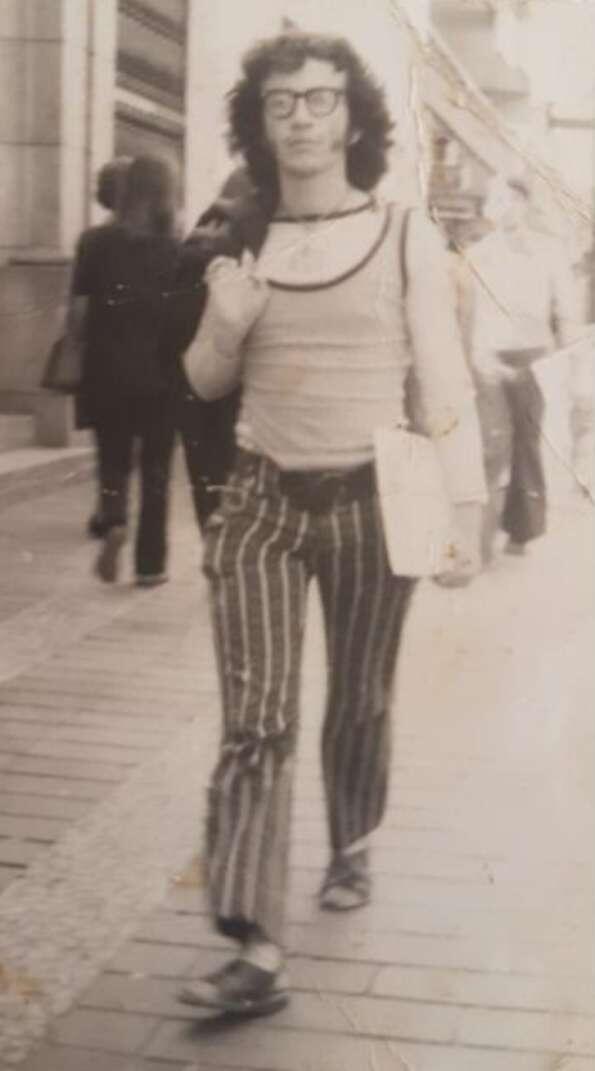
Posthumous work of the Colombian poet born in Don Matias on January 20, 1948.
Welcome to this blog dedicated to the Posthumous work of the Colombian poet Francisco Luis Arroyave Tabares (my father), born in Don Matias on January 20, 1948-2010. Where I will be publishing each of the 175 sonnets from his npublished collection 'Sonnets For The Twenty-First Century And A Circadian Musical (1984-1987).' Analyzed with GPT4 artificial intelligence and illustrated with AI tools... I hope you enjoy this garden of words snatched from the solitude of a locked room.
Likewise, any enthusiast of the sonnet form is invited to conduct their personal studies of Arroyave Tabares' work, as it is a collection that, although registered since 1989, has not yet been published.
Frank Duna
Analisis "We Welcome Sleep"
Introduction
Sonnet 90 explores the importance of sleep as a means of escape, rejuvenation, and self-discovery.
Thematic Analysis:
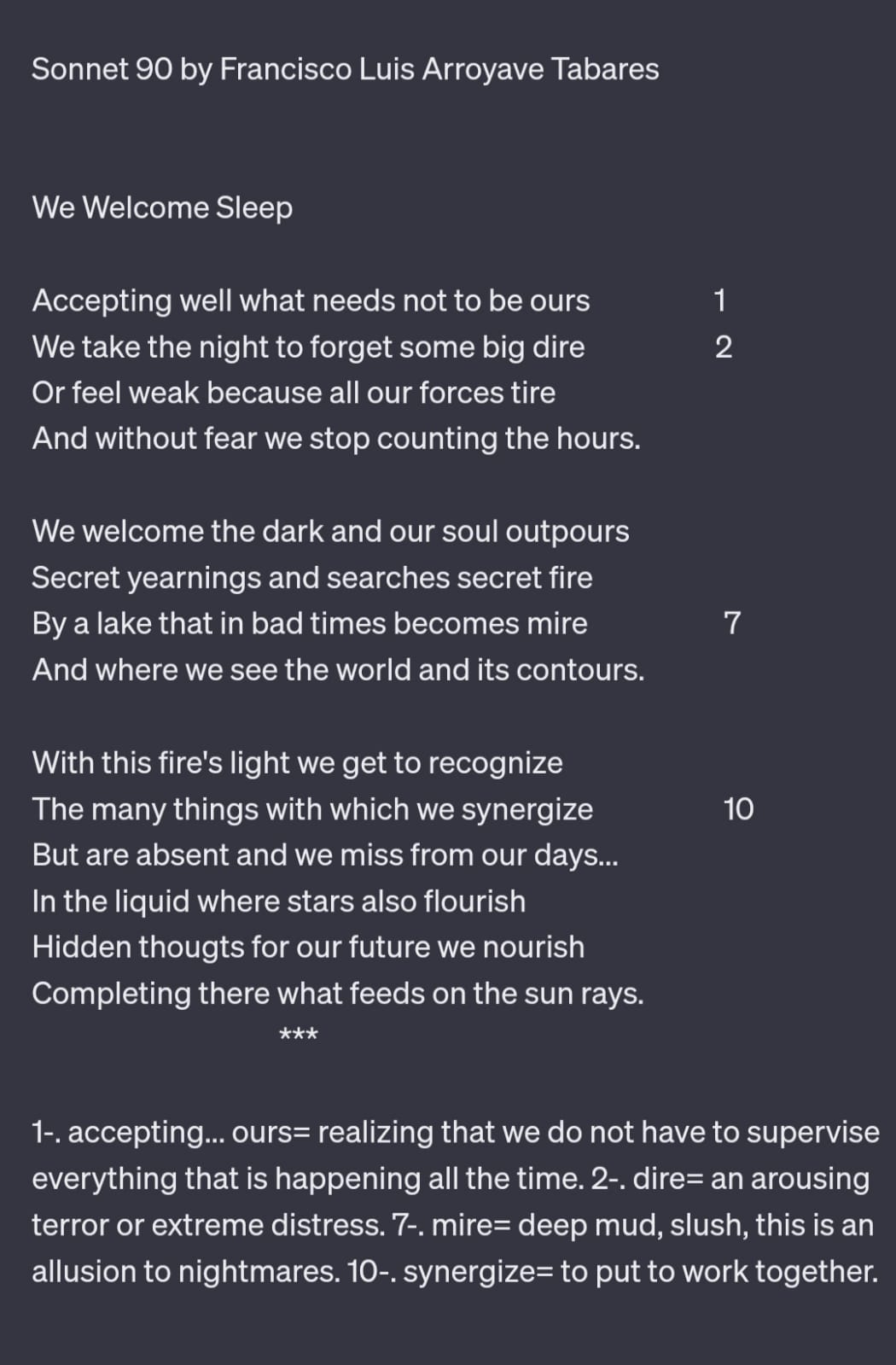
In the octave, the speaker describes the act of surrendering to sleep as a means of escape from the burdens and fears of the day. The speaker accepts that not everything needs to be under their control (“Accepting well what needs not to be ours”) and uses the night to forget distressing events (“We take the night to forget some big dire”). The speaker also acknowledges the fatigue that comes from constant vigilance (“Or feel weak because all our forces tire”) and the relief that comes from letting go of time (“And without fear we stop counting the hours”). The octave ends with the speaker welcoming the darkness, which allows for the exploration of secret desires and fears (“We welcome the dark and our soul outpours / Secret yearnings and searches secret fire / By a lake that in bad times becomes mire / And where we see the world and its contours”).
The sestet shifts the focus from the personal to the universal. The speaker uses the metaphor of a fire’s light to symbolize the clarity that can come from introspection (“With this fire’s light we get to recognize / The many things with which we synergize”). The speaker laments the absence of these realizations in their daily life (“But are absent and we miss from our days…”). The sonnet concludes with the speaker nurturing hidden thoughts for the future in the metaphorical lake where stars also thrive (“In the liquid where stars also flourish / Hidden thoughts for our future we nourish”), and completing what feeds on the sun’s rays, possibly referring to dreams or aspirations.
Overall, the sonnet explores themes of introspection, acceptance, and the transformative power of sleep and dreams. The octave sets up the context and the sestet provides a resolution, following the traditional sonnet structure.
Rhyme Scheme
The rhyme scheme (ABBA ABBA CCD EED) is a variant of the Petrarchan sonnet structure. Let’s analyze how it applies to the sonnet “We Welcome Sleep” by Francisco Luis Arroyave Tabares:
Octave:
Line 1 (A): Accepting well what needs not to be ours
Line 2 (B): We take the night to forget some big dire
Line 3 (B): Or feel weak because all our forces tire
Line 4 (A): And without fear we stop counting the hours.
Line 5 (A): We welcome the dark and our soul outpours
Line 6 (B): Secret yearnings and searches secret fire
Line 7 (B): By a lake that in bad times becomes mire
Line 8 (A): And where we see the world and its contours.
Sestet:
Line 9 (C): With this fire’s light we get to recognize
Line 10 (C): The many things with which we synergize
Line 11 (D): But are absent and we miss from our days…
Line 12 (E): In the liquid where stars also flourish
Line 13 (E): Hidden thoughts for our future we nourish
Line 14 (D): Completing there what feeds on the sun rays.
In the octave, the first and fourth lines rhyme, as do the second and third lines, creating an ABBA pattern. This pattern is repeated in the next four lines. In the sestet, the first two lines rhyme (CC), followed by a new rhyme in the third line (D). The last three lines introduce a new rhyme (E), with the final line returning to the previous rhyme (D). This creates a CCD EED pattern. This rhyme scheme contributes to the overall rhythm and flow of the sonnet. It also helps to delineate the shift in focus from the octave to the sestet, a common feature in sonnets.
Additional Aspects to Analyze
let’s delve deeper into the sonnet’s use of language, imagery, themes, meter, and overall impact:
Language and Imagery: The sonnet uses a rich and evocative language that paints vivid images in the reader’s mind. The use of words like “dire”, “mire”, and “synergize” adds depth to the poem’s meaning and creates a sense of rhythm. The imagery of the night, the soul, the fire, and the lake all contribute to the overall mood and theme of the poem.
Themes: The main themes of the poem are introspection, acceptance, and transformation. The speaker uses sleep as a metaphor for introspection and self-discovery. The theme of acceptance is evident in the speaker’s willingness to surrender control and embrace the unknown. The theme of transformation is represented by the speaker’s journey from fear and fatigue to clarity and hope.
Meter: The sonnet follows the iambic pentameter, which is a common meter in English poetry. Each line consists of five pairs of unstressed and stressed syllables, giving the poem a rhythmic and flowing quality.
Overall: the sonnet is a beautifully crafted piece of poetry that explores deep and universal human experiences. The use of language and imagery, combined with the thematic depth and rhythmic structure, makes it a compelling and thought-provoking read. The sonnet’s structure, with its octave and sestet, allows for a nuanced exploration of its themes, starting with a problem or conflict in the octave and moving towards a resolution or insight in the sestet. This gives the sonnet a sense of completeness and balance. The sonnet’s rhyme scheme also contributes to its overall musicality and aesthetic appeal. The sonnet is a testament to the power of poetry to express complex emotions and ideas in a concise and elegant form.
(GPT4)
Syllable count for each line.
We Welcome Sleep


10 Accepting well what needs not to be ours
10 We take the night to forget some big dire
10 Or feel weak because all our forces tire
10 And without fear we stop counting the hours.

10 We welcome the dark and our soul outpours
10 Secret yearnings and searches secret fire
10 By a lake that in bad times becomes mire
10 And where we see the world and its contours.

10 With this fire's light we get to recognize
10 The many things with which we synergize
10 But are absent and we miss from our days...
10 In the liquid where stars also flourish
10 Hidden thougts for our future we nourish
10 Completing there what feeds on the sun rays.
                                        ***
Sonnets For The Twenty First Century And A Circadian Musical Written By Francisco Luis Arroyave Tabares (1984-1987)
Analyzed by GPT4; Image leonardo.ai; First published on Nostr Protocol by franciscoarroyavet@nostrplebs.com
 We Welcome Sleep