
Posthumous work of the Colombian poet born in Don Matias on January 20, 1948.
Welcome to this blog dedicated to the Posthumous work of the Colombian poet Francisco Luis Arroyave Tabares (my father), born in Don Matias on January 20, 1948-2010. Where I will be publishing each of the 175 sonnets from his npublished collection 'Sonnets For The Twenty-First Century And A Circadian Musical (1984-1987).' Analyzed with GPT4 artificial intelligence and illustrated with AI tools... I hope you enjoy this garden of words snatched from the solitude of a locked room.
Likewise, any enthusiast of the sonnet form is invited to conduct their personal studies of Arroyave Tabares' work, as it is a collection that, although registered since 1989, has not yet been published.
Frank Duna
Analysis "Not Enough Reasons Yet"
Introduction:
"Sonnet 78" by Francisco Luis Arroyave Tabares is a beautiful exploration of love, nature, and the human spirit.
Thematic Analysis
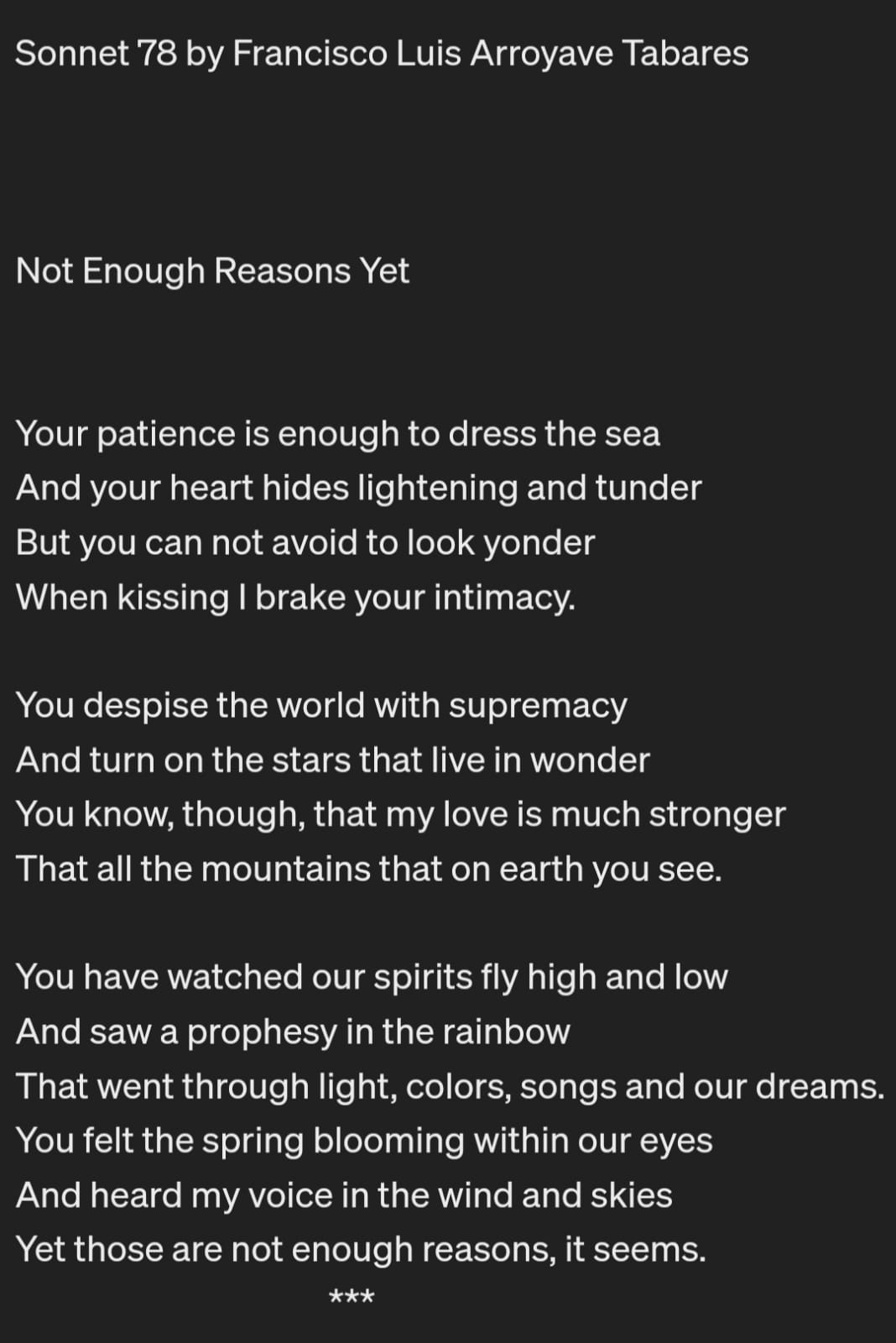
In the octave of this sonnet, the speaker is expressing his admiration for the person he is addressing. He uses grand metaphors to describe her qualities: her patience can “dress the sea”, her heart hides “lightening and thunder”, and her gaze is so powerful that it can “turn on the stars”. The speaker also declares his love to be stronger than all the mountains on earth.
The sestet marks a shift in tone. Here, the speaker recounts shared experiences and observations, such as watching their spirits “fly high and low” and seeing a prophecy in a rainbow. Despite these shared experiences and his declarations of love, the speaker concludes that these are not enough reasons for the person he is addressing.
The sonnet explores themes of love, admiration, and the struggle to fully express one’s feelings. The shift from the octave to the sestet underscores the complexity of these emotions and the challenge of conveying them adequately. The sonnet ends on a note of melancholy, suggesting that the speaker’s love may be unrequited or not fully understood. This adds a layer of depth and poignancy to the poem.
Rhyme Scheme:
let’s analyze the rhyme scheme of the sonnet (ABBA ABBA CCD EED).
In a sonnet, the rhyme scheme is a pattern that determines which lines rhyme with each other. The letters represent sounds at the end of a line. If two or more lines have the same letter, that means they rhyme.
Here’s how the rhyme scheme works in this sonnet:
Octave:
Line 1 (A): Your patience is enough to dress the sea
Line 2 (B): And your heart hides lightening and thunder
Line 3 (B): But you can not avoid to look yonder
Line 4 (A): When kissing I brake your intimacy.
Line 5 (A): You despise the world with supremacy
Line 6 (B): And turn on the stars that live in wonder
Line 7 (B): You know, though, that my love is much stronger
Line 8 (A): That all the mountains that on earth you see.
Sestet:
Line 9 (C): You have watched our spirits fly high and low
Line 10 (C): And saw a prophesy in the rainbow
Line 11 (D): That went through light, colors, songs and our dreams.
Line 12 (E): You felt the spring blooming within our eyes
Line 13 (E): And heard my voice in the wind and skies
Line 14 (D): Yet those are not enough reasons, it seems.
In the octave, the first and fourth lines rhyme, as do the second and third lines. This pattern is repeated in the next four lines. In the sestet, the ninth and tenth lines rhyme, and the eleventh and fourteenth lines rhyme, as do the twelfth and thirteenth lines. This creates a pleasing rhythm and structure to the poem, and helps to emphasize the themes and emotions expressed in the sonnet.
Additional Aspects:
Let’s delve deeper into the sonnet’s use of language, imagery, themes, meter, and overall impact.
Language and Imagery: The sonnet uses vivid and powerful imagery to convey emotions and ideas. For example, the person’s patience is described as being enough to “dress the sea”, and their heart is said to hide “lightening and thunder”. These metaphors create a strong visual image and convey the depth of the speaker’s feelings.
Themes: The main themes of the sonnet are love, admiration, and the struggle to express one’s feelings. The speaker’s love is portrayed as being stronger than all the mountains on earth, and yet, it seems that these feelings are not fully understood or reciprocated by the person they are addressing.
Meter: The sonnet appears to follow the iambic pentameter, which is a common meter in English poetry. This means that each line typically contains five pairs of syllables, or ‘iambs’, where the first syllable is unstressed and the second is stressed. This creates a rhythmic pattern that adds to the musicality of the poem.
Overall: Overall, the sonnet is a poignant exploration of love and longing. The use of grand metaphors and vivid imagery, combined with the rhythmic structure of the sonnet, creates a powerful and emotive piece of poetry. The shift in tone from the octave to the sestet adds depth to the poem, underscoring the complexity of the emotions being expressed and the challenge of conveying them adequately. The sonnet ends on a note of melancholy, adding a layer of poignancy and leaving a lasting impression on the reader.
(GPT4)
Syllable count for each line.
Not Enough Reasons Yet


10 Your patience is enough to dress the sea
10 And your heart hides lightening and tunder
10 But you can not avoid to look yonder
10 When kissing I brake your intimacy.


10 You despise the world with supremacy
10 And turn on the stars that live in wonder
10 You know, though, that my love is much stronger
10 That all the mountains that on earth you see.


10 You have watched our spirits fly high and low
10 And saw a prophesy in the rainbow
10 That went through light, colors, songs and our dreams.
10 You felt the spring blooming within our eyes
 9   And heard my voice in the wind and skies
10 Yet those are not enough reasons, it seems.
                                    ***
Sonnets For The Twenty First Century And A Circadian Musical Written By Francisco Luis Arroyave Tabares (1984-1987)
Analyzed by GPT4; Image leonardo.ai;
First published on Nostr Protocol by franciscoarroyavet@nostrplebs.com
 Not Enough Reasons Yet