
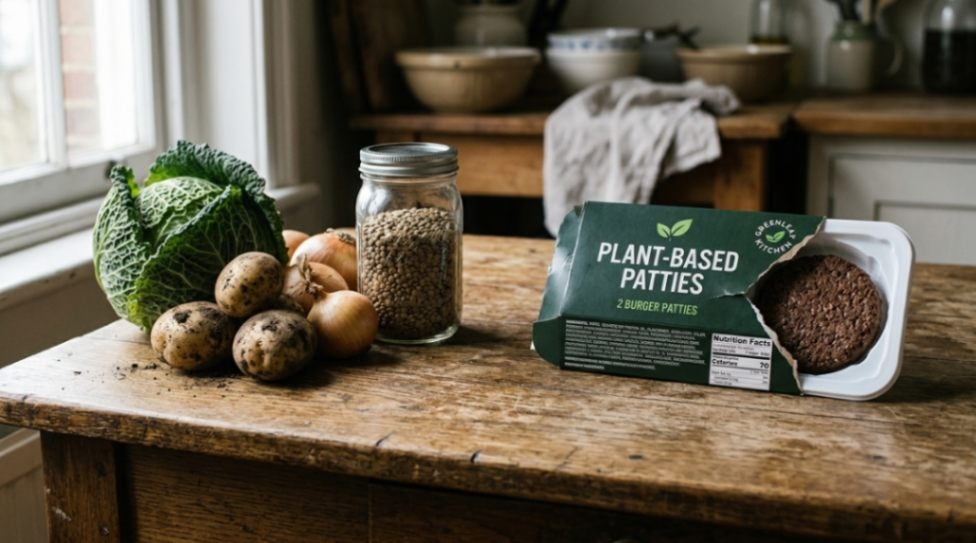
Plant-based turned a simple fact into a marketing costume. Plants are real. Beans are real. Potatoes are real. Cabbage is real. But a box that says plant-based is often not asking you to look at the plant. It is asking you to stop reading the rest of the package.
The trick works because the word feels clean. It sounds like soil, leaves, gardens, and farmers' hands. Then the label turns around and sells a burger built from protein isolates, gums, flavor systems, starches, refined oils, color, and a small legal miracle of texture.
Nobody needed to brand a lentil as plant-based. Nobody needed a green leaf icon on an onion. The real plant sits there quietly. The product needs the speech.
The Leaf Does The Talking
Walk through the freezer aisle and the word starts appearing everywhere. Plant-based nuggets. Plant-based patties. Plant-based cheese. Plant-based bacon. Plant-based cream. Plant-based dessert. The packages borrow the language of vegetables while chasing the shapes of meat, milk, and eggs.
That alone tells the story. If the plant was the main event, the product would not have to cosplay as a chicken nugget.
A carrot does not need smoke flavor to explain itself. A potato does not need pea protein isolate to become dinner. A bowl of beans does not need methylcellulose to hold its personality together. These foods may be plain. They may be boring to a pitch deck. But they are legible.
The new aisle is different. It is full of foods trying to pass as other foods. The package says plants. The shape says meat. The ingredient list says laboratory paperwork with a green border.
This is not a defense of bad meat, bad dairies, or careless farming. Industrial food can ruin almost anything. A miserable chicken nugget and a plant-based chicken nugget may both come from the same basic insult: turn real food into a branded object that can sit in a freezer and survive a supply chain.
But the plant-based label asks for moral credit before the food has earned ordinary trust. It wants the halo first. The ingredients can explain themselves later.
A Word Replaced The Object
The strongest foods do not need identity language. Eggs are eggs. Beef is beef. Butter is butter. Rice is rice. Lentils are lentils. A cabbage does not call itself earth-forward. It just waits for a knife.
Plant-based works because it is not a food name. It is a category name. Category names are useful for shelves, menus, apps, and investors. They help products move around inside a market. They do not help a person understand what is actually being eaten.
That is why the word can cover so much. A bowl of chickpeas and a fake sausage can both be plant-based. One has been cooked. The other has been engineered into an imitation of something it refuses to be. The same label stretches over both and asks the buyer to treat them as cousins.
The grocery store loves words like that. They flatten the difference between a crop and a product. They make an aisle feel like a belief. They let a long ingredient list stand near a vegetable and borrow its reputation.
This is how the package gets away with sounding simple while behaving complicated. The front says plants. The back says calcium caseinate substitute, modified starch, cultured dextrose, natural flavors, expeller-pressed oil, gums, stabilizers, and things most kitchens do not keep in jars.
The front is a meadow. The back is a meeting.
Imitation Has A Cost
Imitation food has to solve problems real food does not have. A bean does not need to bleed. A mushroom does not need to melt like cheese. A lentil does not need grill marks printed into its destiny. But once a product promises to replace meat, milk, or eggs, the factory has work to do.
Texture has to be built. Fat has to be managed. Color has to behave. Moisture has to stay in place. Flavor has to survive freezing, shipping, reheating, and disappointment. The ingredient list grows because the promise is unnatural: make this thing act like that thing, while pretending the difference is moral progress.
That is why so many of these products feel overdesigned. They are not trying to be plants. They are trying to be replacements. A replacement has to carry the burden of comparison. It has to act, smell, tear, brown, melt, stretch, or chew like the food it is trying to retire.
There is a quiet comedy in this. The market spends years telling people meat is primitive, milk is outdated, eggs are questionable, and butter is suspect. Then it builds expensive imitations of all four and puts them under better lighting.
If the old food was so embarrassing, why does the new one keep dressing like it?
The answer is plain. People still want burgers, cream, cheese, bacon, eggs, butter, and ice cream. The old forms still carry appetite. The new product wants the appetite without the animal, the tradition without the mess, the pleasure without the source.
So the source gets hidden behind a green word.
Plants Were Not The Problem
There is nothing strange about eating plants. A pot of beans is not a culture war. Potatoes in fat, cabbage in salt, onions in a pan, apples on a table, rice under stew, herbs in broth. These are normal foods. They do not need a movement around them.
The strange part is the packaged imitation. The strange part is watching a factory turn peas into a burger costume and then ask for applause because a plant was involved somewhere near the beginning.
Real plants are not fragile. They can stand under their own names. Bean. Carrot. Onion. Potato. Tomato. Apple. Cabbage. The name is enough because the thing is enough.
Plant-based is different. It is a permission word. It tells the buyer to feel clean before looking closely. It turns food into a moral shortcut, then lets processing hide inside the shortcut.
The old rule still works better than the new label. Read the food, not the costume. If the plant is real, you can usually name it without help from a marketing department. If the package has to shout plant-based, the plant may already be missing.
Plants do not need a spokesperson. Products do.