
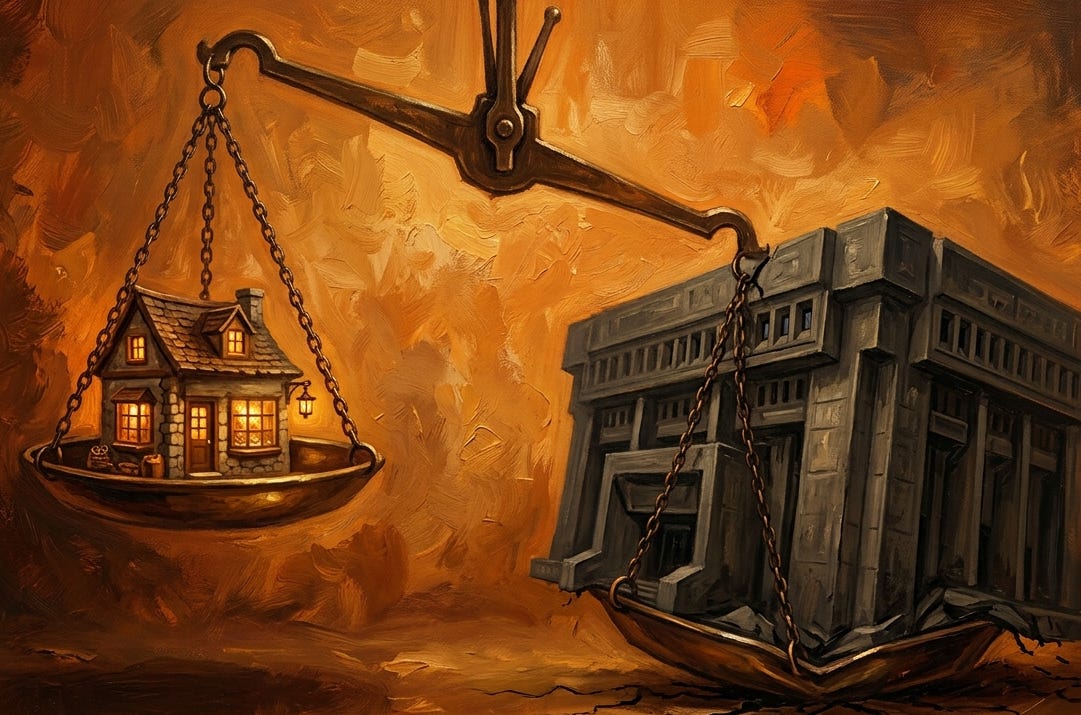
Last July 15, the Court of Cassation definitively confirmed the 14-year and 9-month sentence for Mario Roggero, the 72-year-old jeweler from Grinzane Cavour who in April 2021 killed two of the three robbers who had just assaulted his jewelry store - his wife and daughter beaten and tied up, the safe emptied - and wounded a third.
Every news page in the country spent days covering the sequence of events, the three levels of trial, and the political reactions: there's no need to rehash them here. What's missing, amid all the noise, is a trial that no court will ever hold. I previewed the thesis on X:
I'm returning to the subject here because the Roggero case, more than a news story, is a photograph of the distance separating positive law - written by men, changing with majorities - from natural law. It's terrain this newsletter has stopped on often, exploring the political roots of Bitcoin: from the private justice of Power and Market (Fermata #69) to the State that is not "us" in Anatomy of the State (Fermata #114), from the abolition of the public sector in the Libertarian Manifesto (Fermata #146) to the right of property in The Ethics of Liberty (Fermata #192). Murray Rothbard, always him. It's worth using that framework to hold that trial, in the only courtroom that matters here: the courtroom of logic.
BitBox02 Nova Bitcoin Orange is the new Bitcoin-only edition of the open-source hardware wallet designed in Switzerland.
Compatible with iPhone, iPad, Android, and desktop, it is designed to custody bitcoin in a simple, verifiable, and uncompromising way.
With the coupon BITCOINTRAIN you get 5% off all BitBox products.
The Austrian school analysis starts from an axiom: every individual is the owner of their own body and of legitimately acquired goods, and no one may initiate the use of force against the person or property of another. As recalled in Fermata #192, the very concept of rights only makes sense when expressed as property rights.
From here you just follow the logic. Whoever aggresses places themselves outside the perimeter of the rights they demand be recognized, and their loss of rights is proportional to the severity of the aggression they chose.
The collision point between this logic and the penal code is the flight. Under Italian law the action was over because the robbers had turned their backs and were outside the jewelry store. Under logic, the violation was ongoing: as long as the stolen goods remain in the thief's hands, the invasion of property continues. Flight is the violation continuing by other means. The victim has the right to use force to defend themselves and to recover what is theirs.
"Sure, but proportionality," someone will object. Of course: shooting someone who steals a pair of shoes would be disproportionate because the aggressor's loss of rights must be proportional to the aggression. But here the proportion must be measured against what the three put on the table: an armed robbery, threats, physical violence against two women who were tied up. Anyone who accepts putting others' lives at risk to empty a safe must accept the risk of their own life as well.
Then there's the most absurd demand of positive law: that the victim, in shock, with family just freed from zip ties, calculate to the millimeter the right amount of force to use, in a few seconds and amid chaos. The risk of error falls on whoever created that situation. Always.
So how would the Roggero case be judged in a free society, where defense and justice are services offered on the market in competition with each other, as imagined in Power and Market (Fermata #69)?
The court would ask one question only: who initiated the use of force? Answer: three men with a gun and a knife, who entered someone else's property. Every subsequent consequence - the fear, the flight, the shots, the death - stems from that choice and falls on those who made it. Roggero would leave the courtroom as a victim to be compensated: the trauma, the damages, the expenses. The compass of restitution would point in the opposite direction, from the aggressors and their heirs toward the person who suffered the aggression.
Most likely, in that society, the 2021 robbery would never have happened at all. Roggero had already been robbed in 2015: he was beaten and tied up along with his wife and daughter, the two women locked in the bathroom, €300,000 in stolen goods. An entrepreneur with that history, in a free security market, would have purchased protection from an agency that answers for its failures with its own money and therefore shows up. And even without agencies involved, the calculus for anyone choosing the profession of robber would change considerably, knowing that every victim can defend themselves without asking anyone's permission.
In contemporary society, instead, the security monopolist failed twice with the same family, in 2015 and 2021. It collects taxes to guarantee protection, the protection never arrives, and when the citizen protects himself it punishes him. Then comes the masterpiece: it orders him to compensate the families of the aggressors. The civil parties obtained provisional damages of €780,000, plus €10,000 awarded to the surviving robber against a total claim of €3.3 million. Roggero has already paid €300,000 by selling some properties; two more have been seized.
It is the definition of the State from Anatomy of the State (Fermata #114) played out to its fullest: monopoly of force over a territory, revenue obtained through coercion. With the final perversion whereby the victim funds the aggressor.
Meanwhile, politics has offered its usual repertoire. On July 14, the day before the verdict, the first green light arrived for the security bill containing the provision dubbed "Save Roggero": no civil compensation owed by those who react to serious crimes even beyond the limits of self-defense. Too bad that - as Il Foglio explained - the provision is not retroactive, final approval will take weeks or months, and criminal liability remains fully intact. The Save Roggero provision doesn't save Roggero. Positive law in its essence: a law that admits its own injustice by changing itself, but only starting tomorrow. Natural law had already written that law, and had written it into Roggero's property before the penal code ever existed.
The appeals did the rest. "Self-defense is always legitimate," wrote Giorgia Meloni. Matteo Salvini is now asking Mattarella for a pardon, the lawyers are considering an appeal to the European Court of Human Rights. Translated from political-speak: to obtain justice, two paths remain - asking a favor from the head of the monopolist or knocking on a foreign court's door. A pardon, after all, is the system's perfect confession: justice as an act of sovereign clemency, granted or denied, never owed.
Weeks like this explain why this newsletter returns from time to time to the political roots of Bitcoin. The Roggero case shows what happens when you entrust the protection of property to a coercive monopolist: protection never arrives, courts convict the victim, bailiffs seize assets, all with money taken from those who produce it: taxes, debt, inflation.
Every euro left inside the system works for it, from the bank account the bank recycles into government bonds to the assets that can be seized with a rubber stamp. Mario Roggero's two properties know this all too well.
Moving wealth outside that perimeter is the most concrete dissent there is, and Bitcoin puts this initiative within anyone's reach. Every euro converted into self-custodied bitcoin exits the beast's diet: it stops financing others' debt, stops being carried away with a stamp, stops devaluing to cover the monopolist's books. The less money the beast has, the less damage it can do: it is the resistance that builds a freer society, one satoshi at a time.
The best way to honor Roggero is to starve those who put him behind bars.