Bitcoin Magazine
Tahini’s Bitcoin Treasury: How a Family Chain Outsmarted Inflation
Tahini’s Restaurants, a Canadian fast-casual restaurant chain specializing in Mediterranean and Middle Eastern cuisine, integrated bitcoin into its business in 2020 and has been refining its strategy ever since. Today Bitcoin makes up over 70% of their reserves and has made a critical difference in their expansion to 62 restaurants in just over a decade.
“We just kept putting more and more money into bitcoin.” Omar Hamam, CEO and co-founder of Tahini’s, told Bitcoin Magazine. Omar and his brother Aly Hamam founded the company in 2012, starting with one restaurant in London, Ontario. Tahini’s has since grown to 62 restaurants across the country, their expansion amplified by their adoption of an early bitcoin treasury strategy, partially inspired by Michael Saylor in 2020. The bold move gave them a pool of capital with which they could compete with the giants of the fast-casual food industry.
As a small company that started in London Ontario Canada we operate 4 corporate locations and 3 Franshise locations about to open up in Ontario. We just converted our entire cash reserves that were originally used as savings into #Bitcoin
Time for thread— Tahini’s (@TheRealTahinis) August 18, 2020

“We’re competing with McDonald’s, and Chipotle,” said Omar, adding, “All these companies have more money than 100 Tahini’s. So, to have an advantage like that, where we have a treasury and a balance sheet strategy that puts us in a comfortable place financially, that lets us preserve our wealth over time and space … it was the best decision we’ve ever made for our business.”
The company has implemented multiple innovative strategies throughout its journey, including the deployment of Bitcoin ATMs to many of their franchises, a new media strategy that, according to Aly, has netted them “three billion views over the last five years across all social media platforms,” including a YouTube channel with over 3.2 million subscribers and, of course, their bitcoin treasury strategy.

Aly’s Fascination with Bitcoin Post-COVID, Influenced by Egyptian Currency Devaluation
Aly Hamam was the main driver behind the restaurant’s bitcoin strategy. Shaped by his family’s experiences with the Egyptian pound’s aggressive devaluations over the past 20 years, the catastrophic consequences of runaway inflation were deeply personal to him, an experience that set him up well to discover bitcoin during the March 2020 market crash. “So, I came from Egypt, and over the last two decades, I’ve seen the Egyptian pound drop probably 85% or something like that. And I’ve seen our family struggle. I’ve seen my parents struggle. My parents had money sitting in Egypt over that time. I’ve seen their life savings get wiped away. Sometimes with Egypt, it happens like flash crashes. So, the government will come in and can just devalue the currency within a month, 50%,” Aly recalled.
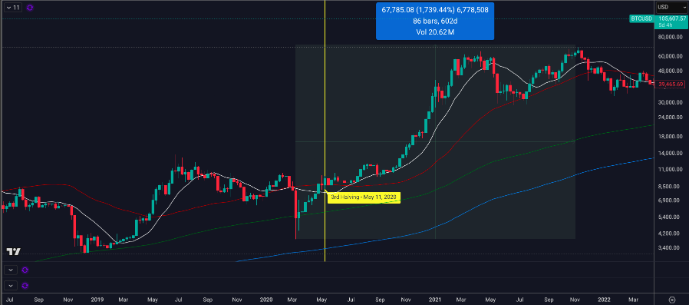
When the COVID-19 market panic happened in March of 2020, the price of bitcoin went from a high of $10,000 to as low as $4,000 in weeks. “I bought a little bit as a gimmick and because it was just down so much, I was like, yeah, I might as well buy it. … The more I studied, I fell down the rabbit hole hard. Over the next few months, I just kept buying more and more and more, and you know those first three months when you discover bitcoin, it’s just like a never-ending consuming over every aspect of your life, listening to podcasts, reading books, and just buying more and more and more,” Aly explained.
After the crash, Bitcoin bounced back up to around $10,000, where it consolidated for months as governments throughout the world prepared their COVID-19 response and unleashed trillions of newly printed dollars into the global economy. Interest rates in the U.S. dropped to zero, and COVID-19 support checks started to flow to anyone in Canada who filled out a form. Omar recalled that “the government was just literally printing money nonstop. And it wasn’t just the Canadian government. It was every single government out there that was doing it. So, we knew there was going to be an inflation problem.” The Bitcoin halving was also taking place right around that time, an additional fundamental force that arguably led to one of the most impressive bull runs in its history.
This was the same era when Michael Saylor famously entered the industry and became the most famous Bitcoin bull to date. However, Saylor’s many speeches and documents on how to structure a corporate bitcoin strategy and how to convince the board of directors or other business partners were just starting to hit the podcast circuit, and the bitcoin treasury playbook was still in its infancy.
Once Aly was “100% in,” he started orange-pilling his family. “So, I started orange-pilling my business partners, my brother, my cousin, and they started buying it personally.” Personally they all started buying Bitcoin in small amounts, but using the company’s reserves was a far more difficult process, Aly explained that “it wasn’t quick. It was a back-and-forth where I wanted us to put the company money into bitcoin, and they were kind of on the edge. ‘That’s a crazy idea.’ ‘This’ and ‘that,’ and then we just kept going back and forth, back and forth until Michael Saylor announced that first buy. I had already set up like all the accounts and all of that was just ready to go. So, when Michael Saylor bought that first batch of bitcoin, that was what pushed us all over the cliff. And a week later, we put whatever money the company had into bitcoin.”
Acquisition Price, DCA Strategy, and Persistence Through Bear Markets
Tahini’s bitcoin investment strategy differs from today’s public companies, which issue stock (and other financial instruments) to buy bitcoin and add to their reserves. As a private company that started accumulating bitcoin before the ETF in the U.S. was approved, Tahini’s took a simpler approach: buy as much as reasonably possible each month, forever. According to Omar, today bitcoin represents over 70% of the company’s reserves.
While their timing was excellent, having started to buy bitcoin for their treasury at around $10,000, the strategy known as “dollar-cost averaging” works very well regardless of price, even in a bear market. Have a look at this DCA calculation, for example.
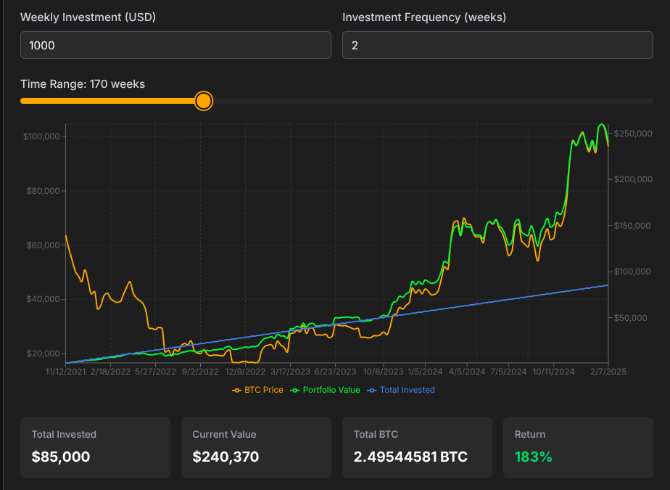
If you started putting $1,000 into bitcoin every two weeks at the top of the 2021 bull market — at nearly $70,000 per coin — every time you made a purchase at a lower price after that, you would be lowering your average purchase price. The result is that on the way out of the bear market — in this example, above roughly $30,000 — you would be at break-even and would be perfectly positioned for the upcoming bull market. The only requirement is having a long-term investment mindset.
“You buy every month, every single month. Ups and downs. I know it sounds too simple, but actually, this is the only way to do it. Right. You just buy, don’t try to outsmart the system, in my opinion, unless you’re really good at this. Put a number aside every single month, and it just pans out. And if you think about it, if you look at the last four years, you would have made more than 2-30x your investment,” Omar explained. He added that, “I have this conversation with a lot of people. Friends, family, everybody. And I always tell them, listen, just start somewhere. Don’t put a big amount and see how it works out for you. Right. So, let’s say you put a thousand dollars and watch it as a number that’s not going to be too bad if anything happens to it. See, if let’s say next year, this 1,000 becomes 1,200 or 1,500. Now imagine if you had 100,000 or imagine if you had a million, right? What would have happened to that amount?”
While there are no hard rules about the optimal frequency of the DCA strategy in Bitcoin, be it for individuals or corporations, Tahini’s opted for monthly purchases, as it made sense given their accounting processes. “Every month, we have a P&L. Every month, we see our profit and losses. And we decide at the end of the month, okay, we’re gonna put this much aside,” Omar explained.
When it comes to amounts,