

The global macroeconomic landscape is currently governed by a single, master variable: the real interest rate.
While mainstream commentators remain fixated on backward-looking CPI prints and headline FOMC statements, the bond market has quietly opened a massive divergence that signals a looming Fed policy mistake, and a generational setup in hard assets and defensive equities.
If you are allocating capital without disaggregating nominal yields from bond-market-implied inflation expectations, you are operating in a trap. Here is the systematic transmission chain of the current macro regime and how to navigate it.
1. The Real Rate Framework: Market-Implied vs. CPI Lag
To read the Fed’s reaction function accurately, we must abandon lagging indicators. The Fed monitors real-money forward pricing.
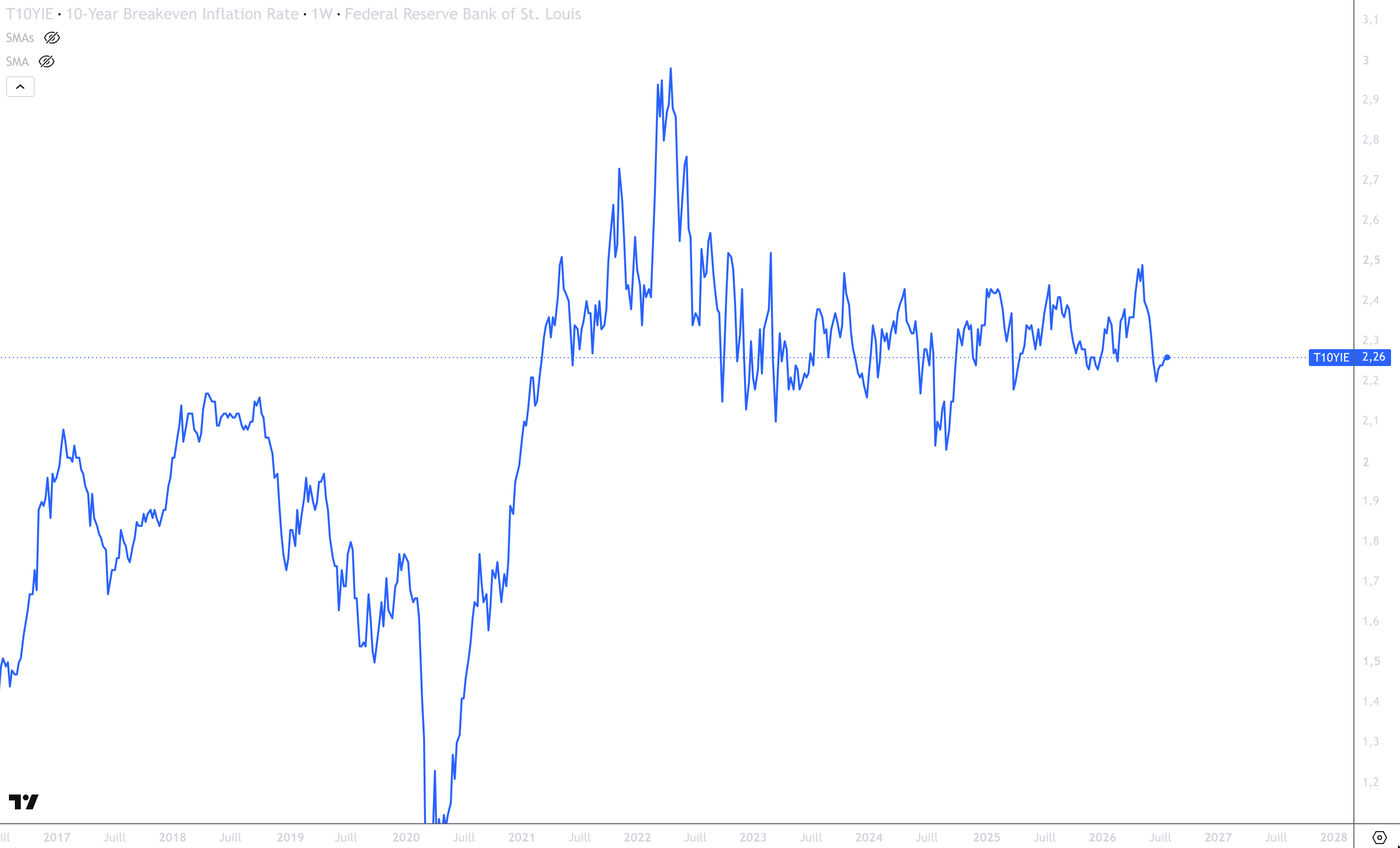
Our core variable is the 2-Year Real Treasury Yield, constructed as: $$\text{2Y Real Yield} = \text{2Y Nominal Treasury Yield} - \text{Inflation Break-Even}$$
The inflation break-even (the difference between nominal Treasuries and Treasury Inflation-Protected Securities or TIPS) represents the bond market's forward-looking expectation of inflation.
Recently, inflation break-evens collapsed back to 2.20%, before bouncing back up to 2.26%, touching the absolute low end of their multi-year range.
Historically, every single time inflation expectations reached this 2.2% floor, the 2-Year nominal yield followed them downward as the Fed was forced to turn dovish to prevent economic choking.
Nominal Yield (High)  ───┐
                         ├───> Real Rate Spikes (Choking Risk)
Break-even (Collapsing) ─┘
The divergence we see today—where nominal yields remain elevated while forward inflation pricing collapses—signals that the Fed is running a short-term real yield that is far too tight for a cooling economy. This is a classic policy mistake setup. The Fed has no structural incentive to push real short-term rates higher in a disinflationary environment. A dovish pivot is not just possible; it is mathematically forced.
2. The Dollar Transmission Chain: S&P 500's Foreign Revenue Headwind
The surge in real yields has acted as a powerful magnet for global capital, driving a relentless bid into cash. This has propelled the US Dollar Index (DXY) up by 7% since May 2026, confronting major resistance in the 103–104 range.
While a strong dollar is often celebrated by politicians, it is a silent killer for corporate earnings.
Approximately 40% of S&P 500 revenues are generated abroad and denominated in foreign currencies. When the USD index rises by 7%, those foreign revenues shrink by 7% purely on currency translation when consolidated back into dollars.
At a DXY of 104, this currency translation headwind represents a non-negligible drag on S&P 500 earnings growth, compounding the valuation pressure of higher discount rates. This is why a hawkish Fed is doubly hazardous for equities:
-
Higher Discount Rates: Compressing P/E valuation multiples.
-
Lower Translated Revenues: Directly crimping the denominator (E) of the P/E equation.
3. Gold: Coiled at Key Structural Support
Gold is the ultimate mirror of real interest rates. Because gold is a non-yielding asset, a rising real rate raises the opportunity cost of holding it, prompting tactical capital to exit and sit in cash.
Following the stabilization of real rates post-November 2022, gold entered a historical bull market. The recent spike in real rates has temporarily capped this momentum, forcing a healthy correction.
[Real Rates Rise] ──> [Opportunity Cost Increases] ──> [Gold Corrects to Support]
Today, gold is resting near critical structural support at $3,900/oz. The next major support zone lies at $3,400/oz.
Given the structural, long-term bull market forces (sovereign debt expansion, central bank diversification), the downside is fundamentally capped. As nominal yields inevitably fall to close the divergence with collapsing break-evens, real rates will roll over, releasing a coiled spring in the gold market.
4. The Premium Playbook: Positioning for the Rotation
As capital exits rate-sensitive, hyper-scalar momentum sectors (the semiconductor/AI melt-up that has dominated since April 2025), it is rotating rapidly into macro-defensive instruments, rate-beneficiaries, and massive cash-pile fortresses.
Value-for-Value Support
If this systematic macroeconomic briefing helps you navigate these shifting market currents and optimize your capital allocation, consider zapping this post on Nostr. Your support preserves independent, institutional-grade research free of institutional bias.