BTC Mesh: Sovereign Communication and Off Grid Bitcoin Transactions
Ever imagined sending a Bitcoin transaction without an internet connection? Or talking to your friends during a total blackout when the cell network just vanishes? It sounds like science fiction, but this technology is an accessible reality, built with low-cost hardware and open-source software. Welcome to the world of mesh networks, Meshtastic, and the **BTC Mesh** project.
This guide explores the universe of decentralized communication networks, showing how they work, why they are vital for our digital sovereignty, and how you can use them to strengthen your privacy and resilience—not just in communication, but in your Bitcoin transactions as well.
https://fountain.fm/episode/nr8qWgi7XNoBbDkc8GZj
https://open.spotify.com/episode/6vKW7Lhi3uOUhlRogAtgej
## What Are Mesh Networks and Why Should You Care?
Our connected world runs on a fragile, centralized infrastructure. Cell towers, internet providers, data centers—if one of these points fails, communication stops. A mesh network turns this logic on its head.
Here, each participant (or "node") connects directly to other nodes within its reach, forming a web of P2P (peer-to-peer) connections. Instead of data passing through a central server, it hops from node to node until it reaches its destination. The true strength of this approach is **decentralization and resilience**. If a node goes down, the others simply find a new path for the information. The network reconfigures and heals itself.
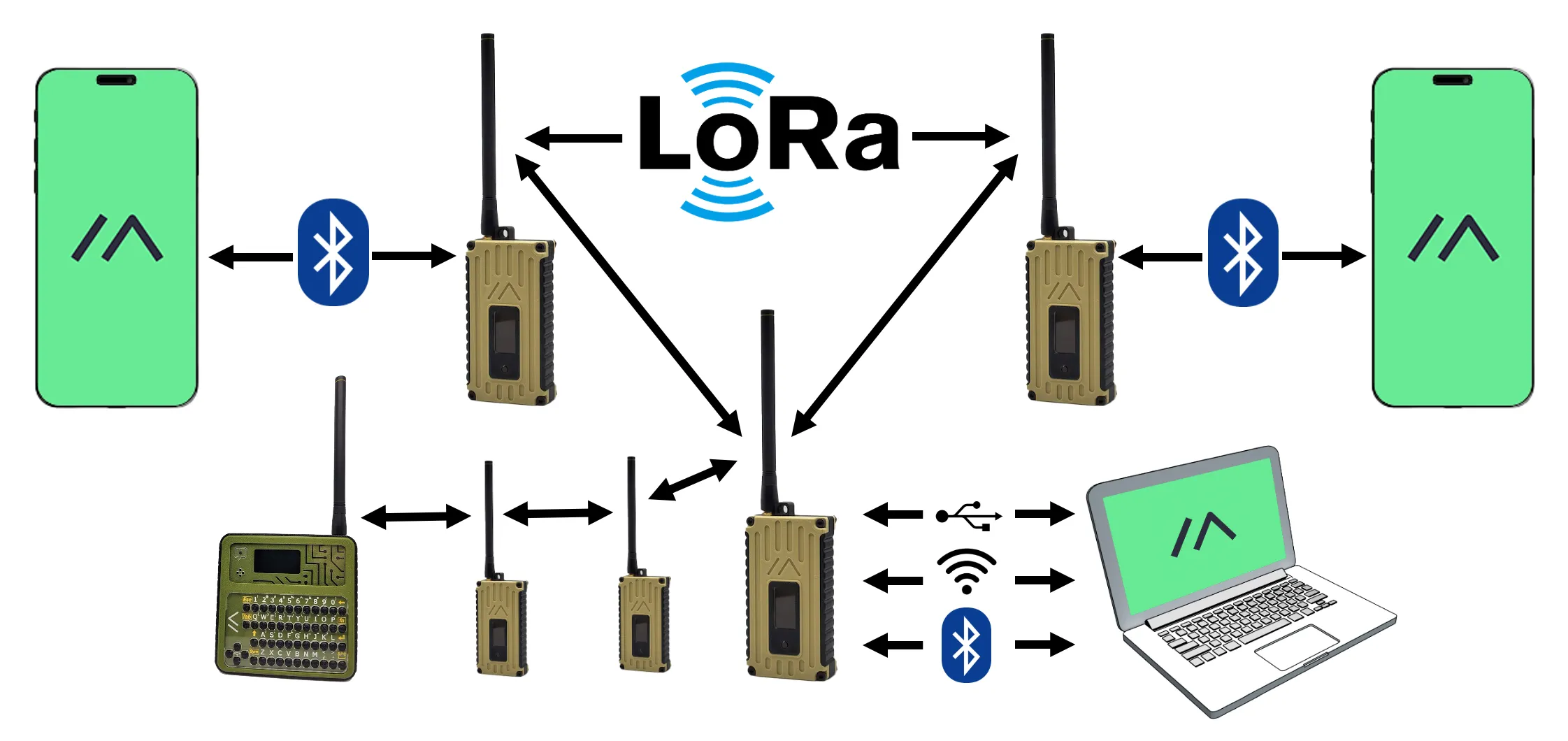Source: [meshtastic.org](meshtastic.org)
## LoRa and Meshtastic: The Dynamic Duo
To create these networks in the real world, the enthusiast community has rallied around a powerful duo:
- **LoRa (Long Range):** Think of LoRa as the physical layer—the "radio waves" of our network. It's a technology that allows for long-range wireless communication with incredibly low power consumption. We're talking about cheap little radios that can send small data packets for miles, running for days on a single battery.
- **Meshtastic:** If LoRa is the physical medium, Meshtastic is the brain. It's open-source software that equips these radios to form a smart, easy-to-use mesh network. Meshtastic handles everything: discovering other nodes, managing routes, encrypting messages, and providing an interface on your phone, connected via Bluetooth.
Meshtastic was originally created as an off-grid communicator, but its usefulness goes far beyond that. Here, privacy is a fundamental pillar. To join a group channel, you need the encryption key. Direct messages are end-to-end encrypted. It's like having a "hardware wallet" for your communication: your private key is secure on your radio, ensuring that only you and the recipient can read the messages.
While Meshtastic is the most popular, alternatives like MeshCore exist, which aim to optimize packet routing. However, the network effect is powerful, and the vast majority of users today are on the Meshtastic platform.
## Introducing BTC Mesh: Bitcoin Transactions Via Radio
This is where Bitcoin enters the picture. The inspiration for the BTC Mesh project came from a mix of necessity and chance. After buying a LoRa radio on AliExpress that, to my frustration, couldn't transmit over long distances—and the seller simply stopped responding—I discovered it worked perfectly within my apartment. With two radios in hand, one for the base and another "defective" one, I had the perfect test environment for a new use case: sending Bitcoin transactions over the mesh network.
[GitHub - eddieoz/btcmesh: BTC Mesh Relay is designed to send Bitcoin payments via LoRa Meshtastic.](https://github.com/eddieoz/btcmesh)
BTC Mesh is a simple application that allows anyone on a Meshtastic network to send a Bitcoin transaction (on-chain, layer 1) over the radio network, without needing a direct internet connection.
### How the Magic Works
The system has two parts: a **client** and a **server**.
- **The Server:** Someone on the network with internet access runs the "server node." This is a computer (a Raspberry Pi can handle it) connected to a LoRa radio and a full Bitcoin node (Bitcoin Core). It acts as the bridge between the off-grid mesh world and the global Bitcoin network.
- **The Client:** Anyone else on the network, even miles away and without internet, can use the "client" on their laptop or phone.
The process is a choreographed dance designed for the low-speed LoRa network:
1. **Preparing the Transaction:** In a wallet like Sparrow, you create and sign your transaction. Instead of clicking "Broadcast," you copy the "Raw Transaction"—a long hexadecimal text.
2. **Sending Over the Mesh:** In the terminal, you run a simple command, pointing to the server's radio and pasting your raw transaction.
3. **The Communication:** Since the transaction is too large for a single LoRa packet, the client splits it into chunks and starts a conversation with the server:
- **Client:** "Hey server! I have a transaction in 15 parts. Can we start?"
- **Server:** "Roger that! Awaiting 15 parts. Send the first one."
- **Client:** (sends part 1)
- **Server:** "Part 1 received. Send part 2."
- This "handshake" continues until all parts are confirmed, ensuring the transaction arrives complete.
4. **Validation and Broadcast:** Upon receiving everything, the server reconstructs the transaction, validates it, and hands it off to its local Bitcoin node, which finally broadcasts it to the worldwide network.
And that's it! Your transaction is sent to the blockchain, broadcast from a radio, without your IP address ever being exposed.
## Maximum Privacy and Sovereignty
BTC Mesh's power lies in its layers of privacy:
- **No IP Trail:** Since the transaction is sent via radio, there is no record of your IP address. To the Bitcoin network, the transaction simply originated from the server node.
- **End-to-End Encryption:** The communication between the radios is encrypted by Meshtastic. No one in between can see the content of your transaction.
- **Extra Layer with Tor:** For maximum privacy, the server node can connect to the internet through the Tor network. This way, not even the server's IP is exposed in the final broadcast.
This combination creates a powerful system for censorship-resistant Bitcoin transactions with high privacy.
## Building Your Kit: The Hardware
Excited to build your own station? The hardware is cheap and accessible.
- **Frequency is Key:** First, know the legal LoRa frequency in your country. In Brazil, use 915 MHz. In Europe, 868 MHz. Buying the wrong frequency will render your radio useless.
- **Popular Brands:**
- **Heltec:** Very popular, with boards like the T114, V3, and the Wireless Bridge, which comes with a practical design and an e-ink screen.
- **RAK Wireless:** Considered more "professional." The RAK4631 model (which I use for my base) is excellent, and the WisBlock line is modular, requiring no soldering.
- **LilyGo:** Famous in the "maker" community. Offers boards like the T-Beam (with GPS), T-Echo (small and practical), and the T-Deck (a full communicator with a keyboard).
- **Seeed Studio (SenseCAP):** Offers robust devices like the T1000-e (waterproof) and the XIAO ESP32S3 (tiny, perfect for compact projects).
- **Antennas:** Don't underestimate the antenna! And a crucial warning: **never, ever, turn on your radio without an antenna connected**, or you could burn out the transmitter.
- **3 dBi:** A more "rounded" signal (a sphere), great for short distances with vertical obstacles.
- **10 dBi:** A "flatter," more directional signal (a frisbee), for long distances with a clear line of sight.
- **Power:** Many boards have connectors for batteries and small solar panels, allowing you to create autonomous nodes.
## Limitations and Considerations
Despite its power, LoRa technology has its limits:
- **Low Bandwidth:** The network is slow. Think 140-character Twitter. It's perfect for messages, but forget about web browsing.
- **Regulation:** Many regions limit the amount of data a radio can transmit per hour ("duty cycle"). Meshtastic respects these limits, which reinforces the need for optimized applications.
- **Need for a Bridge:** For a transaction to reach the global network, one node on the mesh needs internet. The network can be fully off-grid for internal communication, but the bridge to the outside world is necessary for certain applications. **MQTT servers** can play this role, connecting distant mesh networks over the internet.
## Use Cases: Beyond Bitcoin
- **Disaster Communication:** Projects like [Disaster.Radio](Disaster.Radio) focus on using LoRa to coordinate rescue teams during catastrophes.
- **Outdoor Activities:** Essential for hiking and camping in remote locations.
- **Internet of Things (IoT):** In agriculture, sensors can cover vast areas. On farms, they can monitor livestock.
- **Private Communication:** In a world of surveillance, having a communication channel that you control is an act of sovereignty.
## The Future is Decentralized
Projects like BTC Mesh offer a glimpse into a more resilient, private, and decentralized future. They give us the tools to build our own communication and financial networks, free from centralized control.
The technology is cheap, the software is free, and the community is vibrant. Building your first node might seem intimidating, but it's a rewarding project and a practical step toward personal sovereignty.
So, are you ready to get off the grid?

