The Pretty Good way to calculate a user's influence within your web of trust
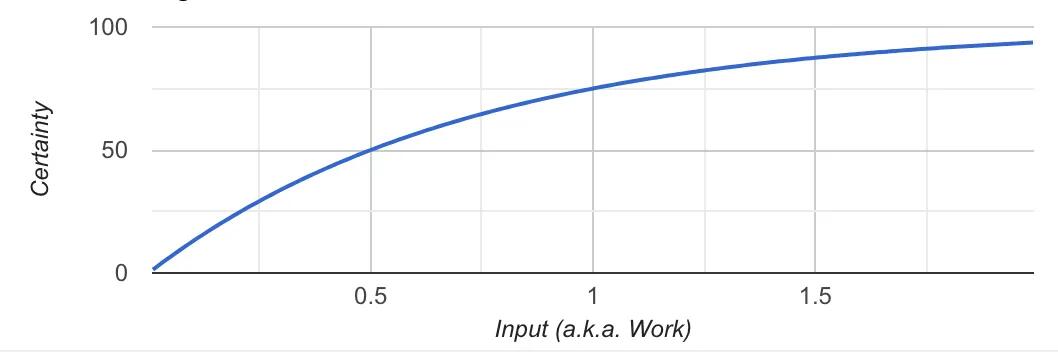
The Influence of a user on your Grapevine, in some given context, is a function of two variables: 1) the Average Score, which is a weighted average of the relevant trust rating (“Alice trusts Bob a certain amount to filter content in the given context”), and 2) the Input, which is the sum of the weight for each individual rating. Think of Input as the “number of ratings,” where more is better, except that in the Grapevine, not every rating is weighted equally. Influence scales linearly with Average Score, as it should, because a high Average Score is a good thing. But the key to the Grapevine is that Influence does not scale linearly with Input. This is one of the central problems with legacy social media: the follower count has no upper limit, and “influencers” are rewarded for high follower count. But the goal of the Grapevine is to seek quality, not chase followers. Input, like follower count, has no upper limit, so we shouldn’t make Influence proportional to Input. The Pretty Good solution is to replace Input with Certainty, which has an upper limit of 100%. As Figure 1 shows, Certainty starts at 0% and increases quickly at first as Input increases, but then levels off at 100% no matter how high Input gets. Influence then equals that user’s Average Score multiplied by the Certainty. Using this system, the key to Influence is not a high follower count, but a high Average Score. The number of trusted ratings is taken into account but does not dominate the Influence score. Users are rewarded, not for their follower count or number of likes or for attracting more and more ratings, but for gaining the respect of the small handful of people who know them best. We now have a tool to ditch the tyranny of the follower count; to cut through the noise of the social media influencer and to find the high-quality needles in the haystacks that we have been looking for.