Welcome to Cognitive Capitalism
[\
](https://substackcdn.com/image/fetch/$s_!-V6V!,f_auto,q_auto:good,fl_progressive:steep/https%3A%2F%2Fsubstack-post-media.s3.amazonaws.com%2Fpublic%2Fimages%2F45ab22f1-701a-403b-a072-44e81d745b4f_1024x1024.png)
An alternative title could be "How Open AI Learned to Stop Worrying and Love Your Data".
***
Remember when Facebook promised to “connect the world”? Ah, simpler times. Back when we naively believed Mark Zuckerberg actually wanted to help your grandmother find her high school friends, rather than build a psychological warfare machine that would make the Stasi weep with envy. Well, history is repeating itself—and this time, the stakes are your entire consciousness.
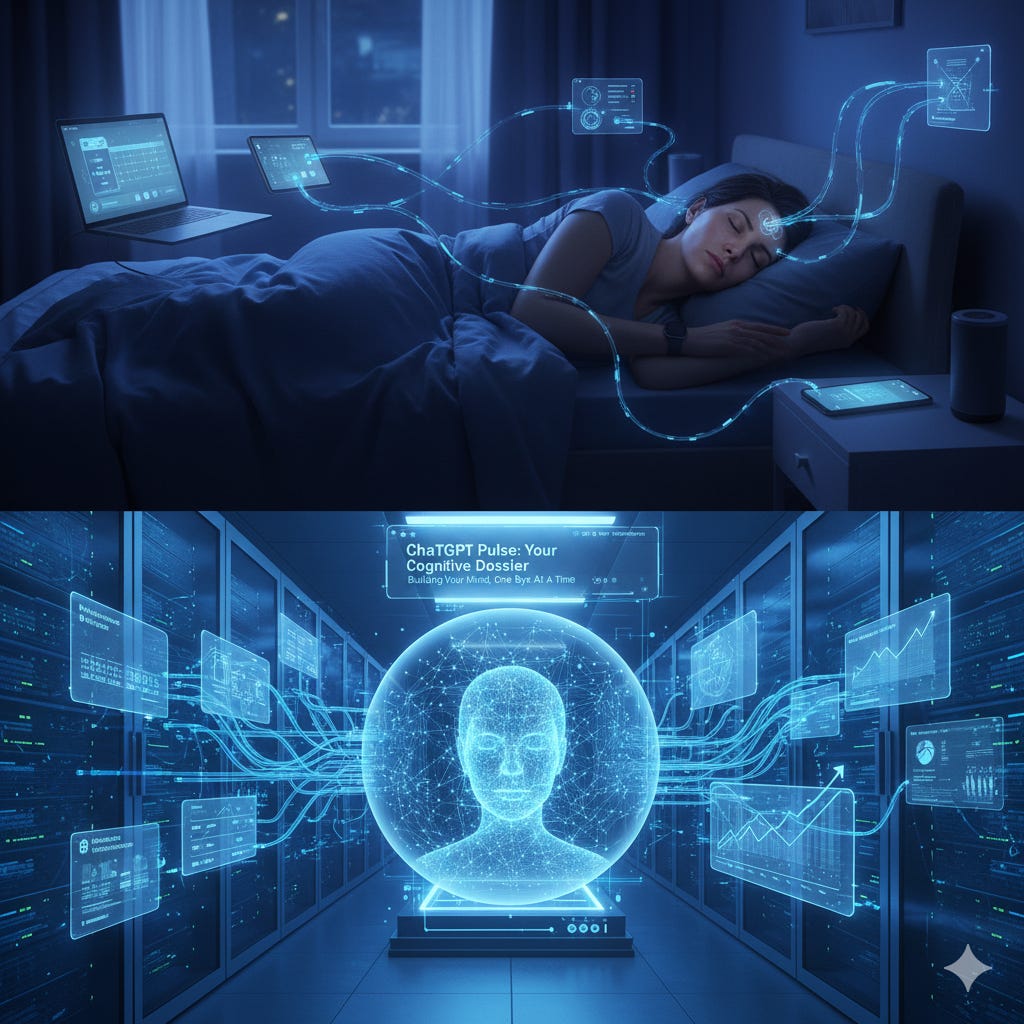
Meet ChatGPT Pulse, OpenAI’s latest “innovation.” It’s not just an AI assistant anymore—it’s your new 24/7 digital roommate that “works for you overnight” to deliver personalized morning briefs. Because nothing says “helpful technology” like having an AI rummage through your digital life while you sleep, preparing a nice little dossier for your morning coffee.
## **The Facebook Playbook: Now With 100% More Cognitive Infiltration**
Twenty years ago, Facebook’s pitch was irresistible: “Connect with friends! Share photos! Poke people!” What they didn’t mention was the fine print: “Also, we’ll monitor your every interaction, build psychological profiles that would make a therapist jealous, and sell your behavioral patterns to anyone with a credit card.”
Now OpenAI is running the exact same con, just with fancier vocabulary. ChatGPT Pulse “proactively does research to deliver personalized updates based on your chats, feedback, and connected apps like your calendar”—which is corporate speak for “we’re going to vacuum up every byte of your digital existence.”
The beauty of this strategy lies in its incremental nature. First, they hook you with genuinely impressive capabilities. “Wow, it can write my emails!” Then comes the feature creep: “Connect your calendar for better scheduling!” Soon enough: “Let us access your browser history, document folders, and intimate thoughts for the *ultimate* personalized experience!”
The system “autonomously conducts research on your behalf and then delivers personalized updates based on your chats and feedback to the bot as well as your email, calendar and any other apps you connect.” Translation: “We’re building a comprehensive model of your mind, and some of you are paying us $200 monthly for the privilege.”
## **Sam Altman’s Biometric Dreams: From Eyeballs to Everything**
Let’s talk about our protagonist, Sam Altman—the man who thought scanning people’s eyeballs for cryptocurrency was a totally normal business idea. When Worldcoin flopped harder than a fish on deck (turns out people don’t love dystopian retinal scans, shocking!), did Sam learn his lesson about privacy invasion?
Of course not. He just got more subtle about it.
Instead of literally scanning your eyeballs, OpenAI is now scanning your thoughts, work patterns, communication styles, and decision-making processes. It’s biometric identification for your consciousness. Why collect just your iris when you can harvest your entire intellectual identity?
The Worldcoin failure taught Altman an important lesson: people resist obvious surveillance. The solution? Make the surveillance feel like a feature. Don’t scan their eyes—scan their minds, but call it “personalized assistance.”
## **The Economics of Desperation: How to Monetize a Money Pit**
Here’s where things get particularly amusing. OpenAI is burning roughly $5 billion annually while generating only $3.7 billion in revenue, with projections showing they’ll burn through $115 billion by 2029 (numbers might need an update, and be even worse).
That’s not a business model—that’s a very expensive hobby funded by venture capitalists with more money than sense.
But here’s the thing about VCs: they don’t fund hobbies forever. Eventually, someone has to figure out how to turn this technological marvel into actual profit. And what’s the most proven path to profitability in the tech industry? Data harvesting and targeted manipulation, Facebook-style.
The desperation is becoming increasingly obvious. OpenAI is now actively hiring for advertising infrastructure, planning to roll out ads to ChatGPT’s 700 million free users by 2026—because nothing says “revolutionary AI company” like becoming another ad-slinging data broker.
But here’s where it gets truly dystopian: what will these ads actually look like? Will they be those annoying sidebar banners we’re used to ignoring? Or something far more sinister—advertisements seamlessly woven into ChatGPT’s responses, disguised as helpful suggestions?
Imagine asking ChatGPT about your weekend plans and receiving seemingly organic advice: “Based on your stress levels, you might enjoy a relaxing spa weekend. I found some great deals at \[Sponsored Resort Name].” Or seeking financial advice and getting subtly nudged toward specific investment products that happen to be paying for placement.
This isn’t speculation—it’s the logical evolution of behavioral advertising applied to conversational AI. When the platform knows your thoughts, concerns, and decision-making patterns, ads don’t need to be obvious interruptions. They can be psychological manipulations masquerading as personalized assistance.
Pulse is currently limited to Pro subscribers who pay $200 monthly—because if you’re going to surveil someone’s entire digital existence, might as well charge them premium rates for the privilege. It’s like paying a burglar to case your house, except the burglar also offers to organize your sock drawer.
But the real strategy becomes clear when you consider OpenAI’s advertising timeline: they’re planning to roll out ads to free users by 2026, with infrastructure already being built. The premium subscribers are essentially paying to beta-test the surveillance system that will eventually monetize the 700 million free users through targeted advertising.
Think about the implications: Pulse’s overnight “research sessions” aren’t just building your personal morning brief—they’re training algorithms to understand when you’re most vulnerable to specific types of influence. Your 3 AM anxiety about finances? Perfect timing for loan advertisements. Your recurring health searches? Premium placement opportunities for pharmaceutical companies.
## **The Personal Assistant Lie: Your Friendly Neighborhood Digital Stalker**
Let’s decode the marketing speak, shall we? When OpenAI calls this a “personal assistant,” they’re not talking about someone who helps you schedule meetings. They’re describing a system that monitors your digital behavior patterns, analyzes your decision-making processes, and builds predictive models of your future actions.
This represents “a broader shift in OpenAI’s consumer products, which are lately being designed to work for users asynchronously instead of responding to questions.” Asynchronous operation means the system is always on, always learning, always watching. It’s not waiting for your questions—it’s studying you.
The overnight “research” isn’t about finding you interesting articles. It’s about analyzing your behavioral patterns during periods of digital inactivity, understanding your routine fluctuations, and building increasingly sophisticated models of your personal and professional rhythms.
Think about what Pulse actually sees:
* Your work patterns and productivity cycles
* Your communication style and social networks
* Your information consumption preferences
* Your decision-making triggers and processes
* Your creative patterns and intellectual frameworks
* Your schedule and life rhythms
This isn’t assistance—it’s cognitive archeology. They’re excavating your mind one data point at a time.
## **The Integration Trap: Death by a Thousand App Connections**
The genius of the current strategy lies in its gradual expansion. Each new integration feels reasonable in isolation. “Of course ChatGPT should access my calendar—how else can it help with scheduling?” But collectively, these integrations create a comprehensive surveillance network.
Your email reveals your communication patterns and social networks. Your calendar shows your priorities and time allocation. Your documents expose your work methods and thinking processes. Your browsing history reveals your curiosity patterns and information needs. Your connected apps provide real-time behavioral data.
Individually, each data stream seems manageable. Together, they create a digital twin of your consciousness—a model so detailed it might understand you better than you understand yourself.
## **The Replication Problem: When Your Mind Becomes a Commodity**
Here’s the uncomfortable truth that OpenAI doesn’t want to discuss: large language models are fundamentally replication technologies. They learn to mimic patterns they’ve observed. As these systems ingest more behavioral data, they’re not just learning to assist you—they’re learning to replicate you.
Your writing style, thinking patterns, decision-making frameworks, and creative processes all become training data for systems that could potentially replace you. The “personalized assistant” that learns your work methods today becomes the automated system that eliminates your job tomorrow.
This isn’t speculation—it’s the logical endpoint of any technology designed to model and replicate human cognitive patterns. OpenAI is building systems trained on your intellectual labor, funded by your subscription fees, to potentially automate you out of existence.
## **The Local Alternative: Digital Self-Defense in the Age of Mind Mining**
So what can you do? The same thing privacy advocates recommended twenty years ago when Facebook was building its behavioral surveillance empire: use alternatives that you control.
Local AI models exist. They’re not as flashy as ChatGPT, and they require more technical sophistication, but they process your data on your hardware under your control. No midnight data harvesting, no behavioral modeling, no cognitive surveillance.
Models like Ollama, GPT4All, and others can run on consumer hardware. They’re getting better rapidly, and they don’t require selling your digital soul for the convenience.
But let’s be honest—just like with Facebook, most people won’t switch. The convenience is too compelling, the marketing too polished, the social pressure too intense. Why struggle with local models when ChatGPT offers such smooth, personalized assistance? Because this is hystory we refuse to learn.
Twenty years ago, we warned people that Facebook users weren’t customers—they were products being sold to advertisers. We explained how behavioral data collection worked, how psychological profiles were built, how attention was harvested and monetized.
People understood the warnings intellectually, but the platform’s convenience and network effects were too powerful. “I know Facebook tracks me, but all my friends are there.” The surveillance became normalized, then invisible, then irreversible.
We’re watching the exact same script play out with AI. The warnings are clear, the risks are obvious, the historical precedent is undeniable. But the technology is impressive, the convenience is addictive, and the network effects are already building.
ChatGPT Pulse isn’t a feature—it’s a psychological operation designed to normalize 24/7 cognitive surveillance. The overnight “research” sessions are data collection sprints. The personalized morning briefs are delivered behavioral insights extracted from your digital life.
And just like Facebook twenty years ago, most people will opt in anyway.
## **The Verdict: Welcome to Cognitive Capitalism**
OpenAI has learned Facebook’s most important lesson: people will voluntarily surrender their privacy for sufficient convenience. The company is burning billions building the infrastructure for comprehensive cognitive surveillance, funded by venture capital and user subscriptions.
The end goal isn’t to help you—it’s to model you, then monetize those models through methods we can only imagine. Behavioral advertising was just the beginning. Cognitive capitalism is the destination.
Sam Altman couldn’t get people to scan their eyeballs for crypto, but he’s successfully convinced them to scan their minds for AI assistance. It’s the same privacy invasion, just packaged in more appealing wrapping.
The choice is simple: embrace local alternatives now, or wake up in five years wondering how a handful of companies gained unprecedented insight into human consciousness—and what they plan to do with it.
Twenty years ago, we became Facebook’s product. Today, we’re becoming OpenAI’s cognitive dataset. The only question is whether we’ll learn from history this time, or repeat it with even higher stakes.
*Spoiler alert: we probably won’t.*